
Nobel Prize in Physics 2026: Francis Halzen wins award for IceCube neutrino discovery
Vishnukumar V | October 6, 2026 | 04:33 PM IST | 2 mins read
Francis Halzen recognised for contributions to the IceCube Neutrino Observatory and discovery of high-energy neutrinos of astrophysical origin
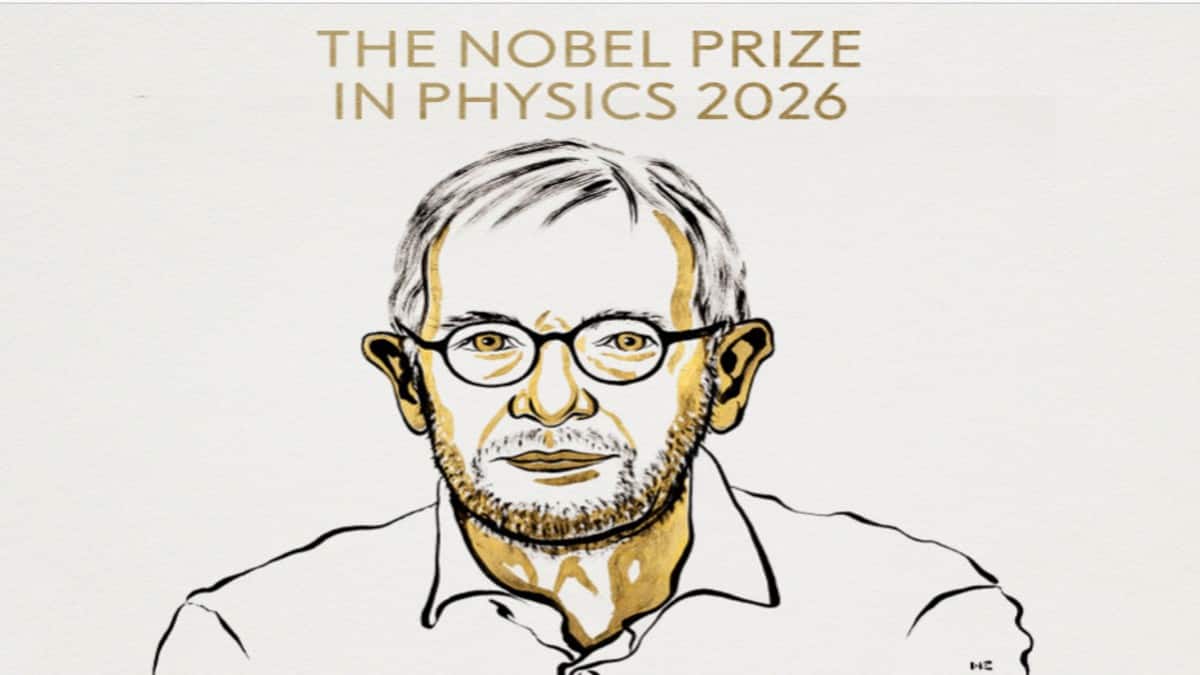
The Nobel Prize 2026 in Physics has been awarded to Francis Halzen for his decisive contributions to the IceCube Neutrino Observatory and the discovery of high-energy neutrinos of astrophysical origin, the Royal Swedish Academy of Sciences announced today, October 6.
Halzen, a professor at the University of Wisconsin–Madison, developed the vision of using the ice at the South Pole to detect neutrinos. His scientific leadership was instrumental in developing IceCube, a cubic-kilometre observatory equipped with light sensors.
The Nobel Prize in Physics carries an award amount of 12 million Swedish kronor.
Also read Nobel Prize 2026: Karl Deisseroth, Peter Hegemann, Georg Nagel win medicine award
Francis Halzen’s IceCube contribution
Halzen first presented his idea of detecting neutrinos at the South Pole in 1988. When a neutrino interacts with an atomic nucleus, it can produce a flash of light that can be detected by sensors placed in the clear glacial ice.
The South Pole offered several advantages for the experiment, including relatively low interference and geological stability. Preliminary tests of sensors in the ice began a few years after Halzen proposed the idea.
Because high-energy cosmic neutrinos are extremely rare, researchers needed a very large volume of ice to detect enough interactions. The IceCube Observatory covers one cubic kilometre and was completed in 2011. Researchers subsequently detected high-energy neutrinos and identified neutrinos originating from beyond the solar system.
Neutrinos are extremely difficult to detect because they pass through the Earth and human bodies without noticeable interaction. Only very rarely does a neutrino interact with an atomic nucleus, allowing researchers to detect it.
High-energy neutrinos are produced in the same environments as other energetic particles. Unlike many other particles, however, neutrinos can travel to Earth without changing direction or losing energy. This allows scientists to study distant, high-energy processes in ways that would otherwise not be possible.
Also read DU college students plan 5 years to bring International Conference of Physics Students to India
Nobel Committee praises Halzen’s scientific vision
Mark Pearce, Chair of the Nobel Committee for Physics, praised Halzen's role in developing IceCube and said his scientific vision had opened a new field of astronomy.
Pearce said, “Francis Halzen has led an international team of researchers and engineers who have provided us with a fantastic instrument. His tenacity and scientific vision has paved the way for a new kind of astronomy.”
The Academy said the neutrino interactions continuously recorded by IceCube could provide new information about the violent environments in which high-energy neutrinos are produced and could potentially reveal previously unknown cosmic phenomena.
Halzen was born in 1944 in Tienen, Belgium and received his PhD from KU Leuven in 1969. He is currently a professor at the University of Wisconsin–Madison in the United States.
 Add as a preferred source on google
Follow us for the latest education news on colleges and universities, admission, courses, exams, research, education policies, study abroad and more..
To get in touch, write to us at news@careers360.com.
Next Story
]Latest Education News
]Related News
]Nobel Prize 2026: Karl Deisseroth, Peter Hegemann, Georg Nagel win medicine award
Rajasthan FMG Stipend Protest: FIR against 35 interns; medical bodies seek dialogue
Pralhad Joshi, French higher edu minister hold talks on strengthening research, institutional partnerships


