
NCAHP Draft: ‘Unqualified’ allied health science professionals need bridge course, exam to keep practising
Musab Qazi | November 9, 2026 | 11:26 AM IST | 4 mins read
The NCAHP draft covers 10 allied health science courses, including physiotherapy, optometry, psychology; those meeting qualification norms can register directly
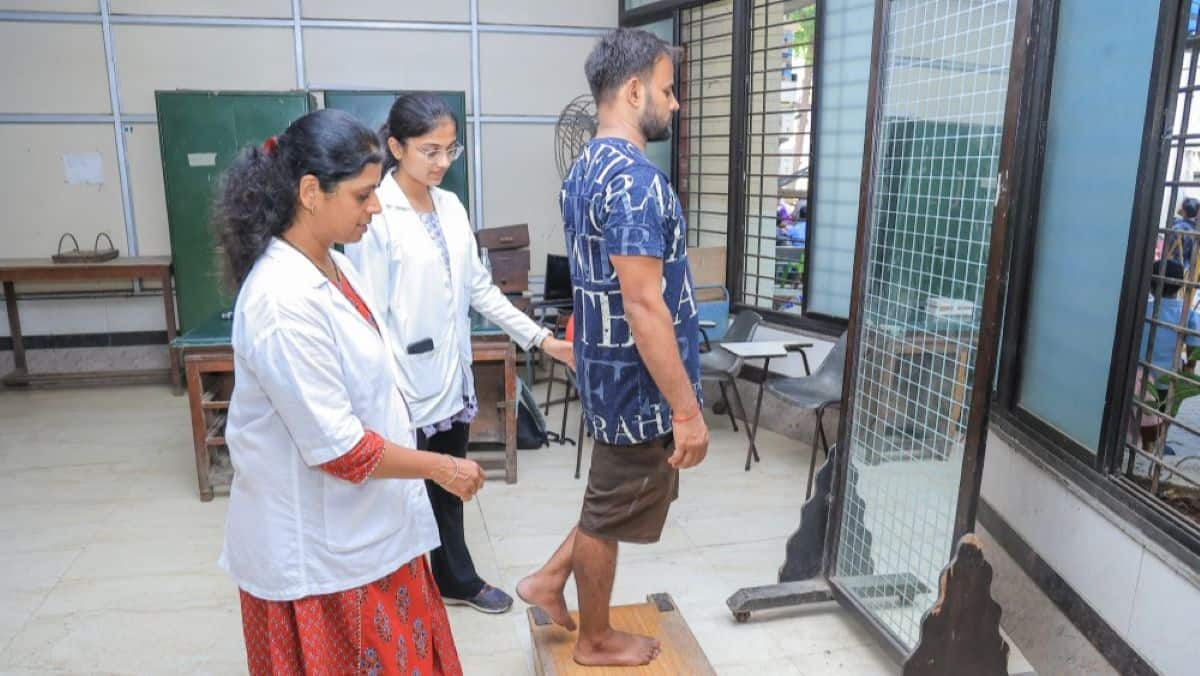
The allied health science professionals that only hold a certificate or diploma – and in some cases, even bachelor’s and master’s degrees – will likely have to take a ‘bridge course’ and clear a qualifying exam to be able to continue their practice.
The National Commission for Allied and Healthcare Professions (NCAHP), the apex regulatory body for allied professions, has proposed a new set of regulations to formally induct the practitioners who lack recognised qualifications into the official rolls or registers for their respective vocations. Under the proposed regulations, the professionals will be allowed to ‘provisionally’ register themselves with their respective state allied and healthcare councils (SAHC), but will have to obtain the full-fledged registration within the next three years by undergoing the course and the exam.
The draft Provisional Registration of Allied and Healthcare Professionals Regulations 2026, was made available for public feedback by NCAHP earlier this week. The document covers trades across 10 broad categories, including physiotherapy, optometry, medical laboratory technology (MLT), psychology and dietetics and nutrition.
Once finalised, these regulations will serve as a key transitory measure to bring the unqualified allied and healthcare professionals (AHPs), who obtained their training before NCAHP came into existence in 2021, at par with the new educational norms set by the commission. The provisional arrangement isn’t meant for professionals whose qualifications already meet NCAHP’s standards, as they can directly apply for registration.
The proposed statutes come a month and a half after the regulator notified the regulations for creating the state and national registers for 57 allied fields. Both are a part of the central government’s ongoing efforts to create a legal framework for bringing uniformity and standardisation in allied and healthcare sector, which, until now, was largely unregulated.
NCAHP Registration: Educational qualification for registration
The draft regulations provide a detailed list of profession-wise minimum educational qualifications required for seeking provisional registration, and prescribe six month- or year-long bridge courses, including supervised clinical training, according to the professionals’ prior education and experience.
For example, it enlists two year-long bridge courses for physiotherapists with a two or three-year diploma and bachelor of vocation (BVoc) degree, respectively. Only those diplomas that are recognised by the state government and are awarded to the admission batches between 1994 and 2021 are considered valid. BVoc courses, on the other hand, should be in accordance with the University Grants Regulations (UGC), with 2021 being the cut-off year.
Under the new NCAHP academic norms, which are being gradually released since last year, the recognised qualification for physiotherapy is a bachelor of physiotherapy (BPT) programme. The commission, while revising the curriculum of the course, has increased its duration from four-and-a-half years to five years, including six months of internship. It also plans to make the National Eligibility-cum-Entrance Test (NEET) appearance mandatory for admission to the course.
For some professions, such as dietician and medical social worker, even those with post-graduation (PG) diplomas and degrees are required to undergo bridge courses. For professions under the community care, behavioural health sciences and other
Professional umbrella, candidates are also required to have a minimum experience ranging from one to five years, depending on the specialisation and educational qualification.
While the regulations provide for a qualifying exam after the completion of the course, in some cases, the test conducted by the institute offering bridge course will be deemed as the qualifying exam.
NCAHP Draft: Bridge course at allied health science institutes
The regulations provide for all working professionals to apply with their respective state councils or, in case of the states without functioning councils, with NCAHP, for provisional registration. In case the councils reject these applications, the candidates can file an appeal with the commission. The certificate of provisional registration is proposed to be issued for three years, and can be extended for another year. The professionals won’t be allowed to practice after the expiry of the certificate.
The NCAHP has suggested that the existing recognised allied and healthcare education institutes would run the bridge course. They will be allowed the same intake for bridge programmes as their regular courses. The colleges, though, can seek additional seats for bridge courses. They are required to admit the candidates through a ‘transparent’ mechanism, on a ‘first come first serve’ basis. The professionals will have to pay a fee “approximately proportional” to the one charged by the institute for regular programmes.
Some of the students pursuing courses deemed ‘unrecognised’ by NCAHP are unhappy with the additional training requirement. Among them is Md Minhaj, a fourth-year BVoc Medical Imaging Technology (MIT) student at Maulana Azad National Urdu University (MANUU), a central university in Hyderabad. He is among 600 BVoc and MVoc (MIT and MLT) students protesting against their courses getting derecognised by the new regulator.
“We did our course in a regular mode. Why should we be asked to register provisionally? If the nomenclature BVoc is unacceptable, it can simply be changed to BSc,” he said. He also points out that while the proposed regulations include three-year BVoc among the minimum qualifications, there’s no mention of either four-year BVoc or MVoc.
Yagna Shukla, NCAHP chairperson, refused to comment on the proposed regulations, as they are under consultation.
 Add as a preferred source on google
Follow us for the latest education news on colleges and universities, admission, courses, exams, research, education policies, study abroad and more..
To get in touch, write to us at news@careers360.com.
Next Story
]Small-town students lack awareness, not merit; institutions must help them with scholarships, admissions
Students in tier-2, 3 towns hear of opportunities like IIT JAM, summer undergraduate research fellowships, even CSIR NET too late to apply. Teachers, institutions can easily close the information gap
Team Careers360Latest Education News
]Related News
]J&K notifies private universities rules, CM says new framework to attract reputed institutions
Punjab govt to provide free UPSC, PCS coaching to 1,000 college students


