
Share teachers before school closure; mergers, student relocation must be last resort: EAC PM paper
K. Nitika Shivani | November 5, 2026 | 04:13 PM IST | 4 mins read
EAC PM paper says fewer school codes don’t mean lower social cost; calls for 10-year district plans before mergers are final; wants institutes to share educators, labs, libraries
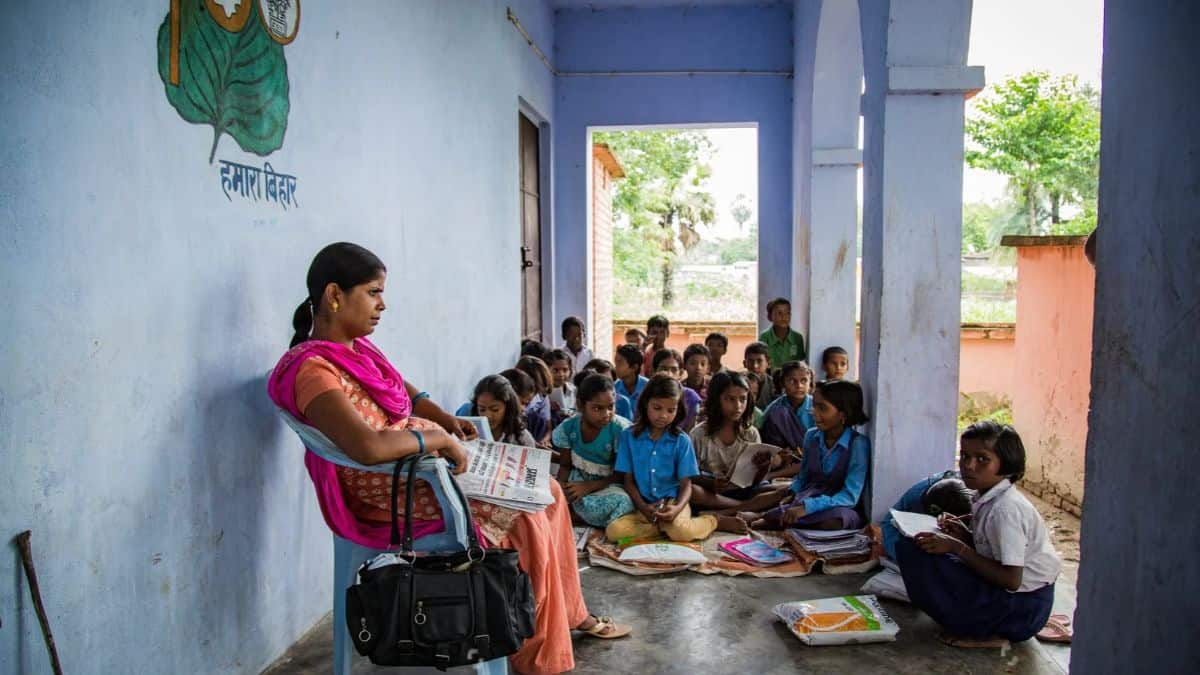
A working paper from members of the Economic Advisory Council to the Prime Minister (EAC-PM) cautions against school closures and recommends that mergers be a last resort, carried out only after a set of safeguards is met. The National Education Policy (NEP) 2020 permits rationalisation of small schools, the paper notes, but requires it to be “undertaken judiciously and without reducing accessibility.”
The paper, “How India is Transforming Educational Capacity under the New Education Policy 2020”, is authored by Soumya Kanti Ghosh and Shashidharan Sharma. Its first recommendation is that districts plan ahead, and that schools share capability before relocating pupils.
According to education ministry data, over 93,000 schools have been shut in India over the last 10 years with Uttar Pradesh, Madhya Pradesh and Odisha having the lion’s share.
EAC PM Paper: 10-year plan, teacher sharing
The paper recommends that every district maintain a rolling 10-year plan for children aged five to nine, 10 to 14 and 15 to 19. The plan should draw on births, current grade cohorts, settlement growth, housing approvals, roads and migration indicators, not just school enrolment.
It says that it should report central, high and low scenarios, compare past forecasts with actual enrolment, and include a travel-time access map. This, the paper says, would reveal whether a falling roll reflects fewer children, movement to another location or management, or exclusion from the system.
Also read NSO Survey: Nearly 50% of children travelling at least 1 km to school walk, more so in rural areas
The authors call this "demographic planning without demographic determinism": forecasts show where closer inquiry is needed but cannot by themselves decide how many schools a district should have.
The paper says the Union government should set common definitions and minimum data standards. States should turn these into stage-specific access rules based on actual journey time, terrain, season and safety, covering the route as well as the destination.
Under the NEP's school complex model, nearby schools and Anganwadis share teachers, facilities and leadership while teaching continues at each site. "Sharing capability and closing a teaching site are not the same intervention," the paper says.
Physical consolidation, it adds, should be considered only after a district shows that shared provision cannot meet the educational need. Special educators, counsellors, laboratories, libraries and workshops can all be shared this way. Digital provision may supplement scarce expertise, but it "cannot replace a capable adult in the classroom," the paper says.
School mergers and safeguards
Where a school merger does go ahead, the paper says the receiving school must be ready first. No sending school should "cease regular instruction" until the receiving school and funded transport have been certified ready. That certificate should cover classrooms, filled teacher posts, subjects, sanitation, meals, disability access and the transport timetable. Where these conditions cannot be met, the paper says shared teachers, mobile specialist services, multigrade support or satellite provision may be better than physical consolidation.
The paper also recommends that every proposed merger or closure carry a school network impact statement. It should set out pupil numbers, travel time by season, transport funding, effects on vulnerable groups, alternatives considered and the planned use of the site.
Parents, teachers, local governments and older pupils should be able to respond before an order is final. States should provide review outside the implementing district office, with a decision before teaching stops at the sending school.
After a merger, the paper says UDISE+ should record whether each school code disappeared through closure, merger, upgrade or correction, and link the old and new codes. Affected pupils should be monitored for at least two years, and districts should publish attendance, retention, transition and learning conditions for those pupils.
Also read For every 100 boys, only 59 girls in rural India complete Class 12: UNESCO Report
School Proximity: Counting the full cost
On cost, the authors say any claimed saving must include the expense of expanding the receiving school, transport and the burden on families. "Fewer school codes do not establish lower social cost," the paper says.
"Lower departmental expenditure is not an efficiency gain" if families end up absorbing the cost through longer, less reliable journeys. It adds that "a nominal seat is not an effective opportunity" if a child cannot reach it safely and regularly. To reflect this, the paper recommends that per-student funding be supplemented by fixed access, transport, transition and quality grants in sparse or difficult areas.
Proximity matters most in primary education, when children have less independent mobility, while older pupils may travel farther only where transport is reliable. Vacated school sites should stay in a public asset register until a reuse plan is approved, the paper says, since disposal without one can mean "a permanent loss of local capacity."
What NEP says
The NEP 2020 recognises that very small schools can struggle to offer subject teachers, laboratories, libraries and counsellors, and its answer is the school complex rather than closure. The paper stresses that the policy contains "no national closure quota and no uniform minimum-enrolment rule."
The paper draws on Portugal, Finland, Scotland, Japan and China. Closures worked better where they came with upgraded receiving schools, transport rights and consultation, and worse where children faced longer journeys and uneven protections. Its safeguards, the authors say, do not prevent reorganisation but subject it "to an educational standard."
The paper clearly carries a disclaimer that its views are those of the authors and do not necessarily reflect the position of the EAC-PM or the government.
 Add as a preferred source on google
Follow us for the latest education news on colleges and universities, admission, courses, exams, research, education policies, study abroad and more..
To get in touch, write to us at news@careers360.com.
Next Story
]Latest Education News
]Related News
]Karnataka rolls out spoken English classes across 1,919 government, PM SHRI, bilingual-medium schools
TS Inter Time Table 2027 LIVE: Telangana Intermediate 1st, 2nd-year date sheet soon; passing criteria
Maharashtra SSC HSC Date Sheet 2027 LIVE: MSBSHSE Class 10, 12 time table soon; board extends form deadline


