
IIT Madras study says AI will reshape job, won't eliminate entire professions; calls for reskilling jobs
Vishnukumar V | October 26, 2026 | 12:54 PM IST | 4 mins read
The Centre for Responsible AI at IIT Madras recommends affordable AI tools, research on AI’s impact on Indian jobs and clear pathways for workers to learn new skills.

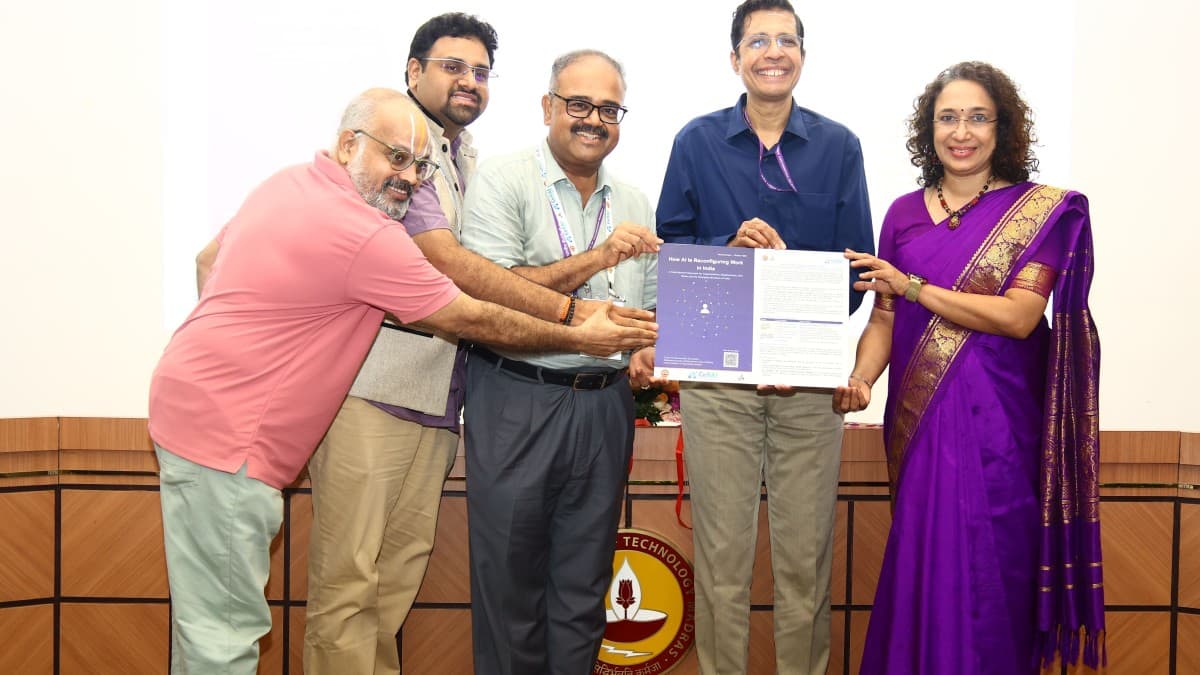
Artificial intelligence (AI) is more likely to change individual work tasks than eliminate entire jobs, according to a new whitepaper by researchers at the Indian Institute of Technology Madras (IIT Madras). The paper calls for a task-based approach to understanding AI’s impact on employment in India, with outcomes depending on how organisations use AI, the cost of adoption and workers’ ability to adapt to changing roles.
The whitepaper, titled How AI Is Reconfiguring Work in India: A Task-Based Framework for Understanding Augmentation, Displacement, New Roles and the Changing Structure of Jobs, was prepared by the Centre for Responsible AI (CeRAI), an interdisciplinary research group at the Wadhwani School of Data Science and Artificial Intelligence (WSAI), IIT Madras. It was released during the Industry Conclave on AI Governance 2026.
The paper examines how AI can automate certain tasks, support workers in existing roles and create new job opportunities. It also highlights concerns about job displacement and unequal access to the benefits of AI adoption.
Explaining the findings, Balaraman Ravindran, head of CeRAI and WSAI at IIT Madras, said, “This paper challenges the idea that AI always takes away jobs. Most jobs have tasks and only some of those can be undertaken by AI. The effect depends on the tasks, the industry, rules for AI and how much it costs to use AI. We also looked at who gains from these changes and who is affected.”
Also read IIT Madras faculty joins global study on electrically controlled molecular rotation
AI’s impact on tasks and jobs
The whitepaper distinguishes between four levels of change: tasks, jobs, occupations and wider labour-market outcomes. It argues that AI’s ability to perform an individual task does not automatically mean that an entire job or profession will disappear.
Gokul S Krishnan, research director at CeRAI, IIT Madras, said discussions about AI and employment often move from what a system can do in a single task to broad claims about entire professions.
Krishnan said, “Most discussion of AI and jobs jumps straight from what AI can do on a single task to sweeping claims about entire professions. Our framework separates four levels within the profession - the task, the job, the occupation and the wider labour-market outcome."
Head added, "AI taking over a task does not automatically mean a job disappears. Whether it leads to augmentation, redesign or displacement depends on cost, capability, regulation, safety and how organisations choose to restructure work.”
The paper identifies different ways in which people and AI systems can work together. In some cases, AI performs most of the tasks while humans review its output. In others, people retain decision-making responsibilities and use AI to improve their work.
It also examines situations in which AI systems may not be capable enough to perform certain tasks, where AI can be used for dangerous work, and where human judgement, accountability and regulatory compliance remain necessary.
AI adoption in India may depend on cost
The researchers highlight the role of affordability in determining which businesses and workers can benefit from AI. The paper uses the term “AI-cost geography” to explain how the cost of AI tools and advanced systems can influence where and by whom they are adopted.
Affordable AI tools could expand access for small businesses and support tasks such as bookkeeping, business process outsourcing and quality checks. In contrast, applications requiring advanced AI capabilities, such as legal work and medical image analysis, may remain concentrated in larger companies and urban centres with better infrastructure and specialised skills.
The paper examines AI’s potential impact across several sectors, including call centres, manufacturing, banking, software development, law, creative industries and small businesses.
It also points to differences in how AI may affect new and experienced workers, formal and informal employees, urban and rural communities, and small and large companies. The researchers identify the creation of new roles and opportunities for career progression as important areas of concern.
Also read IIT Hyderabad to organise international conference ‘PHOTONICS 2026’ in December
Recommendations for AI adoption
The whitepaper recommends three steps to ensure that AI adoption benefits workers and the wider economy.
Promote affordable AI tools: Encourage the use of accessible, task-focused AI tools, particularly among small businesses, to improve productivity and competitiveness.
Study AI’s impact on Indian jobs: Invest in research to identify which tasks and skills can be handled by AI and examine less visible costs involving quality, trust, safety and accountability.
Create pathways to new jobs: Provide workers with opportunities to learn new skills, build AI awareness and move into roles emerging from the adoption and management of AI systems.
The researchers argue that the future of work will depend not only on advances in AI technology but also on how companies redesign jobs and prepare their employees for new responsibilities.
 Add as a preferred source on google
Follow us for the latest education news on colleges and universities, admission, courses, exams, research, education policies, study abroad and more..
To get in touch, write to us at news@careers360.com.
Next Story
]Latest Education News
]Related News
]IIT Madras faculty joins global study on electrically controlled molecular rotation
IIT Madras launches finishing school ‘UDYOG’ to equip BTech biotechnology students with industry-ready skills
IIT Madras’ WSAI to host AI Governance Conclave on October 22; focus on AI safety, measurement


