
ISRO communication and media scholar India’s sole representative from field in world top 2% scientists list
K. Nitika Shivani | October 24, 2026 | 11:31 AM IST | 5 mins read
Producer at ISRO Space Applications Centre, Devadas Menon studies Indian media consumption – from streaming platforms to Instagram Reels and ChatGPT – and calls for support for social sciences
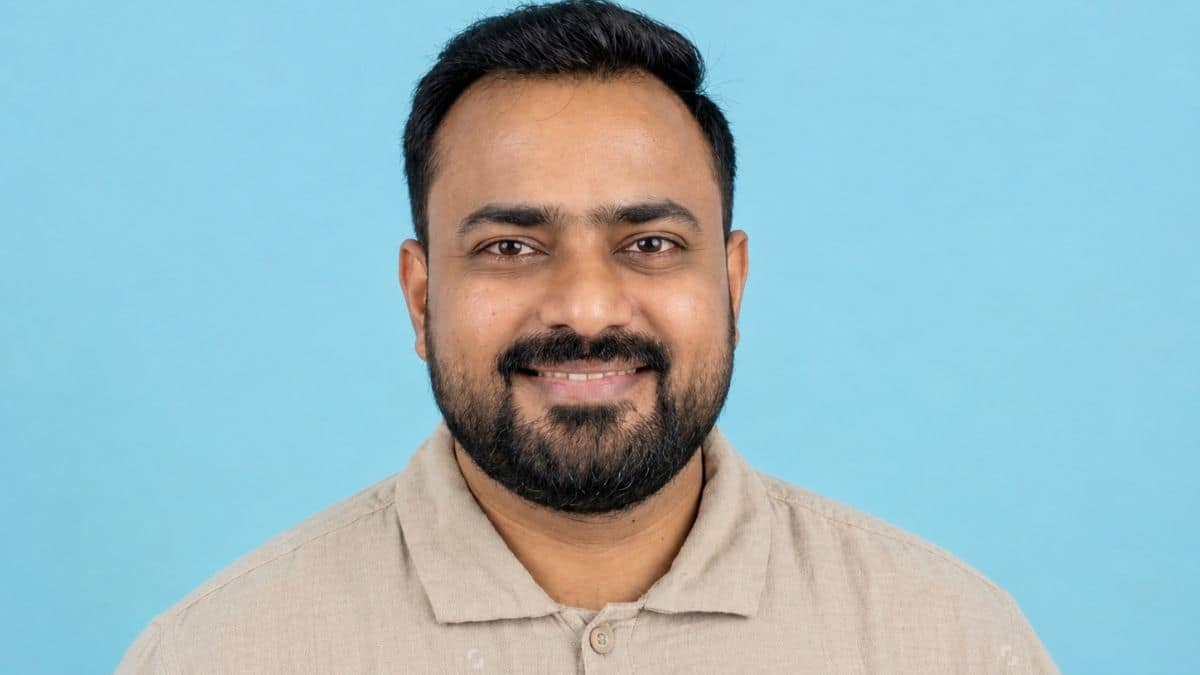
A few months after he published a paper on ChatGPT, Devadas Menon woke up to a surprise. "I woke up to an absolute flood of notifications on my Google Scholar profile," he said. "Researchers from the UK, USA, and Europe were citing our paper."
Menon's work is about the psychology behind India's digital boom. A cyberpsychology researcher, he studies why Indians adopt and stay on platforms and technologies, from Facebook and Instagram Reels to OTT streaming and ChatGPT. "I wanted to understand not just what media people consume, but why they consume it and how it reshapes their psychological and social realities," he said.
He is an assistant producer at the Development and Educational Communication Unit (DECU) of the Indian Space Research Organisation’s (ISRO) Space Applications Centre in Ahmedabad. He now features in the Stanford-Elsevier World's Top 2% Scientists list 2026 for single-year the second consecutive year, and is the only scholar from India in the communication and media subfield. "A social scientist from India can lead a global conversation," he said.
ISRO scholar studies how Indians use social media
Menon’s research has followed India’s screens over the years. It began with television viewing during the Covid-19 pandemic, “a period when digital screens became our primary window to the outside world”, he said.
He then studied social media, starting with Facebook and moving to other platforms, all except Twitter. After TikTok was banned in India, he turned to Instagram Reels.
His reels based research looked at user motives, age and personality traits such as narcissism. “We discovered how short-form algorithmic loops satisfy immediate psychological gratifications,” he said. The work has fed debates on “digital dependency, attention economies, and social media well-being among youth”.
He also studied why Indians subscribe to over-the-top (OTT) streaming services. “My findings highlighted a cultural shift away from traditional linear television toward highly personalised, asynchronous viewing,” he said of the work, which appeared in” Telematics and Informatics Reports and the Quarterly Review of Film and Video.”
Menon said mainstream models in his field were built around Western users. “Historically, mainstream communication and cyberpsychology models have been built entirely around Western demographics,” he said. “The core contribution of my research is the localisation of these global frameworks to the Indian socio-cultural context.” His work, he said, “provides empirical baselines for how Indian users interact with modern digital interfaces”.
The ChatGPT study
His 2023 paper "Chatting with ChatGPT”, published in Heliyon, “stands as one of my most widely cited works globally”. His Reels research is his next most-cited work.
Using the Unified Theory of Acceptance and Use of Technology (UTAUT) model, the paper found that “performance expectancy and social influence are critical factors” in the adoption of conversational AI.
Menon said he took it up when others were wary. “In early 2023, when OpenAI first launched ChatGPT to the public, the academic world was largely panicking about plagiarism, or dismissing it as a passing tech fad,” he said. Some peers advised him to slow down, “warning that social science models take years to mature. But we trusted our data and pushed forward.”
Menon was also invited by Springer Nature to contribute an entry to the Palgrave Encyclopedia series. “I am incredibly proud to be the only Indian researcher extended this particular opportunity in our field,” he said.
Chikkaballapur to ISRO
The DECU works on satellite communication for development. “Our mandate revolves around leveraging satellite communication and space technology for social development, digital literacy, and educational broadcasting across India,” Menon said.
As a social scientist there, he studies how audiences respond to various media. His work “helps optimise how science and educational programming are designed and delivered to the masses, ensuring that India’s space assets translate into meaningful grassroots empowerment”, he said.
Menon grew up in Chikkaballapur, Karnataka. He completed a Master’s in electronic media at Bangalore University (2006-08), a Master’s in Mass Communication at Sikkim Manipal University and a degree in sociology at Annamalai University. He began his research career at Bangalore University’s Department of Communication and later taught at the Central University of Tamil Nadu before joining ISRO.
Funding and publishing costs
Menon said social science research in India operates in “a highly STEM-oriented academic ecosystem”.
“In India, the vast majority of substantial institutional grants and research funding are heavily prioritised toward hard sciences, engineering, and technology,” he said.
He said article processing charges at top international journals “are often priced in USD or Euros, making them prohibitively expensive for individual Indian researchers without institutional coverage”.
Menon called the One Nation, One Subscription (ONOS) initiative “a monumental game-changer for the scientific community”. Coordinated through the INFLIBNET Centre, it offers free access to over 13,000 journals from publishers such as Elsevier, Springer Nature and Taylor & Francis, he said.
Menon also described his thoughts on Indian representation in the field as “bittersweet”. “While I am profoundly honored to represent India, it is sobering to realise that I am the sole scholar listed from our country in this specific subfield,” he said.
“We need to actively train young scholars in advanced research methodologies, data analytics, and cyberpsychology frameworks,” he said. “Our local institutions must provide greater incentives for publishing in top-tier global journals indexed in Scopus and Web of Science.”
Next: Psychological realities of evolving AI
Menon’s research will “expand deeper into the psychological realities of the evolving AI landscape, focusing on algorithmic well-being, deepfakes, and the psychological impacts of generative AI on information ecosystems in the Global South”, he said.
His advice to aspiring researchers, “move past purely descriptive writing and embrace empirical, data-driven rigor by mastering advanced quantitative methodologies and cyberpsychology frameworks”, and “build a thick skin against journal rejections, treat feedback as a roadmap to refine your methodologies, and stay consistent”.
 Add as a preferred source on google
Follow us for the latest education news on colleges and universities, admission, courses, exams, research, education policies, study abroad and more..
To get in touch, write to us at news@careers360.com.
Next Story
]Boomerang effect? Jadavpur bookstalls report fourfold rise in sales after Durga Puja attack sparks resistance
CPI(M), AISA, APDR report their best sales ever, readers queue up till midnight to buy books in protest, say organisers; SUCI stall was lost but locals and students save the rest
Pritha Roy ChoudhuryLatest Education News
]Related News
]NEET PG Counselling 2026 LIVE: MCC round 1 seat allotment results out; MD, MS cutoffs, reporting begins soon
Jamia Protest: HLC appeals to students to end agitation, cooperate with JMISU drafting committee
‘Free Kashmir’, ‘Free Sharjeel Imam’ graffiti reported at Jamia; VHP demands action


