
IRIS 2026: State, private universities to be part of ANRF’s next call for R&D, says NITI Aayog's Karandikar
Team Careers360 | October 1, 2026 | 01:59 PM IST | 5 mins read
Careers360 is hosting the India Research & Impact Summit (IRIS) 2026, bringing together researchers, policymakers, university leaders and higher education stakeholders to discuss the challenges and opportunities shaping India's research ecosystem
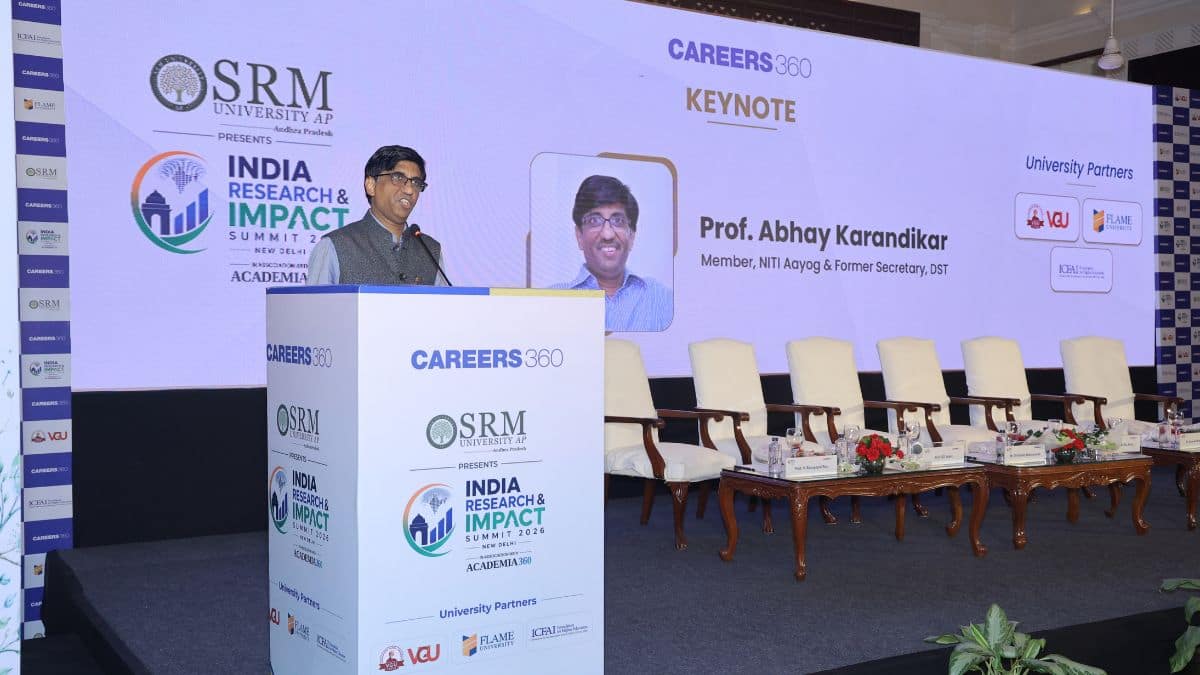
Professor Abhay Karandikar, a member of NITI Aayog and former secretary of the Department of Science and Technology (DST), discussed the contributions of researchers in science and India's research funding ecosystem. Karandikar was speaking at Careers360’s IRIS 2026 summit.
Karandikar highlighted the objectives of the Anusandhan National Research Foundation (ANRF) and the expansion of research in various fields, envisioning Viksit Bharat 2047.
Speaking on the research and development across the country, Karandikar said: “I hope that the next call will come out in time, perhaps next month. In that call, we will include state public universities as well as private universities. I hope that the programme will be strengthened further in the years to come. That is actually one of the major objectives of the ANRF. The whole idea of the Hub-and-Spoke model is that one of the hubs can be an institution that is doing very well in research and can therefore act as a mentor to the other institutions.”
He further added that private sector is spending significantly less on research and development; despite having around two lakh startups, only about 20,000 are technology startups, and perhaps only 6,000-7,000 are truly deep-tech startups.
“This is because investment in these startups by venture capital and private equity has been limited. One of the reasons is that technology development takes longer, the gestation period is longer, and it requires significant patient capital,” Karandikar said.
Capital funding in deep-tech area
However, to address both issues, improving venture-capital funding in the deep-tech area and enabling our corporates to invest more in R&D, an institutional intervention announced last year was the establishment of the Rs 1 lakh crore Research, Development and Innovation Fund.
“This fund can become a limited partner in alternative investment funds and invest in deep-tech startups. It can also provide long-term debt to listed corporates. It does not necessarily have to be limited to startups. It can provide long-term loans of 12 to 13 years, potentially at a low interest rate of 3% to 4%. We are hoping that this will catalyze private-sector investment in R&D,” he adds.
Sectoral Interventions
The other component involves sectoral interventions, which focus on identifying key areas where our academics and researchers should undertake research.
Sectoral interventions are based on identifying the areas in which our academics and researchers should undertake research.
“As a faculty member myself, having worked at IIT Bombay and IIT Kharagpur, I know that academics generally have the freedom to pursue the research they want to do. I don't know whether any university can dictate exactly what area a faculty member should work in, but certainly, at institutions such as the IITs, you cannot dictate what a faculty member wants to research. However, if we want to focus on certain areas that are very critical from the country's perspective, we have to define certain national priorities.”
The government funding needs to be channeled toward areas that we consider important from the perspective of national priorities. That is where sectoral intervention in research becomes necessary. Depending on the research area, one can contribute to addressing these challenges, he added.
R&D: Three broad challenges
Karandikar further pointed out that if India has to become a developed economy by 2047, it has to address sustainability and fragility challenges.
“By sustainability and fragility, I mean issues such as climate change and geopolitical shifts. It is important that all of us continue to exist and prosper. If we cannot ensure our own sustainability, there is obviously no question of becoming a developed economy. So, sustainability and fragility are major challenges, both globally and for our country, particularly in areas such as climate change and geopolitical shifts,” Karandikar said.
The second challenge is resource constraints.
This includes food and water scarcity, materials, and minerals. For example, by 2047, considering our population and the per-capita milk requirement – around 450 milliliters per person per day – India may not have enough cattle to meet the demand. We also need land for the cattle and sufficient water. Therefore, we need to think carefully about how we address future challenges relating to food and water scarcity.
The third challenge is quality of life.
“We have to address healthcare – not simply by opening more hospitals, but through preventive healthcare and by transforming lifestyles. This also includes transportation, housing, the urban environment, and making our cities more livable. Connectivity is another important dimension, including digital connectivity. So, these are the three broad challenges,” he adds.
Translating research into technology
“How do we take the research that is happening and convert it into technologies and solutions that address the challenges faced by society?”
Karandikar explained that one of the problems is that technology research is limited to only a few universities. Moreover, the research being conducted does not always translate into practical technologies and solutions.
“We also have relatively weak industry – academia linkages, primarily because industry has not been spending enough on R&D. To address this, the government has introduced both institutional and sectoral interventions. We are hoping that, through these interventions, we can create an ecosystem in which academia has a much stronger connection with the industry ecosystem. Academia can then focus on research that addresses some of the challenges facing our country and, at the same time, contributes to addressing global challenges as well,” Karandikar said.
“I have touched upon perhaps five or ten technology-related aspects, but I recognize that the university ecosystem is much larger than simply focusing on science and engineering. There are many other challenges today in terms of research – for example, policy research, data and evidence-based research for policymaking, and understanding what is happening in the age of artificial intelligence.”
Concluding his speech, Karandikar further added that AI is changing not only teaching and education but also the dimensions of research itself, including scientific discovery.
“I have not touched upon all of those aspects, but I am sure that today's discussions, through the panel and the other speakers, will be able to address many of these issues," Karandikar adds.
Careers360 is hosting the India Research & Impact Summit (IRIS) 2026, bringing together researchers, policymakers, industry representatives, university leaders, and higher education stakeholders to discuss the challenges and opportunities shaping India's research ecosystem.
 Add as a preferred source on google
Follow us for the latest education news on colleges and universities, admission, courses, exams, research, education policies, study abroad and more..
To get in touch, write to us at news@careers360.com.
Next Story
]


