
Nobel Prize in Chemistry 2026: Henri B. Kagan, Kenso Soai win for asymmetric organic synthesis
Vishnukumar V | October 7, 2026 | 06:36 PM IST | 2 mins read
Henri B. Kagan and Kenso Soai have been awarded the Nobel Prize 2026 in Chemistry for discoveries that explain how chemical reactions can produce a single mirror-image form of molecules.
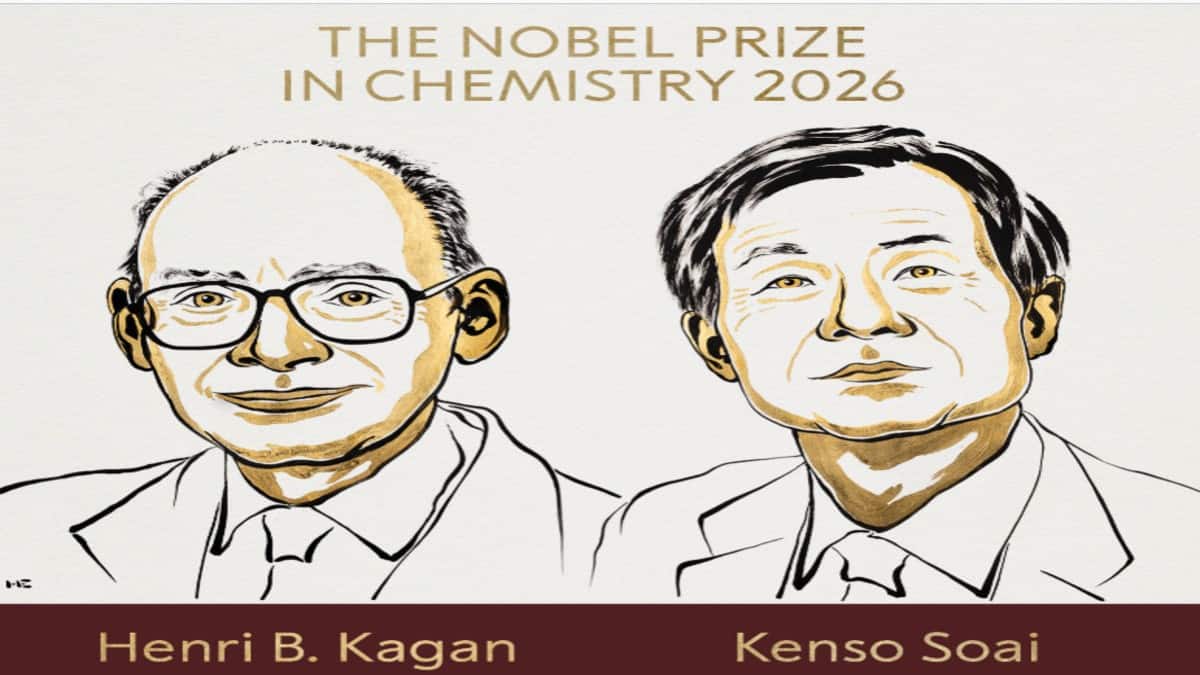
The Nobel Prize 2026 in Chemistry has been awarded to Henri B. Kagan and Kenso Soai for the discovery of “non-linear effects and autocatalysis in asymmetric organic synthesis”. The Royal Swedish Academy of Sciences announced the award today, October 7, 2026.
The discoveries by Kagan and Soai helped explain how homochirality can emerge spontaneously. Homochirality refers to the presence of only one of two possible mirror-image forms of a molecule in living organisms. The Nobel Prize recognises their work on chemical reactions that can be driven to produce one such mirror image.
The prize amount is 12 million Swedish kronor, which will be shared equally between the two laureates.
Also read Nobel Prize 2026: Karl Deisseroth, Peter Hegemann, Georg Nagel win medicine award
Nobel Prize in Chemistry 2026: What is homochirality?
Some molecules, including amino acids, exist in two forms that are mirror images of each other. However, living organisms contain only one of these forms. According to the Royal Swedish Academy of Sciences, how this chemical asymmetry emerged had remained a mystery to chemists for more than a century.
Chemists attempting reactions that could produce two mirror-image molecules would generally obtain equal amounts of both forms. Producing only one form is important in areas such as pharmaceutical development because only one mirror image of a molecule may have the desired effect when it interacts with living organisms.
“Heinri Kagan and Kenso Soai have provided a solution to a chemical mystery that is over a century old: how homochirality can emerge spontaneously. The chemical reactions they have developed are spectacular,” said Heiner Linke, chair of the Nobel Committee for Chemistry.
Henri B. Kagan's contribution
Henri B. Kagan made the first decisive contribution in 1986, when he discovered a new method of manipulating chemical reactions. This enabled him to produce a greater excess of one mirror-image form than had previously been considered possible, according to the Academy.
Kagan was born in 1930 in Boulogne-Billancourt, France. He received his PhD from the Collège de France in 1960 and is Professor Emeritus at the former Universite Paris-Sud.
Also read Nobel Prize in Physics 2026: Francis Halzen wins award for IceCube neutrino discovery
Kenso Soai's contribution
Kenso Soai continued the work and in 1995 published research describing a chemical reaction with the potential to become homochiral. In 2003, he succeeded in presenting a reaction in which only one of the two possible mirror-image forms was produced. The Academy said that, apart from life itself, no one had previously achieved this.
Soai was born in Hiroshima, Japan, in 1950. He received his PhD from the University of Tokyo in 1979 and is Professor Emeritus at Tokyo University of Science.
The Royal Swedish Academy of Sciences said the discoveries by Kagan and Soai have established how homochirality can emerge. Their work has also been decisive for chemists who design chemical reactions used in the manufacture of pharmaceuticals.
 Add as a preferred source on google
Follow us for the latest education news on colleges and universities, admission, courses, exams, research, education policies, study abroad and more..
To get in touch, write to us at news@careers360.com.
Next Story
]Latest Education News
]Related News
]NTA holds Chintan Shivir 2026 at new office to strengthen exam system, students' experience, trust
UP Scholarship 2026-27: Applications open for UG, PG, diploma students at scholarship.up.gov.in
Govt addressing genuine grievances of students, but don't use them for political gains: Fadnavis


