
'A Black Law': West Bengal teachers to 'hit the roads' in protest against bill on inter-university transfers
Team Careers360 | September 12, 2026 | 06:35 PM IST | 5 mins read
Faculty bodies demand recruitment, protection of research autonomy and withdrawal of proposed legislation
By Pritha Roy Choudhury and Vishnukumar
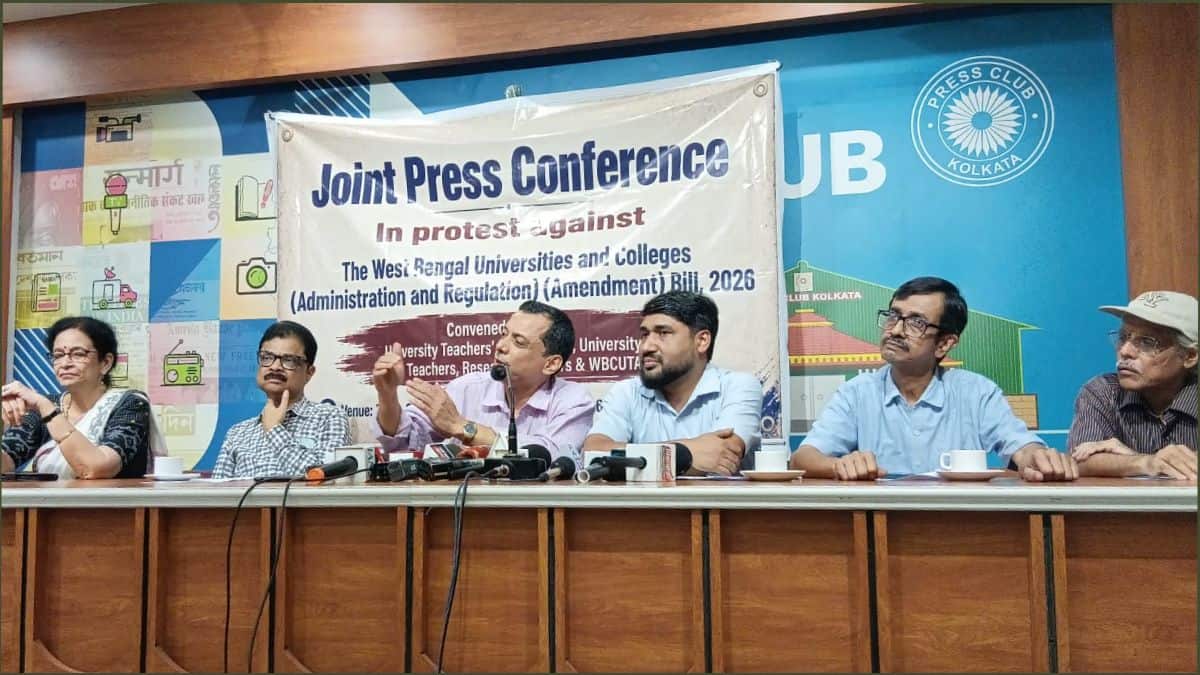
KOLKATA: University teachers and associations in West Bengal have announced a three-step protest plan against the proposed West Bengal Universities and Colleges (Administration and Regulation) Amendment Bill, 2026, starting with a letter to the Governor next week, followed by a signature campaign and a statewide street protest involving teaching and non-teaching staff, research scholars and students if their demands are not addressed.
The announcement was made at a press conference organised by university teachers, teachers’ associations, scholars and the West Bengal College and University Teachers’ Association (WBCUTA) at the Press Club in Kolkata. The teachers have demanded withdrawal of the proposed bill, immediate recruitment against vacant faculty posts and protection of teachers’ research and academic autonomy.
“We will give a joint appeal to the Governor and if this does not happen, all the professors of all the colleges across the state will protest. Next week we are writing to the Governor, then there will be a signature campaign. We will next hit the roads if nothing works, which will include teaching staff, non-teaching, research scholars, students and all,” the teachers said.
Debabrata Das of Rabindra Bharati University said the government should focus on addressing teacher vacancies instead of introducing new legislation that, according to him, could push the higher education system towards privatisation.
“We want them to withdraw the bill, else we will protest,” Das said.
Bills face opposition over autonomy concerns
According to a joint press statement issued by the University Teachers’ Associations and Senates, university teacher representatives, ABUTA, researchers and WBCUTA, the West Bengal government passed the West Bengal Universities and Colleges (Administration and Regulation) (Amendment) Bill, 2026 in the Legislative Assembly on September 10, 2026.
The teachers’ bodies said the bills have been presented as administrative reforms but alleged that they could affect university autonomy, teaching, learning and research.
The joint statement also raised concerns over the security of the provident fund of university teachers and employees. It alleged that the changes could weaken the government-aided higher education system and increase the migration of meritorious students, researchers and teachers to other states or abroad.
Faculty vacancies remain a major issue
The teachers said the government should immediately address faculty shortages instead of relying on transfers.
The joint statement claimed that the number of teachers, employees and officers has fallen significantly across both new and old universities and that more than 50% of posts are vacant even in some leading universities.
The associations said transfers do not increase the overall number of teachers and could instead disturb the balance of institutions.
“Transfer never changes the numbers; rather, it destroys the balance of the system and lowers the quality of educational institutions,” the joint statement said.
The teachers have demanded that the recruitment process for all vacant university posts be started immediately.
Mahalaya Chatterjee, professor of economics (Retd) at Calcutta University, also questioned the government's reported argument that experienced teachers are being transferred because rural colleges and universities require their expertise.
“We have only 40 percent of the faculty working,” Chatterjee said.
Transfer policy sparks concerns
The JUTA general secretary and professor at Jadavpur University, Partha Pratim Roy, said teachers should not be transferred without their consent, particularly when they are involved in ongoing research.
Roy said transferring a teacher who is working on research requiring specialised instruments could disrupt the project and affect students.
“One cannot keep research half way and move because of transfer. What will happen to the students?” Roy said.
Roy also demanded recruitment of teachers in both new and old institutions, including colleges located in rural areas.
The teachers said colleges and universities should remain spaces for free thinking and academic work.
Experience alone not a reason for transfers
The joint statement also rejected the government's argument that experienced teachers need to be transferred to other universities to share their knowledge and expertise.
The associations said experienced teachers already contribute to other institutions through bodies such as Boards of Studies, Research Advisory Committees, Advisory Committees and Moderation Boards.
They argued that the government should instead establish a system of “swift and impartial recruitment” to fill vacancies.
The associations said the responsibility for recruitment lies with the government and alleged that successive governments have failed to address the faculty shortage.
Government-aided education faces privatisation fears
The joint statement questioned whether the proposed changes could gradually weaken government-aided higher education institutions and create space for private universities.
The teachers alleged that the measures could make government-aided institutions “gradually irrelevant” and help the private education system expand in West Bengal.
Chatterjee also warned that if such policies continue, teachers could move to private universities, leaving public institutions without experienced faculty and potentially affecting students.
Jadavpur University professor questions research plans
Gautam Maiti of Jadavpur University questioned the government's proposed changes to higher education and research.
“The teachers in the universities have developed expertise. Why is the government trying to spoil the higher education system in the state?” Maiti said.
He said new faculty members should be recruited according to UGC rules and questioned the government's plan to transform universities into centres of excellence.
Maiti also questioned any proposal under which the government would decide research topics and subjects.
Teachers recall 2017 Act
The teachers also raised concerns over the West Bengal Universities and Colleges (Control and Regulation) Act, 2017.
Das described the 2017 Act as a “kala kanoon” and said the matter is still before the court.
The joint statement said the earlier legislation should have been withdrawn and the government should have held discussions with stakeholders to address the problems facing higher education.
Instead, the teachers alleged that the present government has expanded the framework through the 2026 amendments.
Five demands outlined in joint statement
The joint statement listed five key demands from the state government:
- Immediate repeal of the amended rules.
- Immediate recruitment against all vacant posts in universities.
- Allocation of funds to improve infrastructure in all government-aided universities.
- Immediate appointment of vice-chancellors in universities currently without one.
- A special financial package for newer universities, including posts for teachers and educational employees and funds for academic and infrastructure development.
The teachers’ associations said their joint movement will continue and that they will pursue legal action if necessary.
The associations said they hope the media and general public will support their campaign to protect the government-aided higher education system in West Bengal.
 Add as a preferred source on google
Follow us for the latest education news on colleges and universities, admission, courses, exams, research, education policies, study abroad and more..
To get in touch, write to us at news@careers360.com.
Next Story
]‘Chowkidar-cum-Gatekeeper’: Why Visva-Bharati’s biotech head won’t enforce order for monthly workload reports
Tathagata Choudhuri says the order reduces him to a ‘chowkidar-cum-gatekeeper’ and that neither UGC and education ministry documents nor Visva Bharati University’s own laws support it
Pritha Roy ChoudhuryLatest Education News
]Related News
]NEET PG Counselling 2026 LIVE: MCC round 1 choice filling closes soon; seat allotment results on Oct 24
‘Not to be mistaken for regulatory relaxation’: NMC on MSMER 2023 denotification
IIT Gandhinagar student falls from building, police yet to receive formal complaint


