
‘What nationalism will he teach us?’: Jadavpur University ex-faculty ‘stunned’ by CM’s anti-national smear
Pritha Roy Choudhury | August 27, 2026 | 01:25 PM IST | 6 mins read
Outraged by West Bengal CM’s ‘anti-national’ charge, ex-faculty point to Jadavpur University’s links to the freedom movement, remind that questioning is part of university life
Nilanjana Gupta was “stunned” by the chief minister, Suvendu Adhikari’s statement. A retired professor from Jadavpur University’s department of English, she said a closer look at JU’s history would show that the university itself emerged from an effort to build an education system independent of colonial control. “I wish he had studied Jadavpur University’s history properly. Had he done so, he would not have said this today,” Gupta said.
She was referring to Adhikari’s announcement that he would “establish nationalism inside and outside Jadavpur” to rid the campus of “tukde-tukde gangs [that] are anti-national”. He also ordered a probe into ‘anti-national’ graffiti, claims that the campus opposed the singing of Vande Mataram and similar allegations. Adhikari is set to hold a meeting in Jadavpur on Friday, August 28.
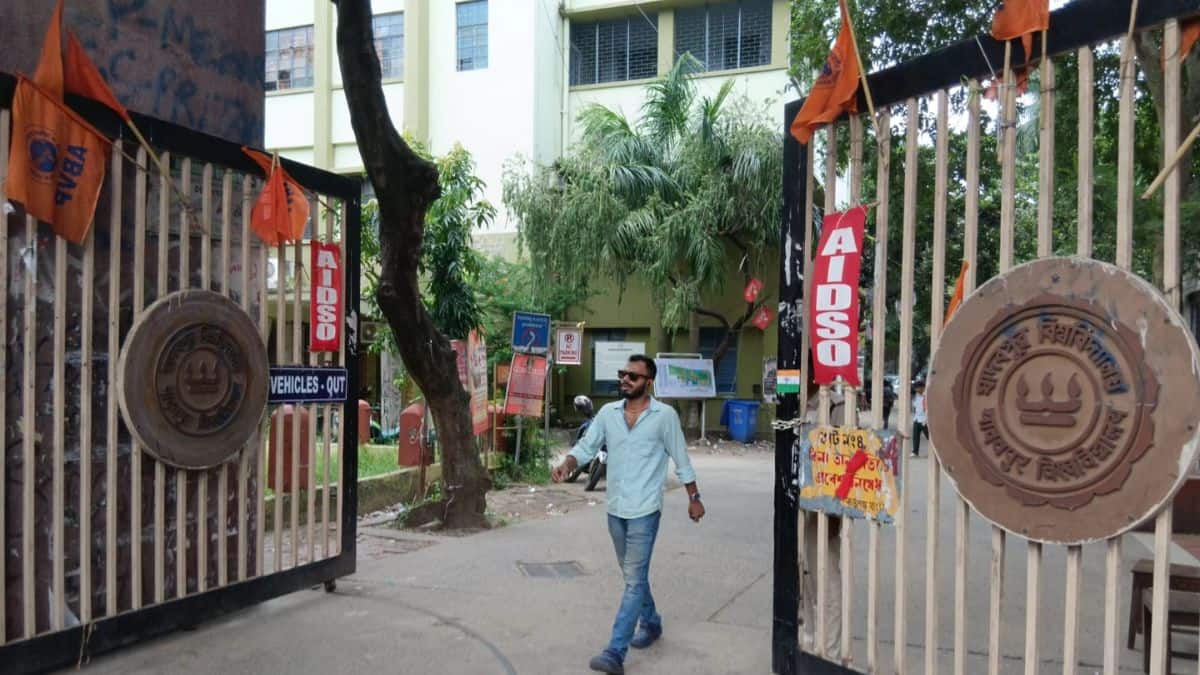
The West Bengal CM’s statement came after a week of turmoil that began with a ‘raid’ by the BJP-affiliate, Akhil Bharatiya Vidyarthi Parishad (ABVP), on the Jadavpur University campus last week and the resistance put up by left-leaning student groups, leading to a violent clash that lasted hours. ABVP supporters trying to enter the campus also damaged the Jadavpur University emblem, designed by famed artist, Nandalal Bose.
Gupta also drew a parallel with what she said was the political targeting of premier universities, such as Jawaharlal Nehru University (JNU) and Jamia Millia Islamia. The “tukde tudke gang” label has its origins in a slogan allegedly raised in JNU at a protest a decade ago.
Also read Removing deprivation points from admissions will change JNU’s character, make it elitist: Professor
“The way the ABVP people are speaking is also the way BJP leaders are speaking. When Jadavpur [Bengal Technical Institute then] was being established during the colonial period, the British had certain rules about what could and could not be taught,” she said.
Vande Mataram ‘always sung’ at convocations
Former Jadavpur University teacher Pabitra Sarkar, who later served as vice-chancellor of Rabindra Bharati University, countered several of the allegations being made about Jadavpur University, especially to label the storied institution as “anti-national”.
Sarkar said Suvendu Adhikari’s claim that “Vande Mataram” is not sung at Jadavpur University was incorrect.
“I was employed at Jadavpur from 1963 and used to teach there. Every time there was a convocation, the event started with Vande Mataram and ended with Jana Gana Mana. This is the rule of Jadavpur University. It is sad that the chief minister does not know this,” Sarkar said.
He also questioned the claim that Jadavpur University does not allow officials from the education department to visit.
“I am yet to decipher the meaning of this. Jadavpur always goes to the education department office whenever there is a need. The VC goes, the registrar goes. So whatever he said – I did not understand the logic,” Sarkar said.
According to Sarkar, the controversy also needs to be viewed in the context of attempts to increase the influence of the ABVP among students in West Bengal.
“The main reason is that in West Bengal, there is no impact of ABVP among the students. So this is an area they are trying to capture. They want the ABVP's influence to increase among the students,” he alleged. He also sought to explain that “azadi” slogans should not be automatically interpreted as anti-national.
“When Left-aligned students shout ‘azadi’, they mean freedom from illiteracy. They are not anti-national,” he said. “They have made a number of allegations against Jadavpur which I believe are absolutely wrong. There is no other university like Jadavpur in the state.”
Jadavpur University and freedom struggle
Gupta said Jadavpur’s history cannot be separated from the nationalist movement and the efforts of Indians to create institutions that were not controlled by the British.
She explained that the university was born out of a colonial-era engineering college known as the Bengal Technical Institute. There was no conventional college infrastructure and classes were held at different locations, often in the homes of people associated with the nationalist movement. According to her, teachers and students faced restrictions and the possibility of arrest if the British authorities learnt of some of their activities.
“Teachers and students fought a great deal for what Jadavpur University is today. So my question is: what nationalism will he teach us?” she said.
She pointed to the wider history of institution-building during the colonial period, citing Visva-Bharati, established by Rabindranath Tagore, and Osmania University, established by the Nizam of Hyderabad in 1918. She also referred to the role of nationalist education in the development of institutions such as the Maharaja Sayajirao University of Baroda. Sri Aurobindo spent 13 years at Baroda College – now part of MS University Baroda – before returning to Kolkata to become the first principal of Bengal National College, an institution that grew out of the nationalist education movement and is today part of Jadavpur University.
“Does he know that in the old engineering departments of Jadavpur, the names of donors are inscribed on the walls because they donated money so that students could study there?” Gupta asked. She recalled the story of seven students associated with the anti-British movement who were sent abroad for higher studies by the National Council of Education, Bengal and later returned to India to teach.
“They were sent abroad to complete their PhDs and return to India to teach. All seven came back after completing their studies and helped establish and develop departments here. If this is not nationalism, then what, according to him or them, is nationalism?” Gupta said. One of them was her own great-grandfather, Hiralal Roy. “All seven came back and taught here, despite being paid very little,” she said.
May affect admissions
Gupta fears the present controversy will affect admissions, making students hesitant to come to the campus.
“What happens in such a situation is that some students become scared and refrain from taking admission. This is undoubtedly a loss for us, but it is also a loss for the students. They are unable to enrol in one of the best universities in the country and may instead go to universities in other states,” she said.
“I am really disturbed by what he said. He speaks in Bengali, but the respect is missing,” she said. “I have seen that the relationship between students and the ruling party has never been easy. During the Left Front rule, it was somewhat better; during the Trinamool Congress rule, it became extreme. There have been instances of police beating students. But students have always fought back in such situations.”
Universities not mere ‘producers of human resources’
Another former faculty member questioned the very idea of teaching nationalism as a separate concept in universities. “Nationalism or patriotism is not a subject to be taught. If there is an issue, if a Hindu speaks for or against something, they are secure, but if a Muslim speaks, that becomes an issue. This cannot be patriotism,” he said. Still employed in a different state university, he sought and was granted anonymity.
He said universities should focus on creating spaces where students can think independently and critically rather than being treated merely as producers of human resources. “The government should concentrate on the welfare aspects of the country and work on industries. Universities are not places with a conveyor belt to generate human resources. A university is a place where students can think critically,” he said.
“If there is always this kind of oppression in universities, what is the use of a university? Universities can then be called knowledge and skill factories. New ideas are born in universities,” he further added.
Jadavpur University has set up its own probe panel to investigate the violence on August 20.
 Add as a preferred source on google
Follow us for the latest education news on colleges and universities, admission, courses, exams, research, education policies, study abroad and more..
To get in touch, write to us at news@careers360.com.
Next Story
]MGR Medical University releases faculty data of 13,000 teaching staff after TN group’s transparency push
Arappor Iyakkam hails MGR Medical University move but asks for Unique Faculty IDs, qualifications, photos added that will help cross-check faculty strength against norms; wants online portal to flag dodgy records
K. Nitika ShivaniLatest Education News
]Related News
]Jamia Millia Islamia students refuse to end protest; alumni extend support
JMI Protest: Congress extends support to protesters amid campus unrest
ESTIC 2026: PM Modi to inaugurate emerging science and technology conclave on October 27


