
With ISI Bill 2026, ‘ISI will lose autonomy, become arm of union govt': Academics, political leaders
Suviral Shukla | August 5, 2026 | 07:02 PM IST | 4 mins read
The academics and opposition leaders at the ISI press conference also demanded that the ISI Bill 2026 should be referred to a parliamentary committee.
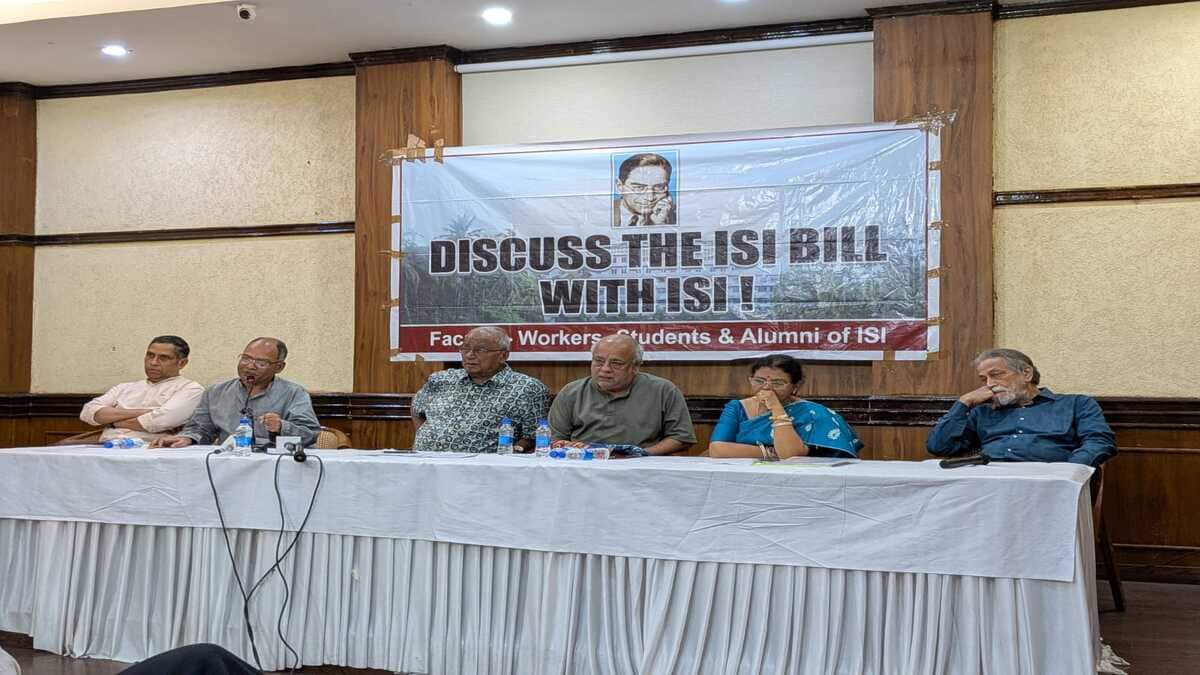
If the ISI Bill 2026 passes, the Indian Statistical Institute (ISI) “will lose all autonomy, internal democracy, accountability, and will be transformed into an arm of the union government”, said a group of academics and political leaders who gathered in Delhi on Wednesday to oppose the Indian Statistical Institute Bill 2026.
The academics and opposition leaders at the ISI press conference also demanded that the ISI Bill 2026 should be referred to a parliamentary committee.
Currently, the ISI operates autonomously under the Ministry of Statistics and Programme Implementation (MoSPI). On August 3, the ministry introduced the ISI Bill 2026 in the Lok Sabha, proposing to upgrade the ISI from a society model to a "statutory body corporate.”
The bill will also bring the ISI’s governance structure in line with the Institutions of National Importance (INIs), such as Indian Institutes of Technology (IITs) and Indian Institutes of Management (IIMs).
'It will be criminal if ISI Bill 2026 is passed'
However, according to the opposition and academics, the ISI Bill 2026 was drafted without consulting ISI stakeholders, including the ISI Society, ISI Council, and Academic Council, as well as the wider scientific community.
Stating that the government has no business interfering with the functioning of the ISI, Prabhat Patnaik, an economist and former professor at the Jawaharlal Nehru University (JNU), said: “It will be criminal if this Bill is passed. The government has no business to interfere with the functioning of the ISI. It should be sent to the committee at least to be discussed with all stakeholders.”
Several renowned academics and political figures also took part in the ISI Bill 2026 discussion, including Saugata Roy, MP, TMC; Pratima Mondal, politician, TMC; John Brittas and V Sivadasan, members of Rajya Sabha from CPI(M).
Praveen Chakraborty, member of parliament for Tamil Nadu, Indian National Congress, said: “ISI acts as a data watchdog so if you tie the watchdog then the government ensures there is no one barking. It is fundamental to understand the government's intention to block data. The bill requires serious deliberation.
'ISI Bill 2026 will reduce control of faculty, academic council'
The major concerns highlighted by the group and the opposition was that the ISI Bill 2026 will transform ISI from a society-based institute into a "statutory body corporate", severing its ties with the general body of the ISI society and eliminating accountability to the ISI Council.
“This handing over of all major administrative and executive authority of the institution to non-employees in the 151%, 2026 is accompanied by a sharply reduced control of even academic decisions by the faculty. The manner in which the functions and powers of the Academic Council (AC) have been reduced is especially alarming,” according to an official statement by the ISI faculty, alumni.
They further pointed out that the new bill will reduce the control of the faculty members and the academic council on even the academic matters, in particular, the manner in which the functions and powers of the academic council have been reduced is alarming.
Notably, the ISI Bill 2026 will require the BoG to consider the recommendations of the academic council only in granting degrees and diplomas, fellowships and other awards, the group said.
In addition, the BoG is the only authority even for the condition of the residence of the students, the statement read.
ISI initiated joint programmes with IITs, IIMs for industry demands: Alumni
They also said that as the decisions about fees will be under the BoG without any recommendations from the academic council, they are sceptical of unnecessary fee inflation and the long tradition of fee waivers and stipends in 151. "We are also worried about the interference in the academic matters of the institute and dilution of the academic content," it said.
“The exclusion of the Dean of Academic Affairs from the BoG, in a change from the second draft of the bill, worries us about interference in the academic matters of the Institute and dilution of the academic content,” it said.
Currently, the ISI is equipped with three undergraduate, 8 postgraduate, and 6 diploma or certificate programmes besides PhD courses.
Of these, ISI has started nine programmes over the last 15 years. The institute also has had a student increase of fourfold in the last two decades, and is about to touch a student teacher ratio of 8:1, all with a sanctioned faculty strength of 281, as per statement.
Furthermore, courses such as MTech in cryptology and security and the Bachelor's in Statistical Data Science (BSDS) have taken final shape through the discussions in the institute's academic council and other consultative bodies.
The institute has also initiated joint programmes with the IITs and IIMs to satisfy the demands of industry, they added.
 Add as a preferred source on google
Follow us for the latest education news on colleges and universities, admission, courses, exams, research, education policies, study abroad and more..
To get in touch, write to us at news@careers360.com.
Next Story
]Latest Education News
]Related News
]Jamia teachers allege political interference in student union protest
HNLU Raipur invites research papers for online international symposium on ‘MSME Credit Access’ in December
JMI Protest: Stir enters Day 16th, students oppose 'closure' of campus


