
ISI Bill 2025: Why Indian Statistical Institute teachers think draft law will ‘dismantle…Bengal’s heritage’
Pritha Roy Choudhury | November 19, 2025 | 06:16 PM IST | 8 mins read
The Indian Statistical Institute Draft Bill 2025 has also raised questions about ISI Kolkata’s free courses, federal structure. 1,800 sign petition to MoSPI
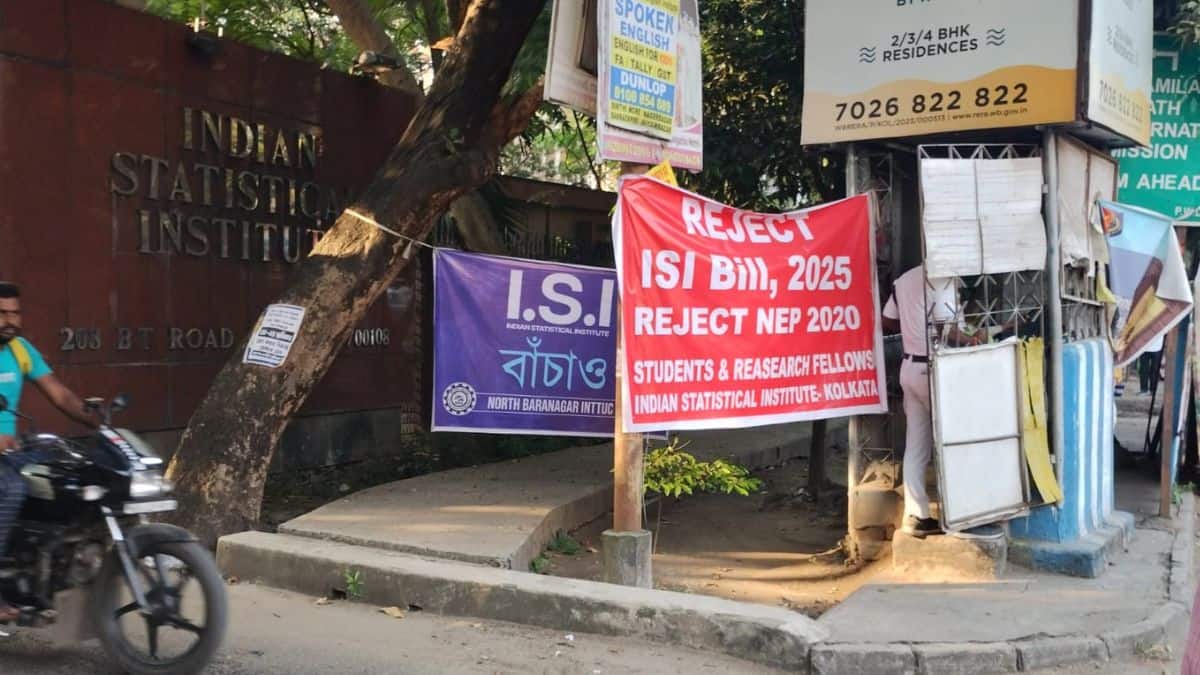
KOLKATA: The main gate of the Indian Statistical Institute Kolkata has its name in stone and metal and a cry for help. A banner hangs in front saying, “ISI bachao”, “save ISI”. The last time ISI Kolkata saw a major protest was five years ago, and held in solidarity with Jawaharlal Nehru University students. This time, it faces what the community sees as an existential crisis.
The Indian Statistical Institute Bill 2025 – the ISI Bill – drafted by the ministry of statistics and programme implementation (MoSPI) seeks to undo its very DNA and remake the 93 year-old institute in the image of other centrally-run institutions of national importance.
Academics, students and alumni of this quiet Baranagar campus in North Kolkata are staunchly against it and have been protesting for over a month. They say the bill threatens the institute’s autonomy, violates the legal structure under which ISI was founded and has run, and drops a question mark over its free programmes, admission policy and the status of its centres across the country. ISI has teaching centres in Delhi, Bengaluru and Chennai.
“The ISI Bill 2025, completely dismantles the structure that we have, replacing the long-standing society model through which the institute has functioned since its inception," said a senior professor, requesting anonymity.
The community held a public meeting last week. They are rallying support among the elected representatives – reaching out to both parliamentarians and their parties – and academics across the world. A global petition addressed to MoSPI has already garnered over 1,800 signatures.
ISI draft bill 2025 and ‘Bengal’s heritage’
The ISI was established in 1932 by Indian scientist and statistician PC Mahalonobis as a society under the Societies Registration Act 1860. With the West Bengal Societies Registration Act, 1961 – amended in ’64 – it was brought within the purview of state law. The memorandum of association has been revised multiple times since the first revision in 1974.
However, even though the ISI is “Bengal’s heritage”, as a professor put it, it is funded by the central government and is an autonomous institute under MoSPI. It was designated an Institution of National Importance (INI) via the ISI Act 1959 which retained the society structure. This is the law that the new bill seeks to replace.
The draft ISI Bill proposes to dissolve the society altogether, converting it into a “statutory body corporate”; all assets, properties, and governance structures of ISI will be transferred to this new entity.
According to the draft, the goal of the new structure is “promoting academic rigour, global competitiveness, and innovation” and “aligning it with peer Institutions of National Importance (INIs)”. ‘Peer INIs’ would include the Indian Institutes of Technology (IIT), the Indian Institutes of Management (IIM) and National Institutes of Technology (NIT) among others. In each of these cases, the central government is far more involved.
The ISI community is seeking an intervention from the West Bengal government, as the institution is part of “Bengal’s heritage”. Plus, its members argue that the central government cannot dissolve a society under state law and that the attempt is “completely illegal”.
As for “global competitiveness”, academics point out that few Indian institutions have a past as storied as ISI’s or can boast its global reputation.
“Scientists such as Meghnad Saha, Satyendra Nath Bose, and Andrei Kolmogorov were all closely associated with ISI. Buildings on the campus bear their names,” said a professor.
Mahalonobis and the ISI also designed the National Sample Survey; its office, the NSSO, is now under MoSPI.
Indian Statistical Institute Draft Bill 2025: Governance changes
The change in governance structure is the biggest concern.
Currently, Indian Statistical Institute Kolkata is led by a council of 33 members. They include seven elected by ISI faculty; two by its non-teaching staff; three representatives nominated by ISI Society from across the country; the heads of the teaching ISI centres in Delhi, Bengaluru and Chennai; and more academics.
If the bill is enacted into law, this will be replaced by an 11-member “board of governance”. Its chairperson will be nominated by the central government; it will have representatives from union government ministries – MoSPI, Department of Science and Technology (DST), ministry of finance – and four “eminent persons”, all nominated by the centre. It will also include the director, dean of studies and heads of centre, themselves BoG appointees.
Also read Delhi University: For many UG students, fourth year a ‘bitter experience’
“It will be completely nominated by the central government,” a professor explained. “There will be no internal representation.” Even though the board will include the director and centre heads, they will all be nominees of the BoG, “eliminating any democratic process”.
The teachers emphasise that ISI’s present governance structure is fundamentally democratic. “Every employee in this institute has some representation in the council,” said the professor, adding that elections are rarely necessary as most decisions are reached by consensus, achieved with relative ease.
Over the decades, this governance model has supported ISI’s strong academic reputation. Its alumni are spread across the world in leading departments of mathematics, statistics, and computer science, and the institute continues to support the Indian government through its expertise in areas such as statistics, cryptology, and national projects.
Academic autonomy at stake
The Indian Statistical Institute draft bill claims its provisions will grant “the institute greater decision-making powers in its day-to-day functioning and planning” but teachers insist that the exact opposite will happen – a total loss of academic autonomy.
ISI will continue to have an academic council but one with its wings clipped. Both its size and powers will contract significantly. The proposed version is much smaller, with centre heads and select division representatives, themselves appointed through nominations.
“The academic council will only be allowed to give suggestions. The final decisions will be made by the board of governance,” said a professor.
This means decisions about curriculum, course structure, and academic content may move out of the teachers’ hands. “We ourselves will not be empowered to decide what we will teach in the class,” he said. “Somebody else will decide it.”
Teachers fear that politically-driven decisions will invade academic spaces. “As we know, things with the current government are not going very well with academics,” another professor said. “The types of things that they are forcing people to teach in class is something that we academics don’t like. They will not be helpful in the long run.”
Teachers also point out that long-term research cannot function with external pressures. “Academics don’t choose research for five years. We have a much longer vision in mind. If somebody directs us on what to do, and that too with a very short-sighted goal, then that would be of no good to us.”
They worry about the fate of ISI’s traditional academic culture, which prioritises research over vocational outcomes. “We are not a vocational school,” a professor stresses. “We don’t make managers for industries. We are mainly academics and we give back to society in that way.”
‘Financially self-sustaining’: Free courses at risk
Equally alarming are the draft policy’s prescriptions on ISI’s finances. In multiple sections it pushes for the institute and its centres becoming “financially self-sustaining”.
Among the “objectives of the institute”, the MoSPI’s draft bill includes this: “To generate and manage resources effectively, with the aim of becoming financially self-sustaining to the extent possible.” Later, it says the teaching centres should strive for financial autonomy as well.
It also pushes it “to enhance collaboration between the industry, academia, and government, in order to, inter alia, promote practical application of knowledge for public interest”.
The ISI Kolkata community fears this spells doom for the two programmes the institute offers for free – BStat and BMath.
Students receive scholarships which, as a professor explained, “allows students from less privileged backgrounds to pursue long-term academic work without worrying about finances”.
Recently, ISI introduced a paid undergraduate course, Bachelor of Statistical Data Science (BSDS), as the government was nudging it to generate revenue. Teachers fear that revenue generation will now become ISI’s priority.
ISI Admission: Proposal and practice
The Indian Statistical Institute is still allowed autonomy in framing its admissions policy but with the entire top administration beholden to the central government, teachers say this leeway doesn’t mean much.
“We have our own entrance examination,” said the professor. “That’s also a very unique thing. We worry that losing academic autonomy could eventually affect even this.”
The draft bill merely says ISI admissions must be “based on merit assessed through transparent and reasonable criteria” and announced in advance.
ISI centres and Kolkata 'headquarters'
Across the country, ISI also runs Statistical Quality Control (SQC) units that serve industry but do not conduct academic programmes.
The Delhi and Bengaluru ones became teaching centres in the 1970s. In 2008, ISI Chennai was upgraded to a teaching centre. In 2011, ISI added a new centre in Tezpur.
The bill does not mention Kolkata as the headquarters, raising fears about land and institutional identity. “Maybe they don’t want to keep things here. Who knows? They want to grab our land, we don’t know,” said another professor. Another clause in the draft bills says that where land has been granted free-of-cost by the state or central government, it “may be disposed of only with the prior approval of the central government”.
“We were not given any meaningful opportunity to discuss or shape the bill. In late July, the secretary of the ministry attended a council meeting and presented the idea of a new bill.”
When the draft was opened for public comments, teachers studied the bill and listed their objections.
The community is now asking parliamentarians to step in before the bill reaches parliament. “A global petition addressed to the ministry has already gathered around 1,800 signatures from leading academics, mathematicians, and ISI alumni,” they said.
For protesting students, the bill threatens a legacy built over generations. “These are long-term things. Institute policy cannot change every time a government changes. That’s very harmful for academics,” said one.
 Add as a preferred source on google
Follow us for the latest education news on colleges and universities, admission, courses, exams, research, education policies, study abroad and more..
To get in touch, write to us at news@careers360.com.
Next Story
]Latest Education News
]Related News
]Maharashtra sets up cell with six principals to monitor drought relief for college students
BJP women MPs meet President Murmu, seek Cong MP's suspension from LS over JNU 'sexual misconduct'
'Reclaim Jantar Mantar’: Student group protests detention of CJP leaders in Delhi


