
NEET protest 2026 exposes an education system grooming students for ‘one rat race after another’
Team Careers360 | July 25, 2026 | 03:38 PM IST | 6 mins read
Behind the NEET protest 2026 lie troubling realities – underfunded schools, overburdened teachers, and a generation taught to chase ranks over learning
NEET 2026 College Predictor
Predict your MBBS, BDS & AYUSH admission chances with the NEET College Predictor. Get personalized college recommendations based on rank, category & quota.
Try Now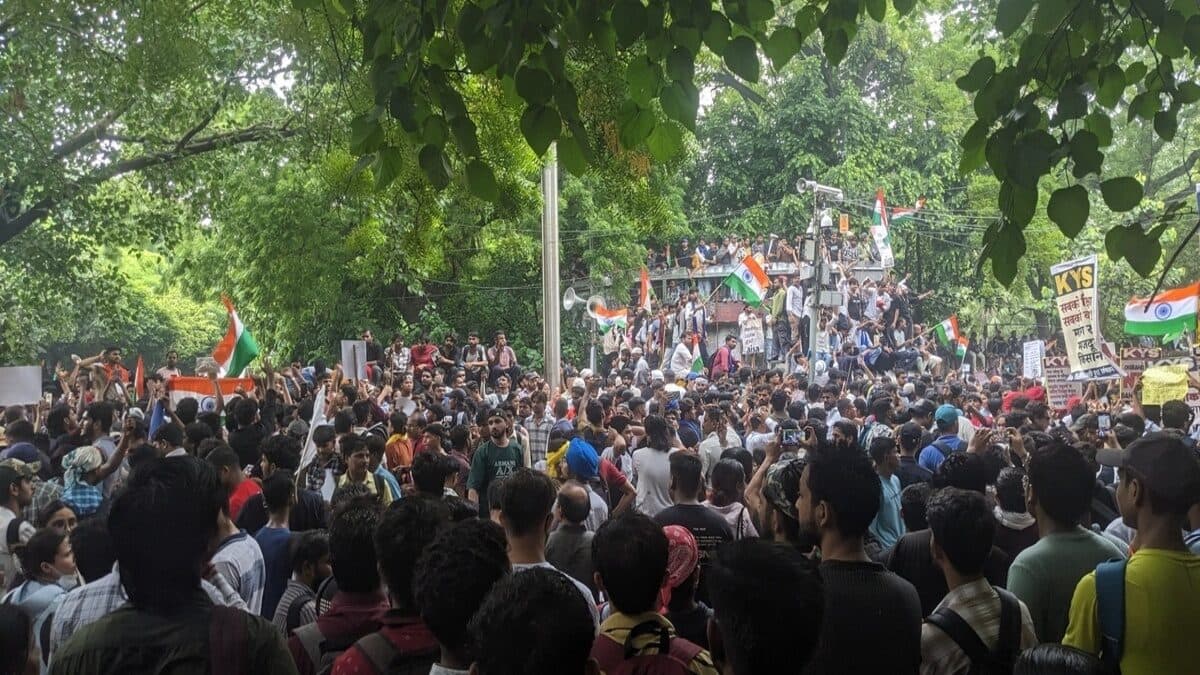
By Gitanjali Diwakar
The recent protests surrounding the National Eligibility cum Entrance Test (NEET) exams, organised by the ‘Cockroach Janata Party’ (CJP), have highlighted an array of issues related to India’s present education system. Not only have they drawn attention to the flaws in the examination patterns, but the agitations also raise questions surrounding accountability.
The discussions surrounding the extremities of such actions do not cease to end. But what deserves to be introspected and addressed is the wave change in perceptions about education at large.
In over 78 years of its independence, India has witnessed the influx of different school education systems. These include conventional options such as the Central Board of Education (CBSE) or the state board, Waldorf-inspired schools, Montessori schools, and the like. What is, however, strange is that despite these options, students are being groomed for one rat race after another. This has disrupted the purpose of learning, interacting, and growing holistically.
NEET Protest 2026: School trends hit teachers
Among the most affected by these trends, are the key players in the game – the teachers. The excessive targets and tasks deny them any scope of a healthy work-life-balance. Overworked tutors are compelled to spend extra hours at school or doing schoolwork as a mark of ‘commitment’. Whether the pay scales match the efforts involved deserves an assessment.
According to a NITI Aayog report, published this year, despite some states progressing in terms of student-teacher ratios, some others witness over 2 lakh vacancies for teaching positions in schools. Some states have also witnessed a pupil-to-teacher ratio (PTR) of about 37:1 at the Higher Secondary level. This is above the permissible limit of 23:1 as prescribed the Right to Education Act.
Further, the report states that India spends only 4.6% of its Gross Domestic Product (GDP) on school education. This does not favour sustainability of school education given in the overall rise in expenditure. The lack of adequate funding leads to poor infrastructure, salaries, and other constraints. Parents are, therefore, compelled to resort to other school systems (sometimes more expensive options) owing these limitations.
Thus, the frustration surrounding a child’s education stems from the first day of school. The troubles unfortunately intensify over the years.
NTA NEET, JEE Exams: Is the college tale different?
The ongoing outcry for accountability in the conduct of a national-level entrance exam demonstrates 12 years (approximately) of exhaustion. For years (some even sacrifice their high school days), students spend hours preparing for an exam viewed as a stepping stone towards a professional life. Be it the NEET, the JEE, or any such qualifying criterion; the aims are two-fold. Quality education and reasonable fee. The denial of either or both only adds to the stress of the individual and their families. After all, school was not easy either.
Let us try to understand the impact of the current issue through a set of numbers. About 1,278 universities responded to the All-India Survey of Higher Education (AISHE) in 2023-2024. The report stated that 98 of these universities offer medical education. But only 7.7% are exclusive medical universities while the others are multidisciplinary universities. During the period, about 21.3 lakh students enrolled for undergraduate programmes in medical science. About 3.8 lakh students graduated with these programmes and approximately 59.6% of them were female students.
What happens to those who do not clear or do not acquire a spot in these universities? Clueless about the alternative options, some choose to miss out on a year of college to prepare again. Some others have their families charting their lives out for them. Some choose to bid adieu to the world. The rather streamlined approach to education seldom guarantees one an opportunity to explore non-conventional paths to professional success.
What must be remembered is that the game does not end with the NEET exam. A 2025 study published in the Journal of Family Medicine and Primary Care highlighted that among those scoring 100–170 in NEET, 34.7% passed the first-year MBBS examinations. While among those who scored between the ranges of 171–230 and 231–450, only 33.3% and 32% passed the first-year MBBS examinations, respectively.
Education is not akin to a mono act. It involves multiple stakeholders. These include the government, the institution, the doctors, the faculty, the support staff and more. The absence of accountability at multiple levels is undeniable. Then again, such situations must motivate the academic fraternity, professional, and industry leaders to work in tandem. In doing so, one can work towards a system of education which fosters passion and meaningful contributions towards a society’s growth.
NEET Protest 2026: Bridging the gaps
Intelligence plus character; that is the goal of true education – said Martin Luther King Jr. The present crisis demonstrates a gap between these two elements. It is therefore worthwhile to consider steps which could bridge them. This would re-kindle a sense of curiosity and perhaps a genuine interest in a space lauded for its human essence.
- Re-define study hours. Let the scores not define a student’s interest in a subject. Organisations must focus on striking a balance between all members of the institution and respect their time. This would enhance the quality of education meted out to the students. Learning would be more enjoyable. It would also facilitate the true essence of tutorial centres by ensuring that they cater to those who truly need it. Additional perks such as health insurance and additional paid leaves for tutors can be considered too.
- Encourage discourses. Allow healthy interactions between students, faculty and other members of the organisation. The process of learning is never a one-way track. Multiple perspectives and opportunities can ensure a greater grasp of subjects and other soft-skills.
- Integrate the Indian way of life. After all, discourses were quintessential of our educational systems. Our history speaks volumes of achievers in various fields such as engineering, medicine and more. The country’s cultural diversity is an avenue for those you wish to debate on policies for public welfare. Ignorance to India’s states, their capitals and traditional stories should be converted into opportunities for innovative pedagogies and not lead to intense punishments. This would also be a favourable parameter to assess a teacher’s contribution.
Teacher’s experience speaks
As an educator, I deem it a privilege to have taught all my students. To seem them do well, is more satisfying than any tangible item money can buy. This profession not only exposed me to the latest trends in society but also tickled my brains. The constant interactions with future generations are opportunities that have helped me grow leaps and bounds. It helped me realise the impact of my words and actions on the lives of others. Moments like these continue to motivate me and teach all that I can to those who yearn for it.
I can confidently say that education must not be a privilege and must not add to the financial stress of the child’s guardians. The dearth of quality teachers, and evaluation mechanisms reflect on our inability to value its role. This can only be achieved if corporations, educational institutions, the government and the public work together. For the lives of the future generations entail a collective responsibility.
The writer is an advocate at the High Court of Madras and the former guest faculty at IIMC Kottayam, Kerala. The views are personal.
 Add as a preferred source on google
Follow us for the latest education news on colleges and universities, admission, courses, exams, research, education policies, study abroad and more..
To get in touch, write to us at news@careers360.com.
Next Story
]CLAT Exam Reform: 3-section paper; scrap GK, current affairs; outsource but not to NTA, suggests NLU panel
NLU Consortium Expert Committee report suggests cutting down to 3 sections; ditching GK, current affairs; outsourcing but not to NTA. Present format stays till CLAT 2027. Here’s what’s changing
Musab QaziLatest Education News
]Related News
]Maharashtra NEET Counselling: Pvt medical colleges move HC, want institute rounds of MBBS, MD admissions back
NEET UG 2026: CBI files supplementary chargesheet in paper leak case
NEET UG Counselling 2026: Stray vacancy round registration begins; apply by October 14


