
‘Shouldn’t forget’: An AI engineer’s platform is gathering evidence of police violence at CJP protest
Sheena Sachdeva | July 30, 2026 | 02:59 PM IST | 5 mins read
IISc graduate Shrey Gupta created The Unbadged to be a ‘public record’. He says Gujarat Police questioned him for 4 hours after he made a post about it on Instagram
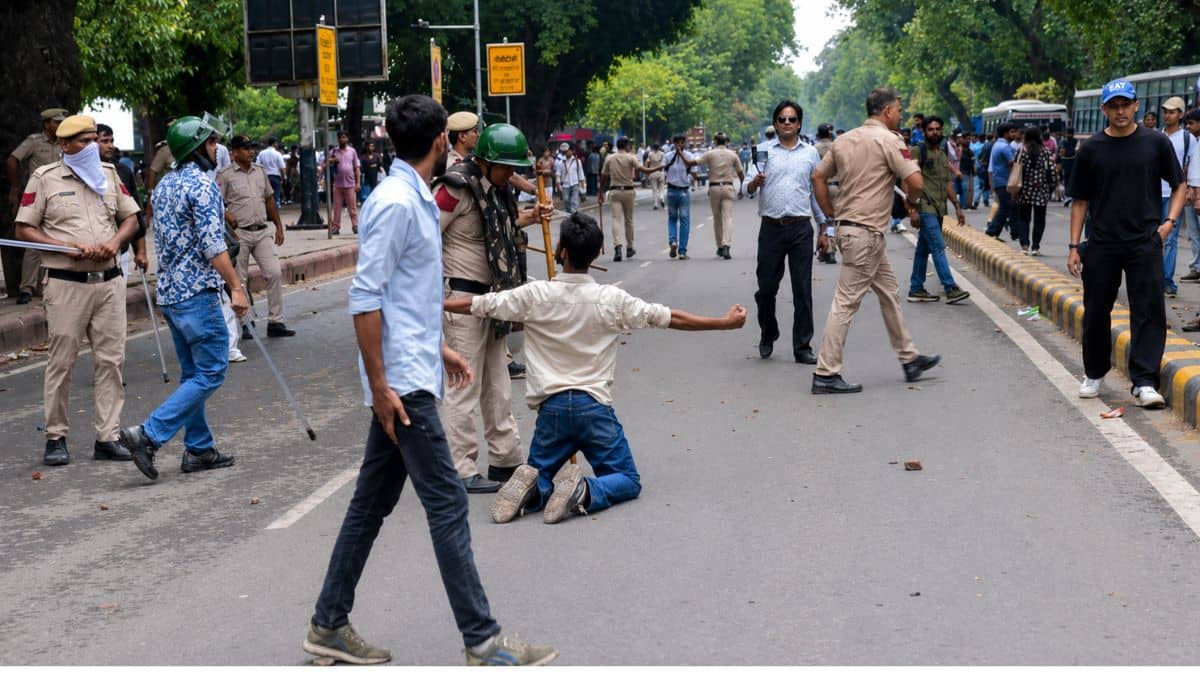
"I just meant to take humanity's side,” says Shrey Gupta. An artificial intelligence (AI) engineer based in Ahmedabad, he developed an online evidence vault, ‘The Unbadged’, to document police action on students at last week’s Cockroach Janta Party (CJP) protest at Jantar Mantar, Delhi.
“I prepared for the Joint Entrance Examination (JEE) exam for seven years, from Class 6. I understand that struggle,” said Gupta, 28. While it tapped into widespread discontent among the youth, the immediate cause for protest was the NEET 2026 paper-leak and the subsequent suicides of over 20 aspirants. The protests forced the education minister Dharmendra Pradhan to resign. The website includes a timeline of the events of July 20 – the day saw lathis, teargas, even pellet guns deployed against students attempting to march to parliament – through the online sources available. He created an anonymous google form. Till July 30, he received 80 submissions and over 10,000 users.
Born in Saharanpur, Uttar Pradesh, and raised in Gandhidham, Kutch, Gujarat, Gupta said his connection to India's examination system is deeply personal. “Both my parents are teachers and I have been a teacher myself,” he said. His father, an educator and an alumnus of the Indian Institute of Technology (IIT) Delhi, introduced him to the world of competitive examinations at an early age.
CJP Protest and Delhi Police: ‘Enraged’ by videos
"I saw all those reels of police brutality in the morning of July 21 and got enraged. I didn't know what to do," he said. Like many software engineers, Gupta turned to AI to brainstorm. The same day, he made an Instagram post asking witnesses to share their records of incidents.
"I thought 10 or 15 people would like it and there would be a few comments. By the evening, I realised people were sharing videos and stories, but comments weren't going to change anything." That night, he decided to build a website, with some help from AI.
"There were certain things that could not be done under any circumstance: facial recognition or making public any submissions people sent me." The site earns its name from the large number of policemen who were allegedly without badges at the CJP protest.
Also read Lok Sabha passes bill to strengthen anti-paper-leak law; higher fines, longer prison sentences
In about four hours, Gupta created an online archive featuring two components: a timeline of the July 20 protests, compiled using publicly-available reports and social media posts, and a Google form allowing users to anonymously submit evidence.
"I published the website at around 2 am. The next morning, my Instagram post had around 2,000 likes and nearly 20,000 views," he said.
‘A public record’
According to Gupta, the timeline was assembled by collating timestamps from news reports, videos and social media posts. "You search for '20th July student protests' on Google, collect different reports and build a timeline from the timestamps. Wherever possible, I have used videos with their original timestamps. In places where a representative video has been used, I've included disclaimers."
Also read ‘Greta Thunberg visit not planned’: How SFI UK which took CJP protests to Leeds, London and beyond
For him, the motivation was simple. "I didn't want anyone to forget. We're in the middle of a five-year election cycle, and there is plenty of time for all of this to be deleted and forgotten. At least one public record should remain."
Gupta rejects allegations of political partisanship. “I'm not taking any political sides. What happened on July 20 should not have happened in a democratic country,” he added.
Threats and police questioning
However, the visibility brought unwanted attention to Gupta.
On July 22, Gupta stated that after he launched the website, he began receiving OTP requests, Telegram messages and calls from unknown numbers after responding to a user who wished to contribute material to the archive.
“I received around 20 OTPs from Swiggy and Zomato [food delivery apps]. Then came 50 Telegram messages in a minute. My phone practically hung because of the number of calls I was getting,” he said.
Soon after, alleges Gupta his photograph, address, phone number and his father's name had been shared online. “Thirty-four people on Telegram told me the same thing, that my information had leaked and that I had come onto the radar of the open-source intelligence (OSINT) community,” he said.
Later that night, around 10.30 pm, four men in plain clothes arrived at his residence in Ahmedabad. "I asked them if I was under arrest. They said no. I asked if I could make a phone call and they agreed. The moment I turned around, one of them opened the grill door from inside and they entered the house," Gupta alleged.
Gupta said he was first taken to a local police station and later to the crime branch for questioning. “The police officer told me that protesting was not the problem, but posting about it online was. I was also accused of my Instagram post leading to violence,” he said. Eventually he was sent home after an interrogation that lasted four hours.
IISc Bangalore on KVPY scholarship
Gupta started preparing for JEE in Class 6, sitting with the Class 9 students his father taught. "I had already studied Classes 11 and 12 by the time I reached Class 9. There was nothing left for me to study from my own syllabus," he said. This also meant he was always the topper, from Class 3 till 12.
With an All-India Rank of 1200 in the JEE Advanced – the second of the two-tier JEE and means for the IITs and IISc – he joined IISc with the Kishore Vaigyanik Protsahan Yojana (KVPY) scholarship. The KVPY scholarship has now been scrapped. He earned his bachelor’s and master’s degrees, with a specialisation in physics, at IISc.
Today, Gupta works as an AI engineer at a startup in Ahmedabad. Until last month, his “life was limited to physics, chemistry and mathematics" and he had little involvement in public activism.
Also read Visva-Bharati professor quits report panel alleging doctored meeting minutes, staff shortage
Competitive exams
Before becoming an AI engineer, Gupta briefly worked as a teacher, another reason, he says, that the protests resonated with him. “My parents are teachers. I have been a teacher. I know what these examinations mean to families," he said.
For Gupta, preserving the events of July 20 was less about politics and more about memory.
"It was heartbreaking to me that students asking for fairness in the examination system were being beaten for it and did not want people to forget it," he said.
 Add as a preferred source on google
Follow us for the latest education news on colleges and universities, admission, courses, exams, research, education policies, study abroad and more..
To get in touch, write to us at news@careers360.com.
Next Story
]


