
CBSE launches computational thinking, AI curriculum for Classes 3 to 8
Vaishnavi Shukla | April 1, 2026 | 06:24 PM IST | 1 min read
CBSE Syllabus: Faculty from IIT Madras, Gandhinagar, Azim Premji University, Dhirubhai Ambani School, along with other subject experts, prepared the syllabi for both computing and AI
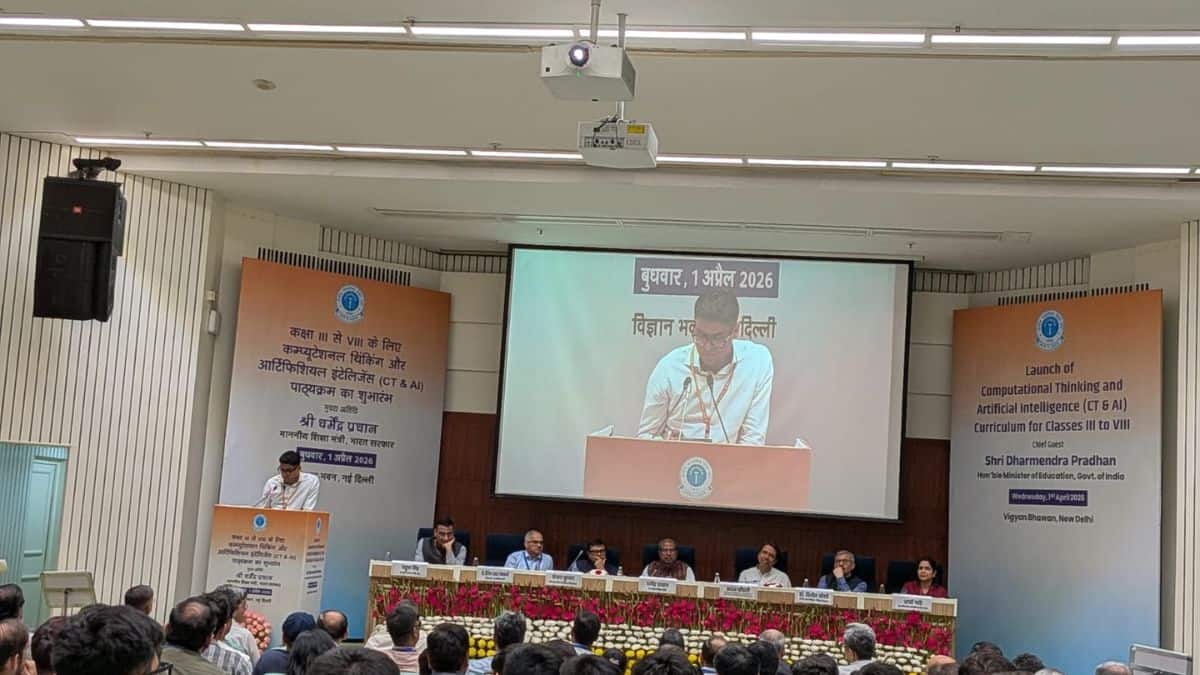
The Central Board of Secondary Education (CBSE) has launched the Computational Thinking and Artificial Intelligence (AI) syllabus for Classes 3 to 8. Faculty from IIT Madras, Azim Premji University, Dhirubhai Ambani School, along with several other subject experts, prepared the CBSE syllabi for both computing and AI.
In addition, IIT Gandhinagar's centre for creative learning was an integral part of curating the syllabi. Several mathematics and computer science teachers and principals were also consulted for the preparation of the curriculum, CBSE’s chairman informed.
CBSE syllabus for computing and AI was launched via a press conference held by the board, in the presence of education minister Dharmendra Pradhan, NCERT chairman Dinesh Prasad Saklani, CBSE chairman Rahul Singh, and several other officials.
The secretary of school education, Sanjay Kumar, informed that India is one of the few countries that has launched AI in schools, along with China, South Korea, Finland, Estonia, and Singapore.
Also read CBSE: APAAR ID must for LOC registration from 2026-27 session; two-level Class 10 exams from 2028
CBSE syllabus approved by NCERT
Furthermore, three documents have been prepared after it was approved by the National Council of Educational Research and Training (NCERT), and are listed below:
- Curriculum
- Teachers' Handbook for Classes 3 to 8
- Teaching Learning Material
While talking about the social media ban by different states, the CBSE secretary also said that he tried to read them and wondered how to segregate academic and social media.
He has also asked CBSE to curate the CT and AI curriculum in other Indian languages and added that NCERT is responsible for collaborating with the State Council of Educational Research and Training (SCERT) and producing the syllabus in other Indian languages.
Further, in the board’s last governing meeting, it said the competency-based assessments will be developed for the skill subjects as per the Programme for International Student Assessment (PISA) standards. It also planned to introduce semiconductor technology as a skill subject for Classes 8-12 students.
 Add as a preferred source on google
Follow us for the latest education news on colleges and universities, admission, courses, exams, research, education policies, study abroad and more..
To get in touch, write to us at news@careers360.com.
Next Story
]Latest Education News
]Related News
]Board Exam Time Table 2027: AP Inter, TN 10th, 12th date sheets out; CBSE, RBSE, JKBOSE, TS schedule soon
CBSE Board Exam Dates 2027 LIVE: Class 10, 12 subject-wise timetable soon at cbse.gov.in; passing marks
Delhi school gets bomb threat, minor student allegedly sent fake email to get school closed


