
Osmania University degree college crammed into 5 school rooms; BA, BSc, BCom students take turns to study
Azib Ahmed | April 1, 2026 | 10:18 AM IST | 7 mins read
OU’s Government Degree College Vikarabad operates in shifts; its 19 BA, BCom, BSc classes, across years and languages, squeeze into 5 rooms, without a lab or library. That’s set to change
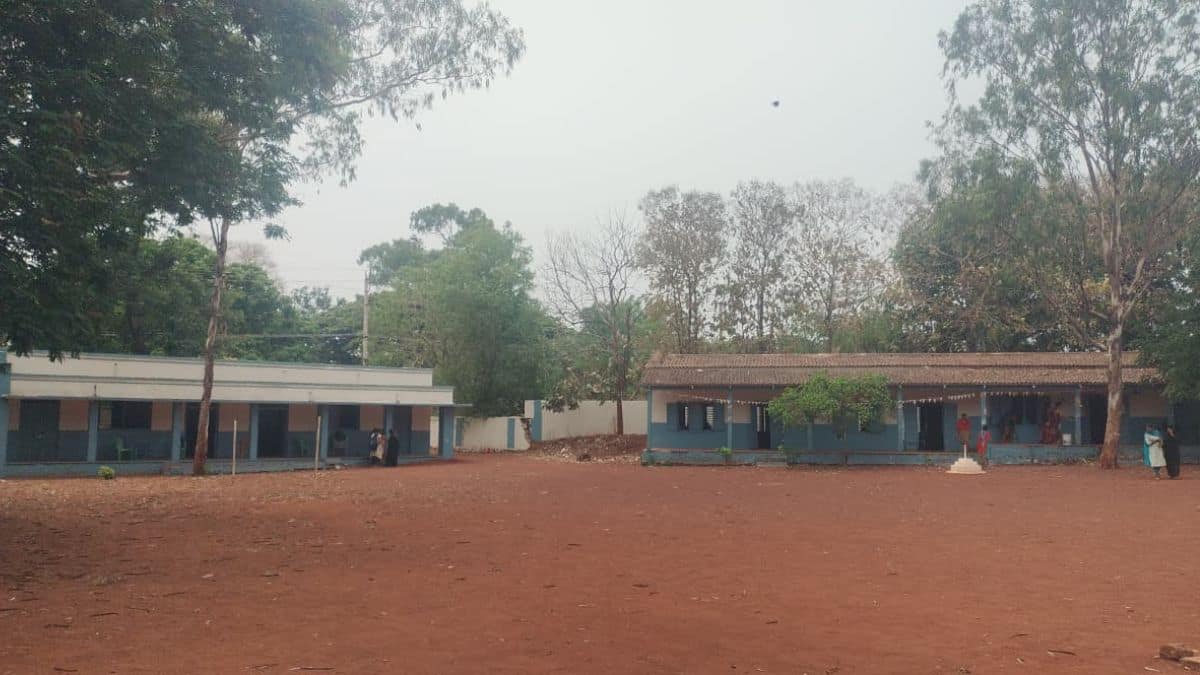
On days when the Class 10 board examinations are held, students of Government Degree College Vikarabad are not allowed to enter their own campus before 1 pm. “Classes begin only after the exam concludes, reducing teaching hours and disrupting an already-strained schedule,” said a student of the college in Vikarabad district in Telangana.
This is because the college, affiliated to Osmania University, operates from a shared school building - Zilla Parishad High School (ZPHS) Vikarabad, and does not have a campus of its own.
For many students, this arrangement means shifting lectures, poor facilities and long waits. A first-year BCom student, who travels nearly 100 km daily on a state-run bus, spending around Rs 875 each month on a pass, said only 10-12 students attend regularly out of a class strength of 21.
Classes run from 10 am to 3 pm, with five lectures in a day. However, due to severe space constraints, multiple batches are adjusted in a limited number of rooms. “There are only five classrooms for all BA, BCom, BSc batches. Classes keep shifting, and sometimes we have to wait outside or sit in corners just to attend lectures,” he said.
Also read Bihar plans to start BA, BSc degree colleges in schools; teachers flag space, staff crunch
So dire is the situation at the degree college, the Telangana Education Commission thought fit to describe its plight in detail in its report, Education Policy for Telangana 2026, placed in public for comment in March. In the report, Government Degree College Vikrabad is upheld as an example of the neglect and underfunding of public higher education in the state.
But the situation in Vikarabad is not an isolated case. Students said that at Government Degree College, Pargi, in the same district, the shortage is even more severe, with only two classrooms for multiple batches. However, it does not find mention in the TEC report.
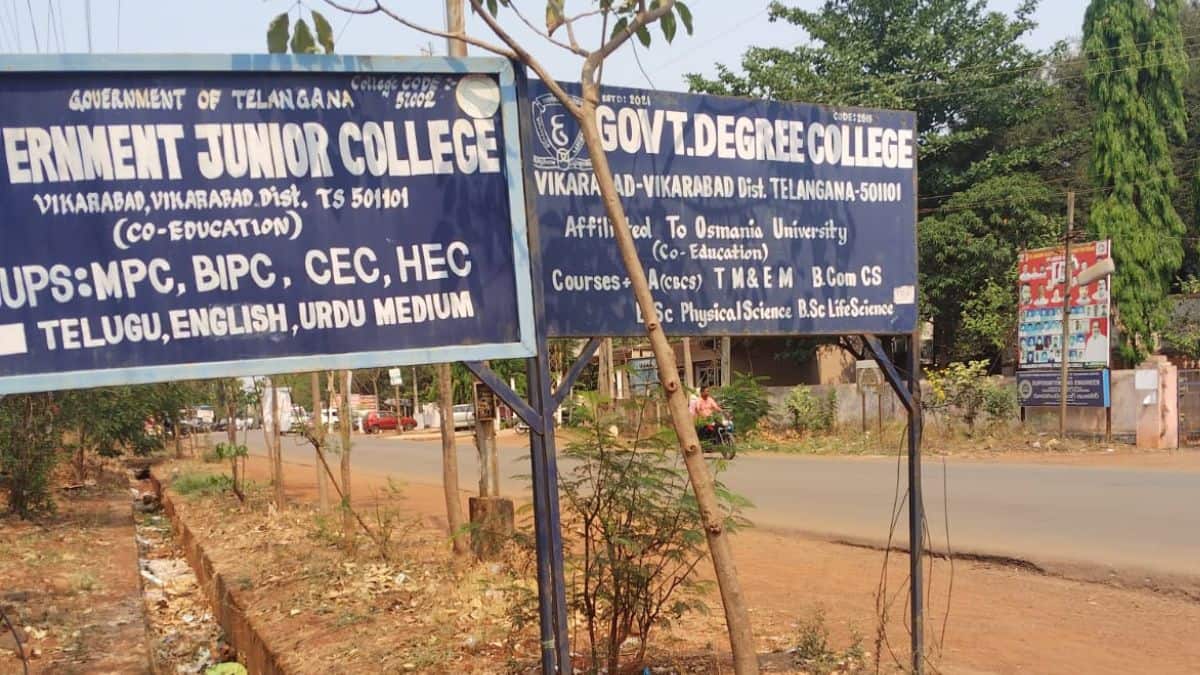 Government Degree College, Vikarabad, affiliated with Osmania University (Image: By special arrangement)
19 BA, BCom, BSc batches in school building
Amid these constraints, the college offers Bachelor of Arts, Bachelor of Commerce and Bachelor of Science degrees in multiple language media, resulting in as many as 19 different batches of students jostling for space in seven rooms.
For example, the Bachelor of Arts degree programme is offered in Telugu and English, with three batches of students in each track. Meanwhile, an Urdu-medium BA programme, introduced just last year, currently has only the first batch.
Similarly, the Bachelor of Science and Bachelor of Commerce degrees are offered in Telugu and English with batches across all three years.
The entire group gets a set of seven tin-roofed rooms on one side of the school playground with school buildings along other sides.
BSc without lab, BA without library
The most basic academic facilities that mark an institution of higher education are missing.
“There is no computer lab or science lab. For computer science, teachers explain on the board, and we manage somehow,” said another student. The student enrolled in the government college due to financial constraints, as private colleges were not affordable. He has completed one semester and is uncertain about his future plans but hopes to prepare for competitive exams.
P. V. Geethalakshmi Patnaik, principal, explained that while the college does not yet have a dedicated science laboratory, students use facilities at nearby government colleges under the T-STEM (Telangana - Science, Technology, Engineering, and Math) programme.
While this provides access, it is also a waste of time. “Taking the entire batch to another village for practicals is a major challenge,” said a teacher, adding that it disrupts schedules and makes it difficult to conduct sessions regularly.
“We are also setting up a computer lab through donations,” Patnaik added.
Students rely on bookstores outside for study material.
A guest teacher said that while the college does maintain a small collection of books, it has no space to maintain it. “If books for BA subjects like political science, economics and history are made available, it will help students a lot,” he said.
Yet another first-year BSc student said he was unaware at the time of admission that the college operated from a school building without a dedicated campus, and realised it only later. His class has around 32 students, though many remain absent.
College without campus, high absenteeism
While the college has a total roll-strength of 175, every student Careers360 spoke to said only a fraction of that number attends.
Students have been for a proper campus for a long time. “For the past four to five months, we have been told that the college will be relocated very soon, but we do not know when that will happen,” he said.
He said the current set-up becomes especially difficult during extreme weather conditions. “In summer, it is very hard to sit and study under the tin roof,” he said, adding that delays in shifting the college could worsen the situation.
Also read ANRF spent just 61% of its budget for 2025-2026, nothing in first 2 years: Parliament panel report
The commission’s 2025 field visit found that the college operates out of a shared school building (ZPHS Vikarabad) with only three classrooms, forcing multiple batches across B.A., B.Com. and B.Sc. streams to share limited space. “To manage extreme space shortages, many colleges have resorted to the ‘shift-system’. This splits the day between arts and science students, effectively halving the instructional hours and contact time required for a rigorous degree. The absence of classrooms, furniture, laboratories, and teaching tools directly impedes learning and undermines student dignity,” the report noted.
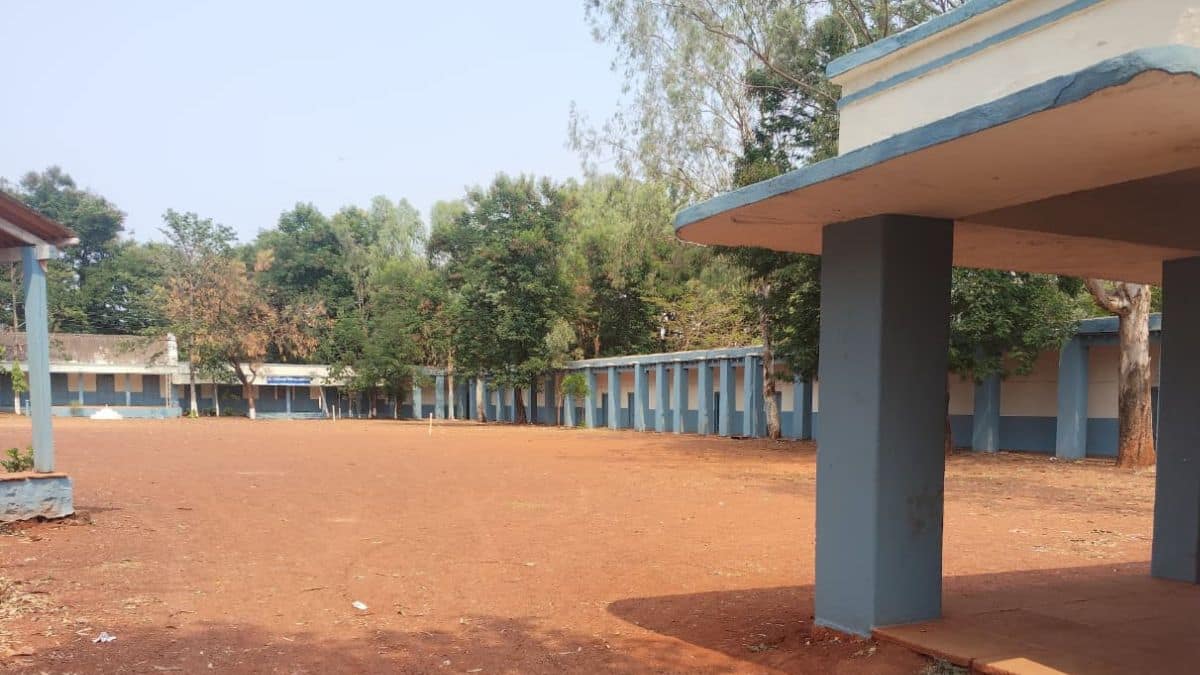 The Zilla Parishad High School campus, which also serves students of the Government Degree College (Image: By special arrangement)
Time-table depends space availability
The day-to-day academic schedule is determined by the availability – or not – of classrooms, said a guest teacher. At times, he said, classes are conducted outdoors or students are asked to shift rooms in the middle of lectures due to space constraints.
The severe infrastructure limitations have made it difficult to follow a fixed timetable effectively. While a timetable exists, “in practice, there are many problems for students to sit and attend classes properly”.
Referring to faculty gaps, he said subjects like political science, economics and history are being managed, but there is no Urdu-language faculty. Teachers sometimes rely on shared notes to support students, he added.
The college has six regular and 10 guest faculty members, Patnaik said, noting that they are sufficient for teaching all the subjects. She also pointed out that the Urdu-medium has been introduced for the BA programme this year, but a dedicated teaching post is yet to be sanctioned for the subject.
Class strength varies, with around 8 to 16 students attending regularly, many of whom come from nearby villages. “Most students are from rural backgrounds,” said the teacher.
Next Move: Teacher training institute’s hostel
The Government Degree College Vikarabad was established in 2021 and has been housed with the school from the start, confirmed Patnaik, its first regular principal. Till her appointment in 2024, the college was run by “in-charge” principals.
Patnaik said the college initially started with around 40 students and now has 175, with two batches having graduated. “Because of space constraints, we had to run a shift system,” she said.
Land for a permanent campus is yet to be allotted, but a move to another temporary one is in the offing. Its next stop is at a teacher training institute’s hostel.
“We are now shifting to a Government DIET College hostel in Vikarabad, where around 18 rooms will be converted into classrooms. This will be sufficient for the current strength and allow us to conduct full-day classes without shifts,” she said, adding that the building required repairs but is now ready and will be inaugurated soon.
Explaining the delay in infrastructure, she said government degree colleges in Telangana are usually started in temporary accommodation based on local demand, with land and funds for permanent buildings sanctioned later. “In our case, land is under finalisation, and once it is allotted, we will seek funds under the Pradhan Mantri Uchchatar Shiksha Abhiyan (PM-USHA) scheme,” she said. “Construction may take another year or two, but we are working towards having a permanent campus with better infrastructure soon.”
 Add as a preferred source on google
Follow us for the latest education news on colleges and universities, admission, courses, exams, research, education policies, study abroad and more..
To get in touch, write to us at news@careers360.com.
Next Story
]Latest Education News
]Related News
]NEET PG Counselling 2026 LIVE: MCC round 1 seat allotment results out; MD, MS cutoffs
Delhi University announces Erasmus Mobility selection process for students, PhD scholars, faculty
MCC NEET PG counselling 2026 round 1 allotment result out; 28,728 candidates allotted MD, MS seats


