
Jadavpur University has 63 researchers in top 2% scientists list – highest count among state institutions
Pritha Roy Choudhury | October 15, 2026 | 10:01 AM IST | 7 mins read
48 JU Kolkata scholars in top 2% scientists list for career-long work and 50 for single year. They say strong research culture built despite funding, infra woes
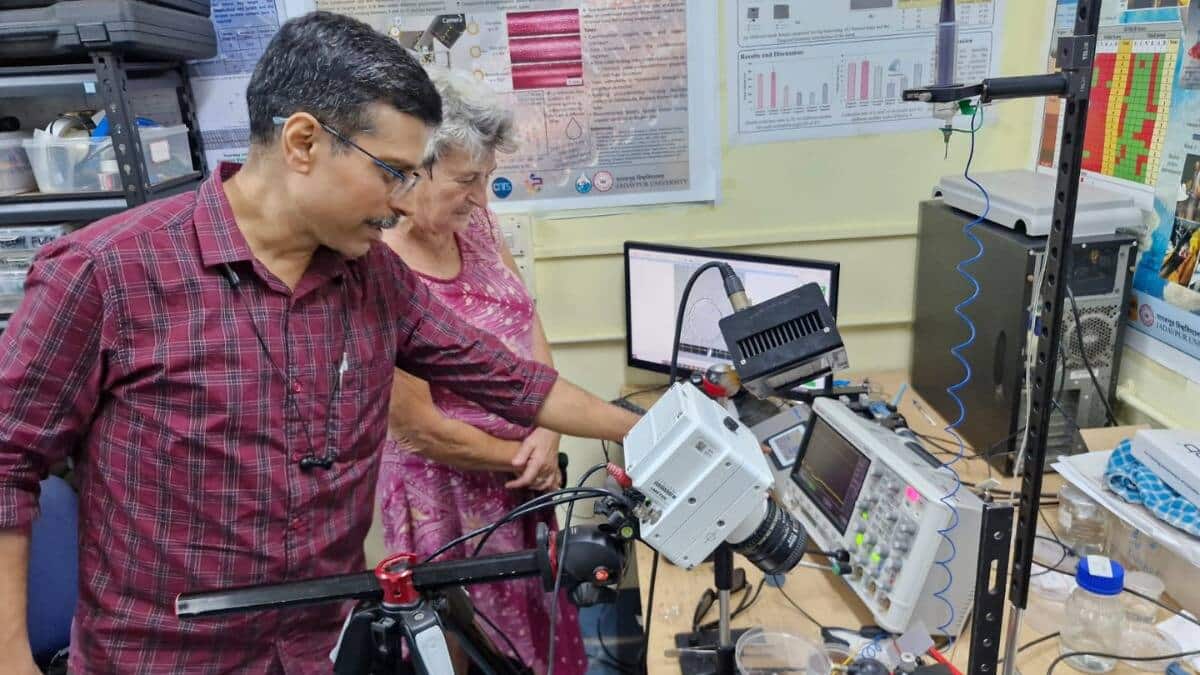
“We have broken or not so sophisticated instruments but we know the basic steps. We are doing very, very well for the last 15 years,” said Ranjan Ganguly, a faculty member in the Department of Power Engineering at Jadavpur University (JU). That grit has paid off.
Sixty-three researchers at the university feature in the 2026 career-long and single-year lists of the world’s top 2% scientists – an outcome the faculty members credit to sustained academic work, strong foundational training and collaboration among researchers.
In the 2026 edition of the “World’s Top 2% Scientists”, drawn up by Elsevier and Stanford University, 48 researchers of the university feature in the career-long list – the most from any state university in the country – and 50 in the single-year list. As many as 35 appear in both, taking the total number of unique researchers across the two lists to 63. Ganguly is in the single-year list.
Also read Sociology at a Crossroads: Why the discipline must move beyond departments to reclaim relevance
The career-long list considers publications and research contributions over an extended period, while the single-year list assesses performance during a particular year. Researchers are assessed within their respective subject subfields, with citations forming an important part of the evaluation.
Faculty members said the university’s research output reflects work carried out in laboratories over several years, alongside the efforts of students and researchers who have continued their work despite limited resources.
Jadavpur University research culture built over years
Ganguly, who works in the energy subfield, said Jadavpur university began witnessing a growing interest in research among students in the late 1990s.
“I have been associated with JU as a teacher since 1997. From what I observed, from 1998-99 a trend started in Jadavpur. Students wanted to do research. It is not that we started getting funds but students felt that they should do research,” he said.
Ganguly, who returned to JU after completing his PhD in the United States, said the university’s research environment developed considerably since 2005. Though the infrastructure available did not always match that of better-funded institutions, students receive a strong grounding in the fundamentals of their subjects.
“Students who go out to study from here get credit for research and broader focus,” he said.
He also pointed to the support extended by the university administration and fellow faculty members. Recalling his decision to return to Jadavpur University, he said the institution had encouraged him to pursue further studies and subsequently contribute more for the university.
According to Ganguly, the willingness of colleagues to support one another has also helped researchers continue their work despite financial constraints.
Ganguly’s work in JU’s Department of Power Engineering focuses on energy and water conservation, including projects aimed at reducing water wastage and addressing water salinity. One of the projects involves the Damodar Valley Corporation (DVC), where researchers are working on ways to minimise water wastage in cooling towers.
He is also working on a solar-based project to reduce the salinity of water in the Sundarbans and another on “fog harvesting”. The first involves using sunlight to evaporate saline water and then condensing the vapour to obtain water with reduced salinity and suitable for drinking.
JU Research: Citations reflect sustained output
For the 2026 career-long list, research contributions from 1996 to 2025 have been considered.
Kunal Roy of Jadavpur University’s Department of Pharmaceutical Technology, who worked in medicinal and biomolecular chemistry, features in both the lists. He said the rankings reflected research contributions made over different periods and the list for medicinal and biomolecular chemistry places him first in India in that subfield. He is on both lists, career-long as well as single-year.
“In the research laboratories, work has been going on for a number of years, and their work and citations are getting reflected,” Roy said.
According to Roy, the university’s faculty members and research scholars have developed a research-oriented environment over the years, supported by specific research grants and funding from central and private agencies.
Jadavpur University Rankings: New researchers and funding
Despite the number of researchers on the lists, faculty members said limited institutional funding remains a constraint, particularly for those beginning their research careers. Roy said newly-appointed researchers generally have to secure external projects and grants to develop their laboratories.
“Establishing a research facility takes time, and access to equipment and other resources is not always available from the beginning. The researcher has to bring a project and develop the lab. That does not happen in a day,” he said.
He added that Jadavpur University depends substantially on external funding because its institutional resources are limited. Unlike institutions that have dedicated funding for research, faculty members at JU often have to seek grants to establish and expand laboratory facilities.
Roy also raised concerns about research fellowships for doctoral students. He said the university has limited resources to provide fellowships and that researchers have also observed a reduction in external fellowship opportunities.
“Fellowship is important. It is manpower development. Both the state and central government should invest in fellowship,” he said.
Roy said greater investment would help strengthen laboratories, improve campus infrastructure and support students pursuing doctoral research. He also called for greater recognition of the university’s research achievements.
“Whenever a researcher from a private university features in the top 2% list, it becomes a major story with extensive publicity. Yet, similar achievements by researchers from our university rarely receive any attention”, he said. “The ranking is showing how the university is performing across all the universities in all the disciplines across the globe.”
Jadavpur University seeks greater investment
A senior academic and official of the university, featuring in the “career-long” list of top 2 percent scientists, said JU developed its research infrastructure through a combination of research-specific grants and extramural funding received by researchers from central and private agencies.The university needed to maintain and expand its existing research infrastructure to sustain its research activities.
The university has previously been considered for an upgrade under the Institute of Eminence initiative. According to the senior academic, Jadavpur University was among eight institutions selected after submitting a proposal and presenting its case before an expert committee. However, the anticipated funding did not materialise at that time.
The academic said the university was hopeful of receiving the required support from the state and central governments. He said the proposed funding of around Rs 1,000 crore, if made available, would help address infrastructure requirements and support further development.
Faculty members said funding constraints affected not only research equipment but also the availability of fellowships and other facilities required by students and researchers.
Jadavpur University Kolkata: List of researchers in top 2%
Given below is the full list of names from JU featuring in the Stanford-Elsevier top 2 percent scientists lists.
Jadavpur University in Stanford University, Elsevier Top 2 Percent Scientists List 2026 | ||
|---|---|---|
Career-long and single-year | ||
Researcher | Field | |
1 | Kunal Roy | Medicinal & Biomolecular Chemistry |
2 | Pulok Kumar Mukherjee | Medicinal & Biomolecular Chemistry |
3 | B. C. Giri | Operations Research |
4 | M. Basu | Energy |
5 | Papita Das | Chemical Engineering |
6 | Kaushik Roy | History |
7 | Shankar Chakraborty | Industrial Engineering and automation |
8 | Saikat Kumar Seth | Inorganic and nuclear chemistry |
9 | S. Nallusamy | Mechanical Engineering & Transport |
10 | Balaram Kundu | Mechanical Engineering & Transport |
11 | Satya Priya Moulik | Chemical Physics |
12 | Bijoy Bhattachryya | Industrial Engineering and automation |
13 | Ujjwal Moulik | Artificial Intelligence & image processing |
14 | Suman Das | Materials |
15 | Himadri Chattopadhyay | Mechanical Engineering and Transport |
16 | Farook Rahaman | Nuclear and Particle Physics |
17 | Chittaranjan Sinha | Inorganic & Nuclear Chemistry |
18 | Debashish Chatterjee | Electrical & Electronic Engineering |
19 | Subhash C. Mandal | Medicinal & Biomolecular Chemistry |
20 | Saikat Dewanjee | Medicinal & Biomolecular Chemistry |
21 | Tapan Kumar Giri | Pharmacology & Pharmacy |
22 | Subhrangsu Kanta Acharyya | Geochemistry & Geophysics |
23 | Prasanta Sahoo | Materials |
24 | Shouvik Chattopadhyay | Inorganic & Nuclear Chemistry |
25 | G C Shit | Mechanical Engineering & Transport |
26 | Amit Konar | Artificial Intelligence & Image Processing |
27 | Soumen Ghosh | Chemical Physics |
28 | Biswajit Mukherjee | Pharmacology & Pharmacy |
29 | Tarun Jha | Medicinal & Biomolecular Chemistry |
30 | Nirmalendu Biswas | Mechanical Engineering & Transport |
31 | Sadhan Kumar Ghosh | Environmental Sciences |
32 | Sandip Sarkar | Mechanical Engineering & Transport |
33 | Ram Krishna Sarkar | Artificial Intelligence & Image Processing |
34 | Kalyan Kumar Chattopadhyay | Applied Physics |
35 | Sukhen C. Das | Materials |
Career-long only | ||
36 | Debotosh Bhattacharjee | Artificial Intelligence & Image Processing |
37 | Samaresh Bhattachacharya | Inorganic and nuclear chemistry |
38 | Dipankar Chakravorty | Applied Physics |
39 | Amitava Chatterjee | Artificial Intelligence & Image Processing |
40 | Malay Chatterjee | Oncology & Carcinogenesis |
41 | Krispasindhu S Chaudhuri | Operations Research |
42 | Amitava Dutta | Energy |
43 | Swapan Kumar G. Goswami | Energy |
44 | Malaya S. Gupta | Medicinal & Biomolecular Chemistry |
45 | Subratanath Koner | Inorganic & Nuclear Chemistry |
46 | Achintya R. Mukhopadhyay | Mechanical Engineering & Transport |
47 | R. Nandi | Electrical & Electronic Engineering |
48 | Tarit Roychowdhury | Environmental Sciences |
Single-year only | ||
49 | Chandan Kumar Ghosh | Applied Physics |
50 | Nilanjan Adhikari | Medicinal & Biomolecular Chemistry |
51 | Sk Abdul Amin | Medicinal & Biomolecular Chemistry |
52 | Sachindranath Das | Applied Physics |
53 | Pratulananda Das | General Mathematics |
54 | Sivaji Chakravorti | Applied Physics |
55 | Ranjan Ganguly | Mechanical Engineering & Transports |
56 | Suvankar Banerjee | Medicinal & Biomolecular Chemistry |
57 | Arnab Das | Applied Physics |
58 | Debangshu Dey | Electrical & Electronic Engineering |
59 | Manas K. Panda | Inorganic & Nuclear Chemistry |
60 | Probir Kumar Ojha | Medicinal & Biomolecular Chemistry |
61 | Kajal Ghosal | Polymers |
62 | Nirmal Kumar Manna | Mechanical Engineering & Transports |
63 | Rajib Bandyopadhyay | Analytical Chemistry |
Kaushik Roy from the Department of History is the only one from a social science field on the list.
 Add as a preferred source on google
Follow us for the latest education news on colleges and universities, admission, courses, exams, research, education policies, study abroad and more..
To get in touch, write to us at news@careers360.com.
Next Story
]IIT Kanpur aims to raise USD 1 billion, focus on cybersecurity, medtech, drones, 4 other strategic areas
IITK Kanpur director says institute needs 3,000 more hostel beds, salary top-ups to attract faculty talent as govt funds, HEFA loans fall short; half the money raised, rest in next 2.5 years
Sheena SachdevaLatest Education News
]Related News
]No teacher, staff member will be forced to resign, says SPPU VC amid political interference row
ICFAI Hyderabad, Sheffield Hallam University sign MoU to boost teaching, research
IIT Kharagpur distributes wellbeing cards to 16,500 students to promote mental health


