
PM Modi announces fast-track courts for paper leak cases, says culprits won't be spared
Ruchika Kumari | July 23, 2026 | 09:35 AM IST | 3 mins read
NEET paper leak crackdown: PM Modi says fast-track courts to be set up to ensure speedy punishment, protect students' future.

NEET 2026 College Predictor
Predict your MBBS, BDS & AYUSH admission chances with the NEET College Predictor. Get personalized college recommendations based on rank, category & quota.
Try Now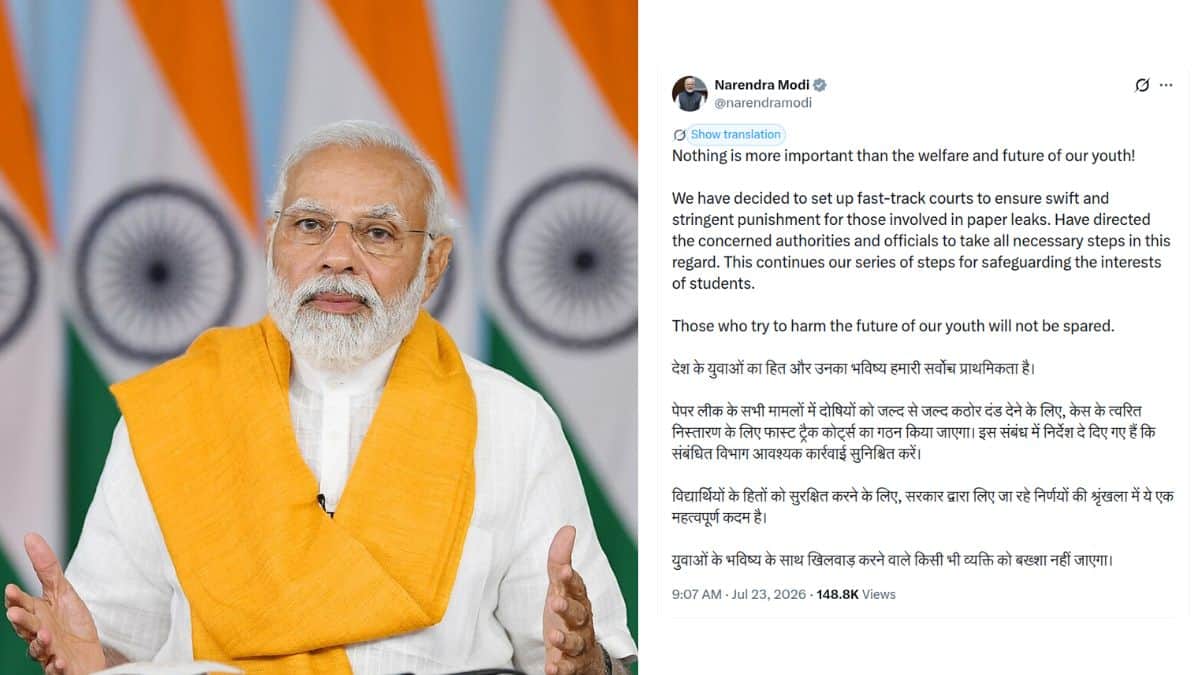
Prime Minister Narendra Modi has announced that fast-track courts will be set up to ensure the speedy disposal of National Eligibilitu cum Entrance Test (NEET) paper leak cases and stringent punishment for those found guilty. In a post on X, the Prime Minister said the decision is aimed at safeguarding the interests of students and protecting the future of the country's youth.
He added that the concerned authorities and officials have been directed to take all necessary steps to establish fast-track courts for the swift disposal of paper leak cases. The post reads, "We have decided to set up fast-track courts to ensure swift and stringent punishment for those involved in paper leaks. Have directed the concerned authorities and officials to take all necessary steps in this regard. This continues our series of steps for safeguarding the interests of students."
Also read CJP Protest latest update: 16 Delhi Metro stations closed; Wangchuk sets condition to end fast
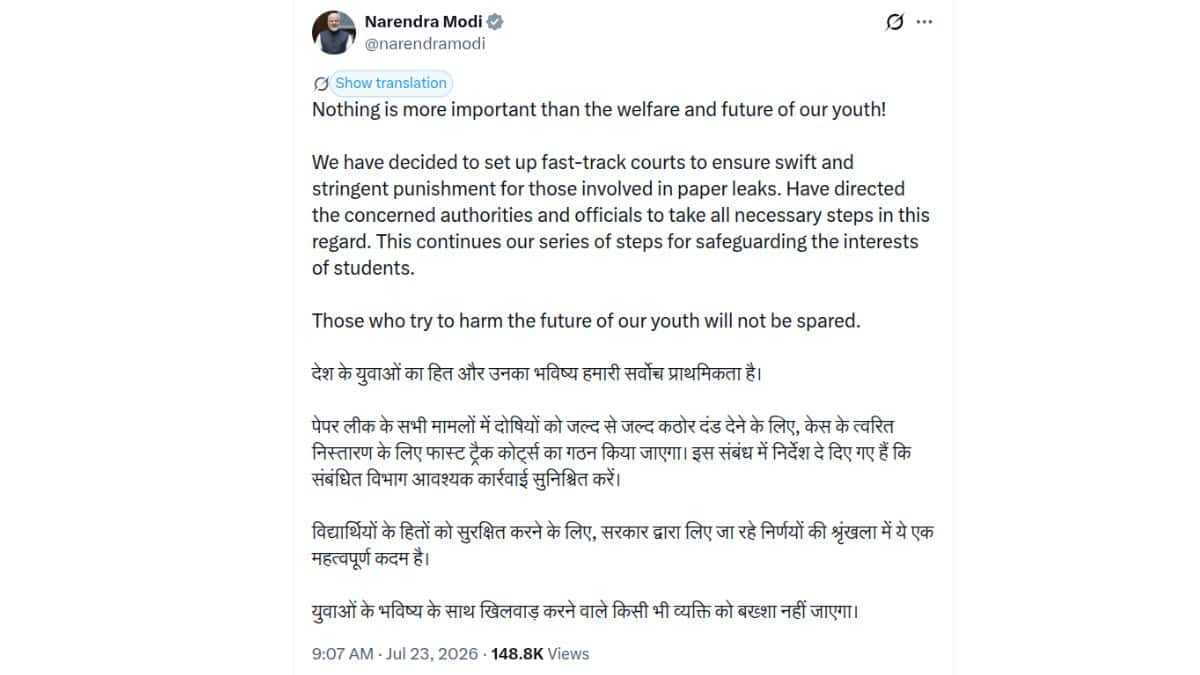
"Nothing is more important than the welfare and future of our youth!" Modi said.
PM Modi asserted that those responsible for harming the future of young people would face strict action. "Those who try to harm the future of our youth will not be spared," he said.
However, the post has drawn widespread reactions across social media, including criticism and hateful remarks.
Paper leak issue dominates Parliament
The announcement comes amid nationwide protests over irregularities in competitive examinations, particularly NEET paper leak. Student groups and opposition parties have been demanding greater accountability in the examination system and stricter action against those involved in paper leak cases for over 40 days now.
NEET paper leak issue has also dominated the ongoing Monsoon Session of Parliament, with the opposition urging the government for a discussion on examination reforms and accountability. Not only at Jantar Mantar, but the paper leak triggered protests in several parts of the country, with demonstrators seeking systemic changes to safeguard students' interests.
On July 22, Nationalist Congress Party (Sharadchandra Pawar) chief Sharad Pawar met Prime Minister Narendra Modi and discussed students' demands regarding NEET, along with issues concerning the education sector. Pawar later said the Prime Minister assured positive and concrete measures on the matters raised.
The statement comes two days after Rahul Gandhi, Priyanka Gandhi Vadra, Akhilesh Yadav and several opposition leaders staged a dharna outside Prime Minister Narendra Modi's residence over the alleged police action against protesting students. The leaders were later detained by Delhi Police after talks with government representatives remained inconclusive.
Sonam Wangchuk's strike continues
Meanwhile, Sonam Wangchuk's indefinite hunger strike entered its 25th day on July 22, with the activist having lost around 11 kg. Wangchuk said he would end his fast if the centre assures that no force, FIRs or punitive action will be taken against students participating in the Cockroach Janta Party (CJP)-led protest.
Currently admitted to Medanta Hospital in Gurugram, Wangchuk said he decided to continue his fast after the police action during the 'Chalo Sansad' march. He added that several Union ministers and 65 MPs have urged him to end the strike. In a letter to Union ministers J.P. Nadda and Jitendra Singh, Wangchuk also sought protection for protesters and said he would appeal for dialogue once the government provides the assurance. Opposition MPs also met him and promised to raise examination reforms and accountability in Parliament.
 Add as a preferred source on google
Follow us for the latest education news on colleges and universities, admission, courses, exams, research, education policies, study abroad and more..
To get in touch, write to us at news@careers360.com.
Next Story
]Latest Education News
]Related News
]NEET UG paper leak: RS panel for mechanism to ensure NTA's accountability to Parliament
Supreme Court rejects plea for independent probe into CJP-led Jantar Mantar protest
Students protest in Latur, accuse Dipke of leaving NEET struggle midway, moving on to other issues


