
Beyond Textbooks: How simulation labs in Tamil Nadu medical colleges are reshaping MBBS training
K. Nitika Shivani | July 20, 2026 | 12:47 PM IST | 6 mins read
MBBS students are learning to treat mannequins, read monitors, and make critical decisions in simulation labs at Tamil Nadu medical colleges, before they face real patients
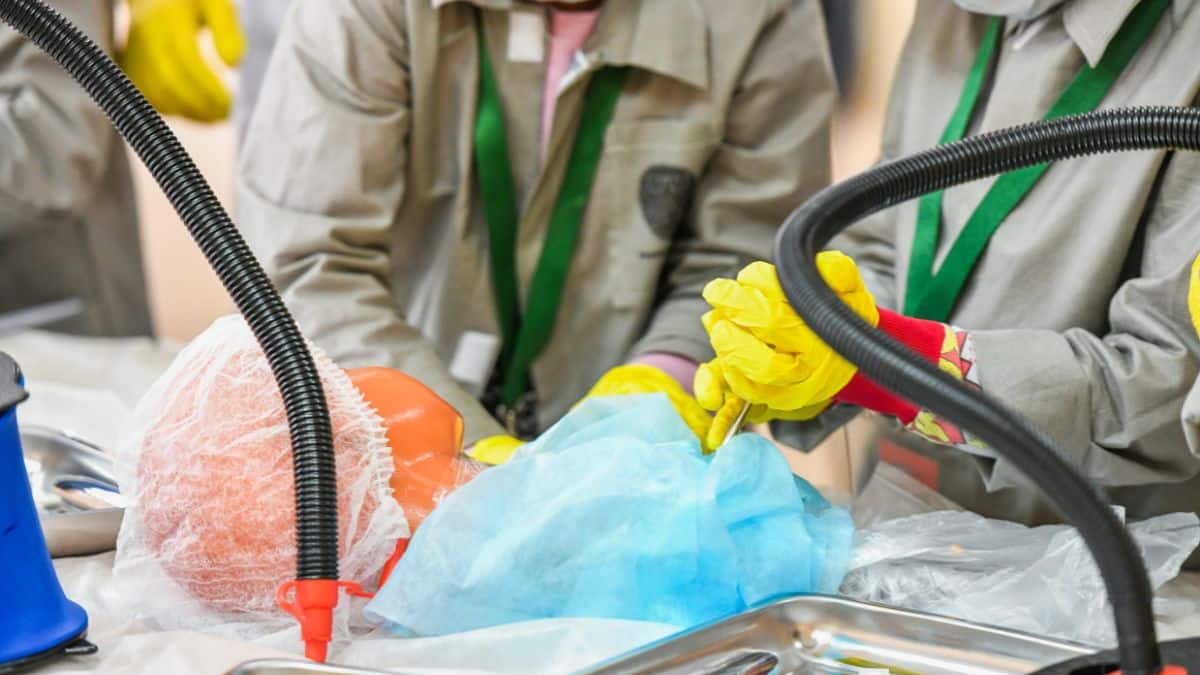
“Walking into the simulation lab for the first time felt completely different from a normal classroom,” said Krithika, a medical student in Chennai. “There were mannequins that could simulate seizures and cardiac arrest, ICU monitors, sonography systems, and laparoscopic surgery trainers. For many of us coming from smaller towns, it felt like we were finally stepping into the kind of modern medical setup we had only seen online or in videos.”
Medical colleges across Tamil Nadu are increasingly introducing simulation labs as part of modern medical training, with advanced mannequins, surgical simulators, ICU monitoring systems, and sonography modules becoming common across campuses.
While these labs are meant to move students beyond textbook learning and prepare them for real clinical situations, students and faculty members say there are still major gaps in how the systems are being used. From limited hands-on exposure and technical glitches to the challenge of adapting to machine-based learning for the first time, many say the transition into simulation-based medical education has been far more complex than expected.
For many students arriving from smaller towns and rural districts, these labs represent far more than infrastructure.
Many are first-generation medical students who moved to larger cities expecting exposure to advanced technology, practical training, and modern learning methods. For them, simulation labs are often seen as the bridge between theoretical medicine and real clinical confidence.
“The first time we entered the simulation lab, everyone was excited,” said Dharshini, a medical student who moved from a smaller town to Chennai to study in Sree Balaji medical college. “Most of us had only studied these procedures in theory before. Suddenly we were seeing machines that could simulate breathing patterns, pulse rates, oxygen drops, and emergency conditions in real time.”
Also read ‘At Regulatory Crossroads’: Psychology courses caught in UGC, NCAHP, RCI tangle, causing confusion
Simulation Labs: MBBS alongside machines
“Unlike traditional classrooms, simulation labs allow students to repeatedly practice procedures before handling actual patients, " said Darshini. “The mannequins can react to medications, display abnormal heart rhythms, and even mimic trauma responses. In theory, the system is designed to reduce fear among students entering clinical practice for the first time.”
She added, “A lot of students come from backgrounds where learning was mostly textbook-based. So when you suddenly enter a highly technical setup, there is excitement but also confusion. You are not only learning medicine anymore — you are also learning how to work with machines.”
Students say one of the biggest challenges is understanding how technology and clinical judgment work together.
“In one session, we were learning circulation-related emergency management during heart complications,” said a second year student studying in Bhaarat medical college and hospital, Chennai. “The mannequin’s pulse would change based on the treatment we gave. Oxygen saturation levels would fluctuate on the monitor. It felt very real. But at the same time, many of us were trying to understand both the medical concept and the software response together.” She said the experience was very different from memorising textbook answers.
“In theory classes, you write what happens during cardiac distress,” she explained. “Here, you have to think quickly, observe the monitor, communicate with teammates, and decide what to do next. That pressure is completely new for many students.”
Virtual Lab Simulation: Pressure of precision
Students practicing sonography said simulation-based imaging sessions were equally overwhelming initially.
“People think ultrasound practice is just moving a probe,” said Nithin Dhamu (name changed) studying in SRM Medical College. “But when you actually start learning, you realise there is hand positioning, pressure control, image interpretation, anatomy orientation, and machine coordination all happening together.”
He described how even slight hand movement errors can distort images completely. “If the angle changes minutely, the scan disappears or becomes blurry,” he said. “Initially, students panic because they feel like they are doing everything wrong. But over time, repeated practice helps.”
Several students said simulation labs have helped reduce the fear associated with making mistakes. “In real patient settings, students are naturally scared of making errors,” said Kripa Kathirvelan, a second-year student. “Here, at least you can fail safely and understand what went wrong.”
“Traditional stitching techniques were learned by watching senior doctors closely and practicing manually for hours,” said Arrjun Sundersesan, another student from Salem who moved to Chennai. “Now we also have digital surgical modules where you work using camera-guided tools. The coordination required is very different.”
According to him, simulation training has introduced students to techniques they may not have otherwise experienced early in medical education.
“The first time you try laparoscopic simulation, your hand movements feel completely disconnected because you’re operating while watching a screen,” he explained. “It takes time for your brain and hand coordination to adjust.”
At the same time, students say there are some teething problems. Like any other new technology, simulation labs have their own set of issues. Software freezes, delayed mannequin responses, calibration issues, and system shutdowns sometimes lead to class interruptions and students have to wait for technical resets.
Also read From IIT Madras to Kharagpur: Why top engineering colleges are now teaching biomedical sciences
Simulation Labs: MBBS teachers learning too
Faculty members admit that teachers are also adapting alongside students.
“Medical education for decades was centred around bedside observation and direct patient interaction,” said Kamala, a faculty member in Chennai who recently shifted colleges to teach in Karaikudi. “Now teachers are expected to understand software systems, scenario programming, simulator controls, and digital teaching methods. It is a transition for us too.”
Some senior professors acknowledged that many educators themselves were never trained through simulation-based systems during their own medical education.
“There are experienced clinicians who are excellent in practical medicine but are still learning the technological side of teaching,” said Jithendran. “Students today expect clarity not only in medical concepts but also in operating advanced systems.”
Faculty members say simulation labs demand much more preparation than ordinary practical sessions. Emergency scenarios need programming, systems require calibration, and sessions must be planned in detail beforehand.
MBBS Courses: Traditional medicine, technology
Kurup, a senior professor from Chennai who has over decade experience in the field and has also worked in NGO’s to help students learn basics of life saving techniques in cases of emergency, said while simulation systems appear impressive during admissions and campus tours, the reality of learning medicine remains demanding.
“Once students start using them, they realise technology does not replace effort. Medicine still depends on observation, quick decision-making, clinical judgment, and deep technical understanding.”
According to him, the future of medical education lies in balancing traditional clinical exposure with technology-assisted learning.
“You still need bedside teaching, patient interaction, manual skills, and old-school surgical practice,” Kurup said. “At the same time, students must evolve with newer systems because modern healthcare is becoming increasingly technology-driven.”
“We are no longer learning medicine through theory alone,” said Sundersesan. “Simulation labs force students to think critically under pressure, communicate during emergencies, interpret machines, and make quick decisions at the same time. Even though there are still gaps in implementation, this kind of training is already changing the way future doctors are being prepared.”
“The learning part is difficult,” Sundaresan said. “But for many of us, this is the first time medicine actually feels real beyond textbooks, as it should be.”
 Add as a preferred source on google
Follow us for the latest education news on colleges and universities, admission, courses, exams, research, education policies, study abroad and more..
To get in touch, write to us at news@careers360.com.
Next Story
]Latest Education News
]Related News
]FT 2026 Rankings: IIM Bangalore takes 11th spot; SPJIMR, MDI, IMT join global top 25
CJP Protest: Delhi Police detain students, party leaders; some take shelter at Bangla Sahib
Delhi University facilitates financial support for faculty member's child with rare genetic disorder


