
Darjeeling Hills University will become a major institute in the region in less than 10 years: Comptroller
Pritha Roy Choudhury | September 5, 2026 | 12:10 PM IST | 6 mins read
Darjeeling Hills University plans specialised courses in tea science, tourism and Himalayan studies; expects new campus by 2027
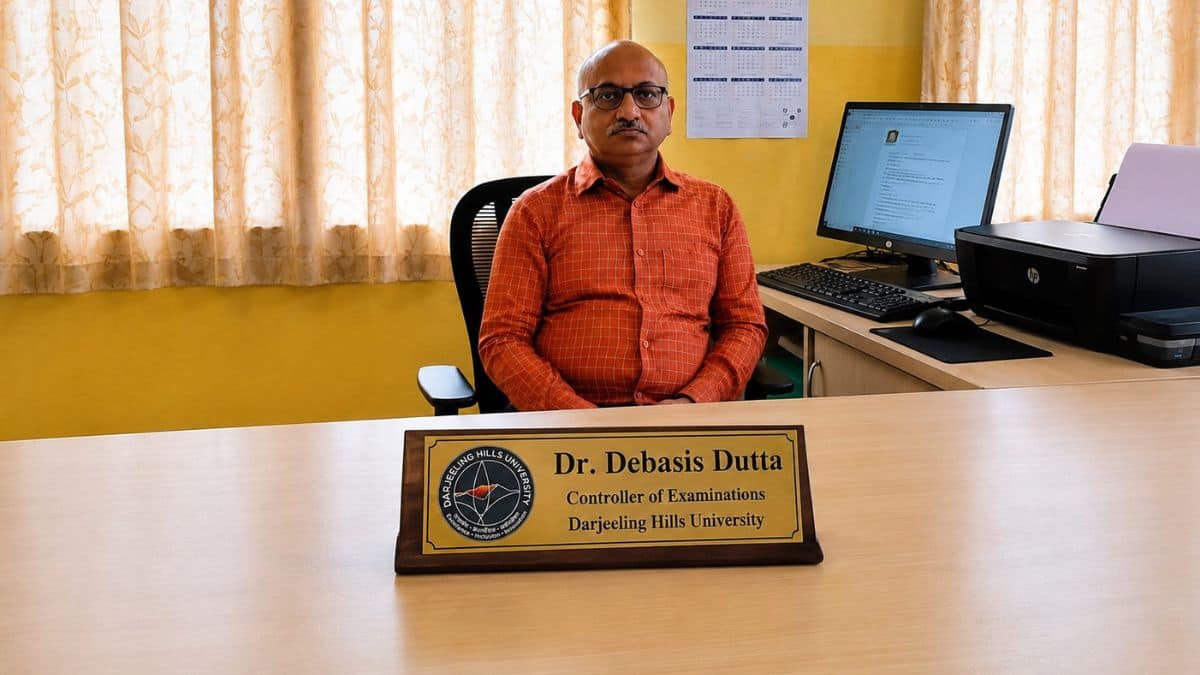
Darjeeling Hills University is gradually shaping up into a major educational institution for the hills, with plans for a permanent campus at Jogighat in Mongpu and the introduction of employment-oriented and region-specific courses in the coming years. Debasis Dutta, comptroller of examinations, speaks to Careers360 about the university’s functioning, future vision, infrastructure challenges, academic expansion, employment-focused initiatives and the overall goal of becoming a leading institution in the region. Edited excerpts:
Could you tell us about the present campus and share plans for the permanent one?
This is a government ITI [Industrial Training Institute] building and we will use it till the completion of the main campus which is coming up at Jogighat, just beside Sitong, in Mongpu. The construction is in progress; we want to start functioning from there from the next academic year, 2027–2028.
How many students and departments does the university have?
We currently offer six postgraduate programmes. We have six departments — Nepali, English, history, political science, mass communication, and mathematics.
We will be coming up with more departments. We want to introduce physics, chemistry, zoology, and botany. For that, we will need laboratories and more space, so we are waiting for the new buildings.
All colleges in the hills will also be affiliated to this university. We need infrastructure, which is now getting ready. Soon, we expect it to become a big university. We dream of making this university one of the major universities in the region. The residents of the hills are also looking forward to that. If that happens, employment opportunities will also rise.
Once the university at Jogighat comes up, the entire Sikkim region will also be connected academically.
How is the university different from other state universities?
Our statutes are yet to be approved by the state government. Once it is approved, it will become a full-fledged university and recruitment processes will also be completed. Presently, we do not have permanent faculty members.
We plan to offer a number of courses that are not taught in other universities. Many of these will be related to the hills and forests – Himalayan services, tourism services, tea management, tea science, and cinchona plantations. There will be good employment opportunities [for graduates].
We are trying to move beyond conventional subjects. We want to offer subjects as per current societal needs. This is our aim and dream.
What is the current condition of the university in terms of faculty and other facilities, like hostels?
At present, the university is functioning with 12 guest faculty members. We do not have permanent teachers. Apart from teachers from Darjeeling, many visiting teachers from other places are also associated with us.
As for hostels, we have started a private facility for girl students from this month. We currently have around 60 students, of whom nearly 40 are girls.
Ours is still a small campus, but we are doing well academically. We are not facing many problems and the students do not complain much. However, they do say they need more space and a bigger campus, which is understandable. We also have a well-equipped library and a canteen.
Did the university face issues with examinations?
No, we did not face any issues because when I was the comptroller of examinations at North Bengal University, I was also in charge of DHU. Results of both universities were always declared on time. The university examinations were never hampered. The only issue arose in 2023 regarding the admission process, but now things are fine.
Which new programmes are you planning to introduce?
The programmes we want to start on a priority basis, as soon as we get the new campus, are botany, zoology, and geography. We will start by offering short-term courses.
The courses we offer are not being offered by old or conventional universities. Zoology and botany, in particular, will have a number of specialised courses.
This is in line with the National Education Policy 2020. The UGC is advising us to introduce employment-oriented courses. Once different colleges get affiliated with this university, we will also start offering undergraduate courses.
We expect to have around 16-17 affiliated colleges, including one private college.
How are you managing the examination schedule considering the geographical challenges of the hills?
As per UGC instructions, examinations should be conducted in June and December. Our examinations for the second and fourth semesters start from May 25 because we want to complete them by June 20. Once the monsoon begins, landslides become a major issue in the hills. We will publish our results by July 31.
Also read West Bengal: After 10-year wait for school jobs, Lepcha teachers now unpaid for 3 months
Are you working towards campus placements for students?
Yes, definitely. Once we get the full campus, we will introduce various short-term courses and also establish a placement cell. Then campus placements will begin. This is another major ambition for the university.
We are waiting for the completion of the campus. We have high hopes that the new government will take the initiative to complete the campus at the earliest.
Though you formally took charge in 2025, you mentioned that you were associated with DHU since 2021, while working at North Bengal University. What has been the most difficult phase of your association with DHU?
I would say the most difficult part has been communication and connectivity problems. We have many paper-setters and moderators who have to travel regularly. Due to climatic conditions and the hilly terrain, we face difficulties. They travel till Bagdogra, and then it becomes difficult to reach Mongpu.
Also, there are no proper homestays or guest houses in Mongpu. We are waiting for the campus to come up because then we will also have a guest house. At times, we try to bring good faculty members, but we cannot because there is no proper place for them to stay.
Another issue is the constant financial crunch. We do not receive funds from the government as and when required. Other established universities have their own funds but we do not. Despite this crunch, I would say we are still providing the best possible services.
We also need more non-teaching staff. We currently have only six Group C and Group D employees. We have requested the government to help us with more. I hope these issues will be resolved soon. Things are getting delayed mainly because of space constraints, but we are doing our best.
Also read With no VC, teachers or campus, Darjeeling Hills University is dying a slow death
How do you see the future of the university?
We have been told that we will get the campus by 2027. Once we get the campus, the new academic session from July 2027 will begin.
I will definitely say that the university’s future is bright. Within less than ten years, it will become a full-fledged and major university in the country.
I congratulate the new government and the education department for their support, and I would also like to request them to provide us with good infrastructure and continued support for the university’s growth.
 Add as a preferred source on google
Follow us for the latest education news on colleges and universities, admission, courses, exams, research, education policies, study abroad and more..
To get in touch, write to us at news@careers360.com.
Next Story
]NCTE: Supreme Court makes annual appraisal reports must for teacher training institutes; overturns HC order
Supreme Court says regulatory powers like PAR are ‘ incidental and ancillary’ to NCTE mandate, dismisses colleges’ claim that only council – not its executive committee – could issue notice
Shradha ChettriLatest Education News
]Related News
]ABVP holds protest at DU against ‘anarchy’, backs democratic institutions
JNU VC acknowledged hunger strike for first time, but refused to speak to rusticated students: JNUSU
DU VC urges newly elected DUSU office-bearers to lead drug-free campus campaign


