
'Shut Down Malls, Close Roads Too': Telegram criticises re-NEET curbs; IIT Kanpur director backs move
Ruchika Kumari | June 17, 2026 | 12:54 PM IST | 4 mins read
Telegram CEO Pavel Durov has reacted to the re-NEET Telegram curbs, while experts remain divided over whether the restrictions will curb misinformation and malpractice.

Most Scoring Concepts for NEET 2027
Download the NEET Most Scoring Chapters and Topics PDF based on the past 5 years’ analysis. Focus on high-weightage topics and boost your NEET preparation.
Download EBook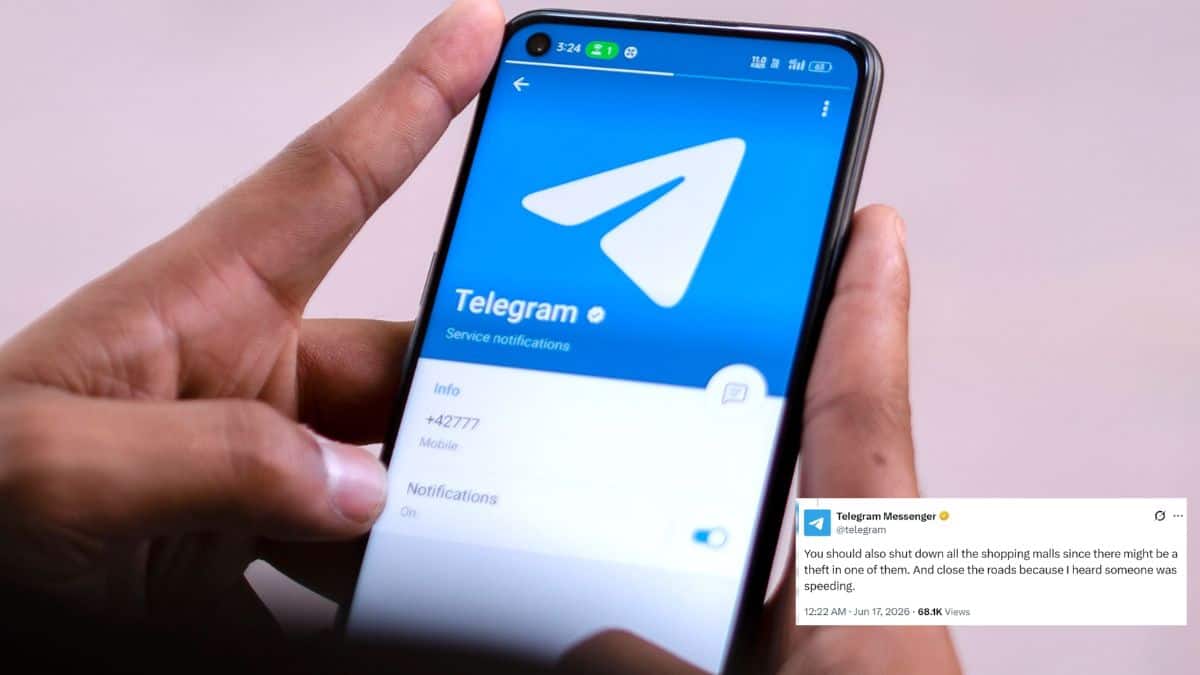
The Centre's decision to temporarily restrict access to Telegram ahead of the NEET UG 2026 re-examination has triggered a sharp debate among cybersecurity experts, students, education administrators and digital rights advocates. Some support the move as a way to curb misinformation, while others believe it is an excessive step that may not stop cheating.
The restrictions, announced ahead of re-NEET examination, include limiting access to Telegram in India until June 22 and disabling the platform's message-editing feature for already-posted messages until June 30. Exam conducting body, National Testing Agency (NTA) said the measures aims at curbing exam-related misinformation, fake paper leak claims and bust cheating rackets.
NTA Director General Abhishek Singh said authorities had not acted in response to any confirmed paper leak but due to the spread of fabricated messages that caused anxiety among candidates."We will not let anything go wrong. We will take all possible actions to ensure that the examination is conducted without any malpractice," Singh told PTI.
He said that fake messages claiming access to question papers were being circulated online, creating confusion and mental stress among students. He cited a recent case cracked by Ahmedabad Police involving the circulation of fake examination-related messages.
Also read 'Don't Delay It Further': Aspirants slam demand to postpone Re-NEET 2026
Ethical hacker questions effectiveness
The move, however, has attracted criticism from several experts. Nisarga Adhikary, the 19-year-old cybersecurity researcher who recently joined Indian Institute of Technology, IIT Kanpur's C3iHub after exposing alleged vulnerabilities in Central Board of Secondary Education's On-Screen Marking (OSM) system.
Replying to NTA's post on X, Adhikary posted, "Can't stop paper leaks..ends up blocking telegram..blocking telegram totally isn't even possible, telegram is designed in such a way which easily allows people to use proxies and other methods of circumvention."
Questing the effectiveness of restricting Telegram, Adhikary posted, "You don't even need a VPN to get around the Telegram ban. Telegram was literally built with censorship resistance in mind and has spent years operating in countries with far more aggressive internet controls than India. History has repeatedly shown that blocking a communication platform is far easier to announce than it is to enforce."
The issue also drew comments from Sarthak Siddhant, a student who gained attention during the controversy surrounding CBSE's OSM system. Siddhant criticised the restrictions, arguing that misinformation exists on multiple platforms and questioning why Telegram had been singled out.
Also read 'Three Attempts, Two Leaks': NEET aspirants open up on repeated uncertainty
Telegram's response spark fresh row
Mocking the restrictions, Telegram's official X account wrote, "You should also shut down all shopping malls since there might be a theft in one of them. And close the roads because I heard someone was speeding," suggesting that the government's response was disproportionate.
The controversy intensified further after Telegram CEO Pavel Durov alleged that competitors may have lobbied against the platform in India.
In a series of posts on X, Durov claimed that Reliance and WhatsApp could have been involved in efforts to restrict Telegram's operations. He also alleged that internet routing disruptions affecting Telegram users outside India may have been linked to a telecom operator associated with Reliance.
Industry sources strongly rejected the allegations, describing them as misinformation and claiming that Durov had confused Reliance Communications with Reliance Industries' digital arm, Jio. Sources noted that Meta's investment in Jio is a minority stake and does not give it operational control over the company.
Also read Telegram link to NEET, UGC NET paper leaks unsurprising: Experts
"Indian telecom Reliance is sabotaging access to Telegram for millions of users OUTSIDE India (including the UAE) via a rogue method called BGP hijacking. The sabotage seems intentional, as Reliance has ignored multiple reports. This may be part of a competitive war, as Reliance is partially owned by Meta, the company behind WhatsApp," Durov said in a social media post on X.
Meta has a small stake in the digital arm of Reliance Industries Ltd (RIL) -- Jio, while subsea cables are operated by another group, Reliance Communications, which is not part of RIL. Durov said network operators are advised to reject unauthorised BGP announcements from Reliance (AS18101) to prevent route hijacks and ensure stable Internet access for their users.
"Such abuse of global Internet routing is alarming. I wouldn't be surprised if Reliance/WhatsApp were also behind the recent lobbying effort to ban Telegram in India," he said.
IIT Kanpur director backs move
Responding to the criticism, IIT Kanpur Director Manindra Agrawal said the primary concern was not the sharing of leaked papers but the circulation of fake leak claims that appear genuine and can mislead students. According to Agrawal, a similar situation occurred during Joint Entrance Examination (JEE) Advanced when fabricated claims created unnecessary confusion among candidates.
He explained that Telegram's message-editing feature was particularly problematic because posts could be modified without clearly indicating that an edit had been made. Such functionality could be misused to create the impression that a question paper had been leaked before an examination.
Also read NTA, IIT Madras say vulnerability of Telegram was used to spread false paper leak claims
"The problem with Telegram channel is not sharing of leaked paper. There are many other ways of doing it. Rather, it can be used to spread fake news of leak that appears genuine," Agrawal said on X.
The Internet Freedom Foundation (IFF) also criticised the government's action, describing it as a disproportionate response to examination-related fraud.
The government has maintained that the restrictions are solely intended to ensure the smooth conduct of the NEET-UG re-examination, which is being held after the original May 3 examination was cancelled amid allegations of a paper leak.
 Add as a preferred source on google
Follow us for the latest education news on colleges and universities, admission, courses, exams, research, education policies, study abroad and more..
To get in touch, write to us at news@careers360.com.
Next Story
]Latest Education News
]Related News
]Maharashtra NEET UG counselling: 2 new medical colleges yet to join CAP-2026, 300 MBBS seats pending
Karnataka NEET UG 2026: KEA allows candidates without seats in stray round, extends choice filling to Oct 19
Maharashtra NEET Counselling: Pvt medical colleges move HC, want institute rounds of MBBS, MD admissions back


