
‘Decision-making at WBNUJS Kolkata was centralised, led to student protest’: VC on restoring trust
Pritha Roy Choudhury | January 16, 2026 | 05:42 PM IST | 5 mins read
NUJS VC on restructuring governance, appointing BSc LLB day scholars, retaining NIRF top-five ranking and NAAC A+ grade, expanding law courses and electives
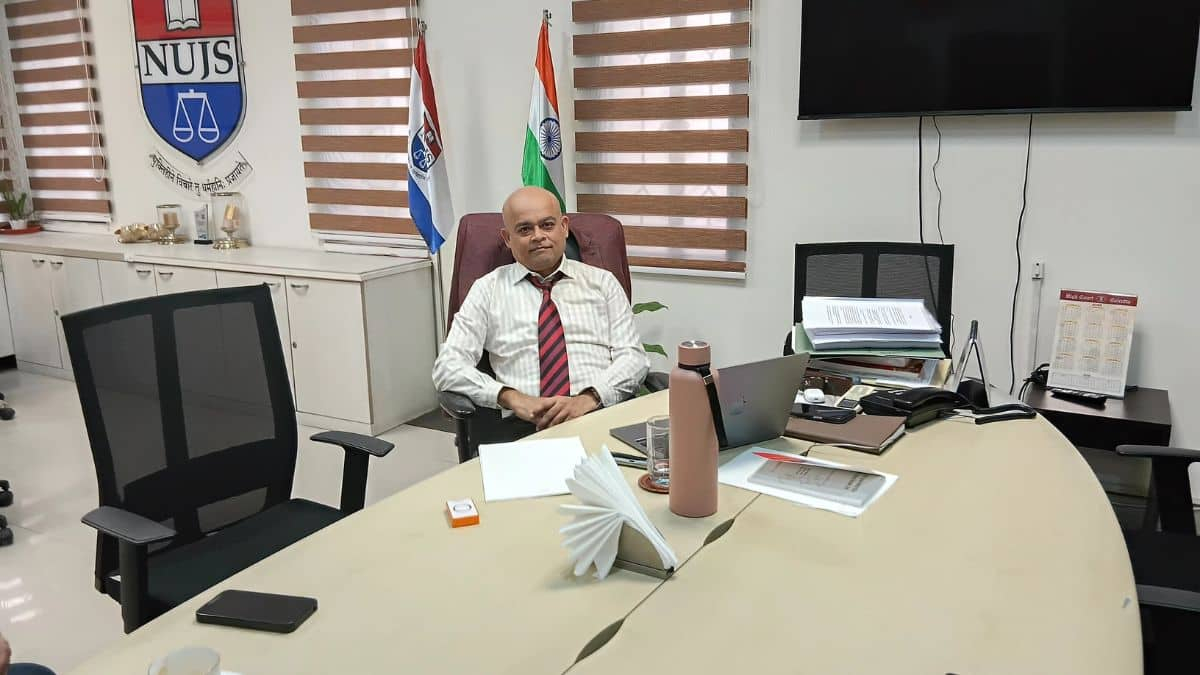
KOLKATA: O V Nandimath, the recently appointed vice-chancellor of West Bengal National University of Juridical Sciences (WBNUJS), in a conversation with Careers360, reflects on steering the institution through a phase of transition and renewal. Having assumed office amid recent unrest, he speaks about restoring trust, decentralising governance, strengthening the university’s finances, and addressing long-standing infrastructure challenges. Edited excerpts from the conversation:
You have taken charge of NUJS after a difficult phase for the university. What were your first priorities when you assumed office?
It’s an interesting question. I am just two months old after assuming the office as VC. To some extent, it was indeed a difficult time during which I had to assume office – particularly the NUJS student agitation which took place in the recent past. So, the first ever task was to understand the sentiments of students, faculty, support-staff and other stakeholders. After some interaction, I realised that there is a certain trust deficit among all of them. Therefore, I had to address the issue of restoring the ‘trust quotient’ among the WBNUJS community.
Naturally, to restore trust, communication is key; there are no superficial substitutes. Within a few hours of assuming office, I addressed the students, faculty and support staff. On January 1, 2026, I convened my first executive council meeting. All these have helped me reestablish the channels of communication, which I believe is the first step. The second is approachability. If my doors are open for everyone, that would help in not only understanding the challenges but solving them.
However, I do believe that it would take some time for people to realise that I do exactly as I say – before they trust me and accept me as their leader.
Also read Law schools slowly relax attendance rules as LLB students seek internships, flexible learning
What systemic or governance gaps contributed to the NUJS unrest?
For reasons unknown to me, decision making was centralised with the VC office. That was likely the main cause of student agitation. You can imagine, if the VC takes all first decisions, then appeals naturally go to the executive, creating transactional engagement. Also, decision quality suffers when the VC must decide everything. So, I had to delegate some powers.
So, I restructured the academic administration of the university using a simple principle – the VC shall be an appellate authority and not the first decision maker. Where I need to exercise plausible discretion, I shall be guided by the collective wisdom within the university, ensuring quality, consistent and well-reasoned decisions.
I appointed five deans for undergraduate studies, postgraduate studies, research, student and alumni affairs, and communication. And delegated all my routine regulated powers. When I need to make decisions, they are already vetted by the deans and I would only act as an appellate authority. This I believe is the way for developing a culture of collective ownership.
What steps are you taking to restore confidence among students and faculty?
Re-establishing trust is critical and that is the only way by which we can elevate institutional standards and quality. As I have said, communication is key. More than words, communication should be action oriented. That alone would build trust for days to come.
Recommencing regular faculty meetings was another step. The entire structuring of WBNUJS (vide its statute) is built upon faculty autonomy and ownership. To harness that sentiment, faculty meetings are crucial. Even the first ever NLS in Bengaluru, which was instrumental in starting the NLU culture in India, was built on the model of faculty autonomy and ownership. As a person who started his academic career in NLS Bengaluru and been there for nearly three decades – I know the criticality of faculty meetings.
In addition, having regular meetings of the governing bodies on strategic matters of growth is also critical. I am planning to have them regularly. Communication to the public is also another element and my deans’ council and faculty are working on it.
What is the current financial health of NUJS? How do you plan to improve transparency around finances and expenditure?
My initial assessment is that we are doing well to manage ourselves. We had a small deficit, which arose due to slow student fee collection and a few new courses that demanded investments before they could attain stabilisation.
However, an aspiring institution like NUJS has to have deeper pockets and financial independence to launch and reach international credibility. This can only happen by developing a strategic perspective plan to augment resources. This is an uphill task. But the beginning is made.
Infrastructure — especially hostels and academic facilities — has been a long-standing concern. What is your roadmap for addressing these issues?
Let me divide this answer into two parts. To immediately support NUJS’ academic combustion we will reach self-sufficiency once our current civil work gets over. In another three months we hope to add a sufficient number of classrooms for all our academic courses.
However, we do not have sufficient hostel facilities. Work to start construction on the additional small piece of land is underway. Until then, we have decided to recruit day scholars for our BSc LLB programme.
Also read CLAT 2026: NALSAR Hyderabad BA LLB (Hons) fee touches Rs 8.25 lakh; offers 132 LLB, 50 LLM seats
How do you plan to balance limited financial resources with infrastructure and academic needs?
All institutions today are in the same boat as they have to deal with limited financial resources. Gone are those days when higher education institutions relied entirely on state funding. The need of the hour is to innovate our methods of financing. Rationalising student fees is one quick-fix but every bit of increase would alienate deserving talent from accessing education.
Providing consultancy services, tapping CSR spend, bringing more endowments and research grants can be few other means by which we can augment resources. But this would take some time.
There were concerns earlier about shrinking electives and faculty capacity.
It’s not just a pool of electives, but the overall academic quality needs to be enhanced. The quality of legal education at WBNUJS is comparable to any other NLU in the country. Despite all the turmoil, NUJS ranked among the top five in NIRF. We were graded A+ by NAAC. There can’t be any better standards to indicate what I am stating confidently.
Having said that, we need to push the bar further and bring greater diversity and quality in our academic offerings. We have an optimal number of faculty to offer sufficient courses, including electives. I have already constituted a team to rationalise the workload. This would help us understand the need for more faculty.
How do you intend to institutionalise student participation in decision-making without allowing governance to become adversarial?
I must mention, student participation in decision making is one of the hallmarks of NUJS. Student Juridical Association (SJA), the student body is the greatest evidence of the same. I have included student representatives while we as deans’ council are deliberating upon various issues of policy, pertaining to student issues.
 Add as a preferred source on google
Follow us for the latest education news on colleges and universities, admission, courses, exams, research, education policies, study abroad and more..
To get in touch, write to us at news@careers360.com.
Next Story
]Latest Education News
]Related News
]SRFTI students allege power cut amid protest; institute defends disciplinary action
TGBIE finds 65 junior colleges in Telangana with fake fire safety certificates
IIT Hyderabad begins PhD admissions for January 2027 session; apply by November 10


