
Sowa Rigpa: India’s Tibetan medicine students must know the language before they treat patients
Azib Ahmed | July 6, 2026 | 01:00 PM IST | 9 mins read
Sowa Rigpa is as much about preserving a cultural identity as pursuing a medical degree. It is taught in Tibetan script, with a separate NEET exam, and recognised under AYUSH
“I realised later that this was connected to my own identity, tradition and culture. If our own generation does not study and preserve it, how will others understand it?” asked Tsering Lhamo, a final-year student of Bachelor of Sowa Rigpa Medicine and Surgery (BSRMS) at Central Institute of Higher Tibetan Studies, Varanasi.
Lahmo, 25, was talking about studying Tibetan medicine. For him, studying Sowa Rigpa was never about becoming a doctor but about preserving civilisation.
Raised in Ladakh in a Tibetan refugee family, Lhamo grew up in homes where traditional Tibetan medicines were part of everyday life long before modern hospitals became accessible to remote Himalayan communities. “In childhood, these medicines were already part of our homes,” she said. “For small illnesses and first aid, families often used Sowa Rigpa medicines first.”
Today, she studies at one of India’s seven institutions teaching Sowa Rigpa, the centuries-old Tibetan medical system now formally recognised under AYUSH and regulated through the National Commission for Indian System of Medicine (NCISM).
Across Ladakh, Dharamshala, Varanasi and other Himalayan regions, Sowa Rigpa is evolving from a tradition passed through families and monasteries into a more formalised medical education system shaped by NEET-based admissions and regulated curricula.
However, the National Eligibility cum Entrance Test (NEET) for this group – and only for this group – is entirely different. While the main NEET – for mainstream medical programmes and even some AYUSH ones – has been cancelled due to a paper leak, the NCISM-NEET-SR UG 2026 exam will be held on July 19. An official NCISM notification on May 1 said online registration will be open from May 25 to June 25. Results are expected on July 27.
For students and practitioners, the entrance process is another sign of how Sowa Rigpa is becoming part of India’s formal medical system. Yet inside classrooms and clinics, the system still remains closely tied to Tibetan language, Himalayan medicinal traditions and cultural identity.
Tibetan language
At the National Institute of Sowa Rigpa (NISR) in Leh, Ladakh, assistant professor Stanzin Kunphel described the system as unique among Indian medical courses because teaching still happens entirely in Bhoti, the Tibetan script used across Himalayan Buddhist communities.
Students cannot simply qualify through science subjects alone. To enter the programme, they must already have studied Bhoti in school. “If a student knows the language and clears the NEET examination after Class 12th, they can take admission,” Kunphel explained.
The language barrier continues to define who can study the system. Most students come from Ladakh, Arunachal Pradesh, Sikkim, Tibetan refugee communities and other Himalayan regions where Tibetan language education exists in schools and colleges.
“The difficult part was not only science subjects. The entrance exam also had Tibetan grammar, essay writing and language sections,” said Lhamo.
For many students outside Himalayan regions, that requirement becomes an obstacle impossible to cross.
Sonam Chuskit, a first-year BSRMS student at the National Institute of Sowa-Rigpa, recalled how one student from her batch dropped out because she had not studied Bhoti in school.
“She left because she did not know the language perfectly and faced difficulty in understanding," Chuskit said. “Now she is learning the Tibetan language and preparing to appear for the NEET exam again.”
Sowa Rigpa: Family to medical institutions
For centuries, Sowa Rigpa survived through oral traditions and hereditary learning systems. “Earlier, fathers taught their sons at home. Knowledge passed through generations or through gurus,” Kunphel said.
That structure is now rapidly changing. “Today, students are getting that knowledge through institutions,” he added.
Kunphel himself studied at the Central Institute of Buddhist Studies (CIBS) in Leh, where Sowa Rigpa is taught alongside Buddhist philosophy, sculpture, painting and traditional Himalayan disciplines.
The Sowa Rigpa course combines classroom study with clinical and practical training over five and a half years. Students learn subjects including pathology, diagnosis, medicinal plants, pharmacy and patient care, along with how traditional medicines are prepared.
“Students learn how to prepare medicines themselves, including powders, decoctions, pastes and syrups,” Kunphel said. “After completing the course, they know how to make medicines independently.”
Tibetan Medicine: A separate NEET
One of the biggest shifts came after 2020, when admissions began moving toward NEET-linked entrance systems under AYUSH and NCISM regulations. Before that, admission was through entrance examinations conducted separately by individual institutes.
Phuntsog Tsering, assistant professor at NISR, said the new examination system has changed how students approach the field. “Students prepare more now. Their interest and commitment have also increased,” he said, describing the shift as a major sign of professionalisation of Sowa Rigpa education.
Admission tests today cover PCB subjects – physics, chemistry, biology – along with Tibetan language and questions related to Sowa Rigpa history and basics. Unlike standard MCQ-based NEET patterns, the examination also asks for descriptive written answers.
Despite growing recognition, student numbers remain small. The Leh institute admits around 10 students per batch, and several institutions still struggle to fill all seats.
“There are only about 15 students in one class,” said Ngawang Soepa, principal of Men-Tsee-Khang (Sowa-Rigpa Medical College & Hospital) in Dharamshala. “Because teaching is in Tibetan, many students do not come here.”
At the heart of Sowa Rigpa education lies a classical medical text known as the “Four Tantras” or “Gyud-Zi.” It includes anatomy, physiology, diagnosis, disease studies, medicinal plants, diet, therapies and preparation of medicines.
The text explains the entire medical system, covering pathology, diagnosis, diet, lifestyle and treatment. Spread across 150 chapters, it forms the foundation of the entire course.
“There is basically one core text, but different teachers teach different chapters over the years,” Lhamo said. “A lot of it has to be memorised.”
Students begin with Tibetan grammar, foundational literature and Sowa Rigpa history. “In the first year, we studied how Sowa Rigpa developed, who the great physicians were and what books they wrote,” Chuskit said.
Understanding of disease
Sowa Rigpa practitioners say their understanding of the human body differs from both modern medicine and Ayurveda. Kunphel compared Ayurveda’s “Vata, Pitta, Kapha” framework with Sowa Rigpa’s own concepts of Lung (wind), Chiba (heat) and Badkan (fluid).
Lhamo said the system sees the body and nature as closely connected. “We see the body and the outer universe as connected,” she said. “Disease happens when the elements inside the body become imbalanced.”
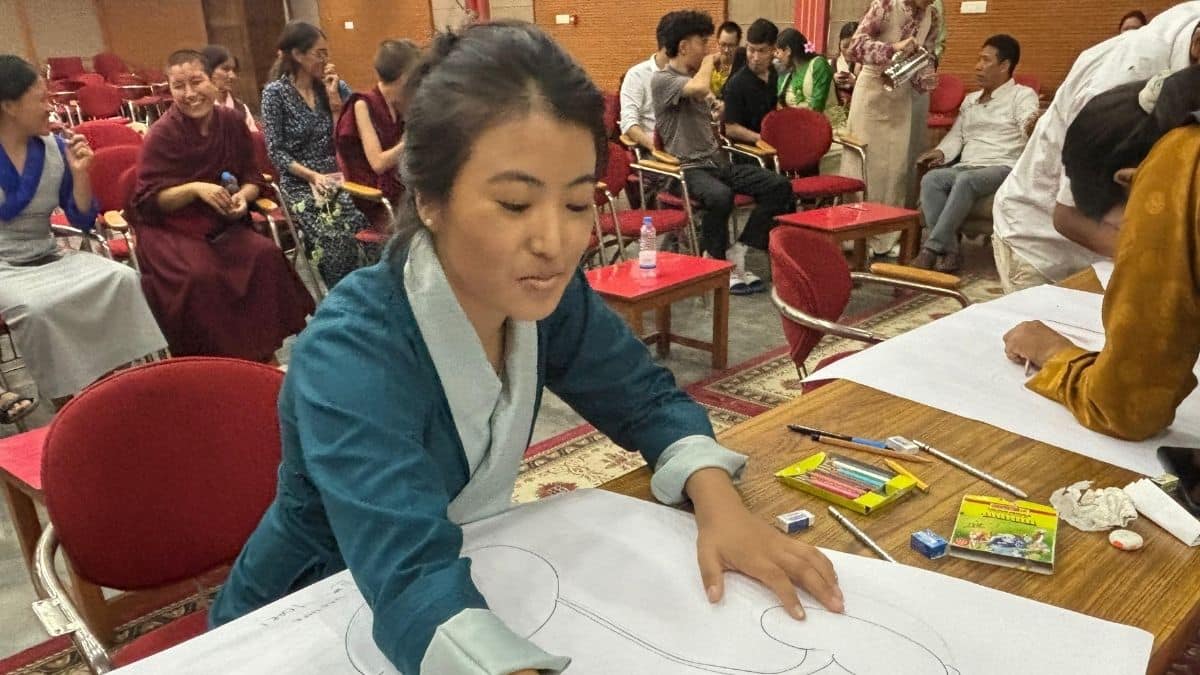 Tsering Lhamo, a final-year BSRMS student at the Central Institute of Higher Tibetan Studies, Varanasi. (Image: By special arrangement)
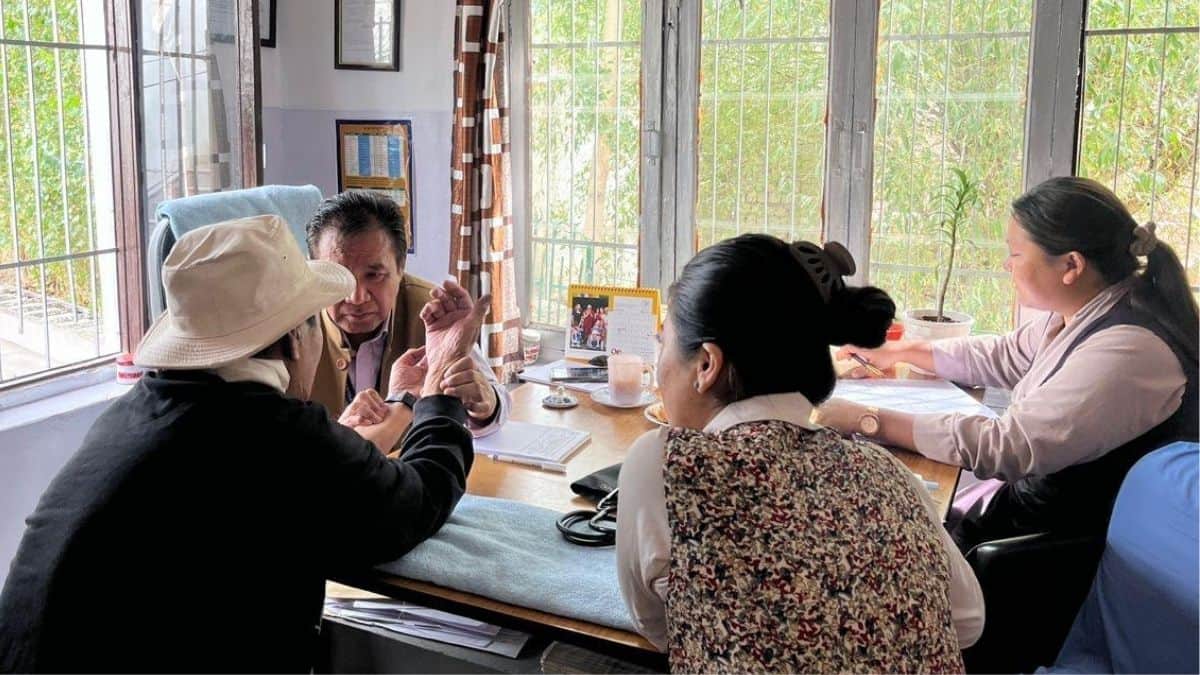
The methods of diagnosis are also different. “I was interested in how doctors can diagnose disease through pulse examination,” Chuskit said, describing what first drew her to the field. “We analyse urine, eyes, tongue and pulse. Most students outside Ladakh do not even know this system exists.”
According to faculty members, Sowa Rigpa medicine depends heavily on Himalayan herbs collected from Ladakh and nearby mountain regions. “Earlier, families collected herbs themselves from the mountains and prepared medicines at home,” Kunphel said. “Now companies are involved.”
As part of practical training, second-year students go on field visits to Ladakh and Himachal Pradesh during July and August to study medicinal plants in their natural habitat.
“Teachers show us medicinal plants, explain their potency and teach us how plants are detoxified before use,” Chuskit said.
Students also learn scientific names, medicinal properties and traditional medicine preparation methods as part of the course. “Some herbs are endangered species and require forest permissions before collection,” Chuskit added.
Although the degree is officially called Bachelor of Sowa Rigpa Medicine and Surgery (BSRMS), students say practice focuses far more on preventive care and therapies than surgical procedures. “In earlier times, there were surgical concepts,” Lhamo explained. “But now the focus is more on medicines, therapy, diet and lifestyle treatment.”
Agreeing to this, Chuskit said, “Surgery exists mostly in theory now,” she said. “Open surgery is not really practised.”
Students said treatment usually begins with diet and lifestyle changes, followed by medicines and therapies such as acupuncture, cupping, massage and moxibustion.
Also read NEET Exam: Why more women qualify, top the lists, but still can't make it to AIIMS
AYUSH recognition
Practitioners believe the biggest institutional breakthrough came in 2010 when the Indian government formally recognised Sowa Rigpa.
Kunphel said Himalayan communities themselves pushed for official recognition. “We requested the Indian government to include it within AYUSH, and in 2010 the government recognised it,” he said. The AYUSH ministry, however, came later.
Ngawang Dorjee, secretary of Men-Tsee-Khang (Sowa-Rigpa Medical College & Hospital), Dharamshala, said recognition brought legal and professional legitimacy to graduates. “The benefit of recognition is that any student with this degree has the right to establish a clinic anywhere in India,” he said.
At the same time, he stressed that Sowa Rigpa still functions as an independent medical system. “AYUSH is separate and Sowa Rigpa is also separate. We follow our own system and courses,” he explained.
Tibetan medicine coexisting with ‘allopathy’
Faculty members said Sowa Rigpa continues to be widely practised across Ladakh and other Himalayan regions alongside ‘allopathic’ – or, modern – medicine, with many primary health centres running separate OPDs for traditional medicine. “The patients who want traditional medicines can choose Sowa Rigpa,” Phuntsog added.
Practitioners say patients frequently seek Sowa Rigpa treatment for chronic diseases such as arthritis, hypertension, diabetes and long-term pain conditions. “Most chronic disease patients prefer traditional medicine because side effects are considered less in long-term treatment,” the faculty member said.
Emergency and acute conditions, however, are usually referred to modern hospitals.
Sowa Rigpa Growth: Institutions and jobs
On April 28, 2026, the Prime Minister Narendra Modi inaugurated the Sowa Rigpa Bhawan and a 45-bed Sowa Rigpa hospital at the Central Institute of Higher Tibetan Studies.
Students and faculty members see such developments as signs that the field is slowly expanding despite small batch sizes and language barriers.
“There is curiosity now,” Chuskit said. “People are beginning to see that Sowa Rigpa is not only traditional healing, but also a serious medical education and career option.”
Graduates today can work as medical officers, researchers, professors, therapists or entrepreneurs in wellness and herbal medicine industries. “There are opportunities to become medical officers, researchers and entrepreneurs,” Chuskit said.
She also said there is growing international interest in traditional wellness systems, adding that there are opportunities outside India as well. “At institutes in Sarnath and Leh, hospitals, therapy centres and academic buildings are steadily expanding,” she said.
However, students and faculty believe awareness remains largely confined to Himalayan communities. “A lot of students still do not know about Sowa Rigpa,” Chuskit said.
Matter of identity
Sowa Rigpa today is not simply about alternative medicine. It is about how an ancient Himalayan knowledge system is trying to survive in the modern world without losing its language, philosophy or identity.
The institutions may be modernising, but for many students, the mission remains deeply cultural.
For Tsering Lhamo, the future of Sowa Rigpa is ultimately tied to whether younger generations continue carrying it forward. “If our own generation does not study and preserve it,” she said, “then how will others understand it?”
 Add as a preferred source on google
Follow us for the latest education news on colleges and universities, admission, courses, exams, research, education policies, study abroad and more..
To get in touch, write to us at news@careers360.com.
Next Story
]Latest Education News
]Related News
]JNU Sexual Harassment Row: Bimol Akoijam to challenge dismissal, file case in 1-2 days
Kerala, UP declares school and college closure on October 19 for Durgashtami festival
Calcutta University Decentralised Counselling 2026: Round 1 registration open for 148 BTech vacant seats


