
‘IIM Ahmedabad Dubai is the brand ambassador of Indian education system in UAE’: Dean of new campus
Sheena Sachdeva | December 19, 2025 | 01:14 PM IST | 10 mins read
IIMA Dubai campus – with its first batch of 35 students, USD 80,000 one-year MBA fees, and start-up incubation focus – aims to create job creators; admission is via GMAT, GRE
.jpg)
Indian Institute of Management (IIM) Ahmedabad launched its first international campus in Dubai in September 2025. It had started with only a one-year MBA course and two centres focussing on case study writing and entrepreneurship. Sunil Sharma, dean, IIMA-Dubai spoke with Careers360 about the new campus, internationalisation of IIMs, education as soft power in geopolitics, and much more. Edited excerpts:
Envisioned in 2023, the IIM Ahmedabad Dubai campus was launched in 2025. What was the process?
The Dubai campus is a product of the joint vision of the two governments – India and Dubai. This vision took almost a year, but we were able to scale it up rapidly with tremendous support from all the stakeholders. These conversations began around February-March 2024 and by September 2025, the campus was up and running.
We launched IIM-A Dubai with a one-year full-time programme admitting 35 students. We started with a small batch keeping in with our unwavering commitment to quality. Students need a minimum of four years of work experience to get MBA admission, just like at IIM Ahmedabad. This degree does not offer specialisations, consistent with all IIM-A programmes.
Also, all IIM Ahmedabad graduates receive an MBA degree – whether from a two year programme or a one-year one. We want to produce managers who will one day become CEOs of their organisations. Great CEOs possess the attribute of being great generalists. We want our students to excel not in one but multiple functional areas.
Launching an international campus needs approvals, and our vision for IIM-A Dubai is to provide high quality programmes. There was strong consensus that MBA courses at IIM-A Dubai have to be of the same standard and same rigour as IIM Ahmedabad. So, now we have one institute and two branches – Ahmedabad and Dubai.
We had to organise things like subjects, courses and timelines. So for example, in Ahmedabad we follow the April to March cycle. But here in the UAE, we follow the September to August cycle, which is aligned with global business schools. Hence, we had to create timelines in terms, session and faculty members. This is one process. The second was that the campus had to be built and we received overwhelming support from the Dubai government.
Did you face any hurdles during the launch?
We did not. In fact, the speed at which the conversation and approvals happened – IIM-A’s faculty came together to design the programme and replicate the same for the Dubai campus – was unprecedented. From getting accreditation from the local UAE regulatory body to identifying a place for the campus – a team did everything together, including construction.
Initially, we were not confident that we would be able to launch in a year. But it happened. Everything happened so quickly, it could be a template or an example for other institutes. We also received immense support from the IIM Ahmedabad alumni and local support here in Dubai.
How do you ensure that both the Indian identity and the UAE culture are represented at the Dubai campus ?
The walls here are painted red, just like the brick structure at IIM Ahmedabad – the symbols and values for which IIM Ahmedabad stands for in terms of architecture, open spaces that are especially designed to encourage conversations, creativity and collaboration.
Hence, our architecture captures the essence and spirit of IIM Ahmedabad. We stand for high quality education, collaboration, and strong alumni. This apart, we also represent the values of the Indian education system – sincerity and prioritising education. In a way, we are the brand ambassadors of the Indian education system here in Dubai.
We are planning to invite local leaders to the campus who can share their perspectives about how organisations work in Dubai. We are also planning to initiate executive education with organisations here, which will result in knowledge and cultural spillovers, and sharing of best practices.
Also read 21 IIMs have less than 200 SC, ST, OBC teachers against 1,880 sanctioned posts despite quota law
The institute started with a one-year MBA course, two research centres, two centres of excellence – one for case study development and the other for start-up incubation. Why this mix?
There is a strong reason why, along with launching a one year MBA programme, we have started a center along with IIMA Ventures, Center for Entrepreneurship, and also Center for Writing Case Study.
During the inauguration, education minister Dharmendra Pradhan had mentioned that he sees IIT Delhi and IIM Ahmedabad as a bridge between two nations — India and UAE. IIM-A Ventures, which has been in existence for almost 20 years, has played an instrumental role nurturing a strong entrepreneurial ecosystem in India, especially in the area of deep-tech. Most marquee space-tech companies have been supported by IIM Ahmedabad.
Now through this, we want to create opportunities for Indian startups and connect them with the entrepreneurial ecosystem in the UAE. We also want to share some of the best practices around acceleration, incubation, investment, nurturing with the local ecosystem, and also learn from them.
The idea is that we connect with investors here in the UAE and create new market opportunities for Indian startups. We want to organise many such events not just for startups but also for other academic institutions who have university-based incubators. We want to bridge the entrepreneurial ecosystem of both the countries.
The reason we set up a centre for case writing is because we believe that management education requires strong contextual intelligence. In order to develop that, it is important for students to know how local companies work and what are the local cultural sensitivities. There are fascinating examples here in Dubai, including the remarkable speed at which the Dubai government works.
Many stories and examples exist in the local system which need to be documented. We want to document them and train our students with them. Further, we also want to disseminate those case studies through our case-study centre. It is not just about running a programme but about participating in the local ecosystem.
Through this centre, we want to organise workshops on learning pedagogy or on case method pedagogy, something that IIM Ahmedabad is known for. We want to share our expertise with others and improve the capacity of the local ecosystem.
Also read MBA Jobs: Capstone projects, case competitions become key placement tools amid hiring slowdown
How many students at the campus are Indian and how many of other nationalities? What is the fee structure?
The cohort comprises all Indian students, though some are Indians from UAE and US regions. There is a lot of interest in this region due to growth opportunities and a strong Indian community. For the first batch we have 35 Indian students, but going forward, we plan to have a more diverse cohort. Our objective is to build a global business school here.
The fees for the one-year MBA course is USD 80,000 and the selection process is the same as IIM Ahmedabad. People have to apply for GMAT or GRE, and then there is an interview panel.
During the initial cohort, we didn't get much time to market and within two months, we had to launch, get visas sanctioned and induct students. The advantage of having a strong brand like IIM Ahmedabad is you don't have to exactly market. So we just opened the applications, numbers came in.
But from next year, we want to get local students and those from other countries as well. We also offer scholarships ranging from 15-20% on need and case-to-case basis.
Currently, we don't have the breakdown data but going forward we aim to maintain this data following standard practices at any global MBA school. While it is possible to capture that kind of data from how many people from that state or country are coming, in the larger scheme of things, good GMAT or GRE score is the only criterion that matters. And as long as people satisfy that criterion, it does not matter which states or country they come from.
Is the curriculum different from what’s followed in the India campus?
The curriculum is exactly the same. Our one-year MBA programme has a component on core courses which includes functional areas like HR, strategy, organisation behaviour, marketing, operations, technology – exactly as at IIM Ahmedabad. Further, there is an international immersion programme similar to IIM-A. In addition, participants do an immersion at the Ahmedabad campus. There is a set of electives where students choose based on their preference.
The advantage of being in Dubai is the proximity of several successful multinational organisations. We intend to invite them to provide practical exposure and share their experience with our students. Sessions with CEOs bring the experience -based learning which is also a strong component of our offerings.
Any new courses in the pipeline?
We didn't have that kind of time to think about new programmes. We have been focussing on setting up campuses, processes, and creating great experiences for our students. Right now, discussions are at a high level regarding intent, vision and the path of growing forward – how all this fits into IIM Ahmedabad’s expansion and, broadly, the internationalisation of Indian education practices.
I'm sure if we do this interview, maybe after six months, I will have more granular information Right now, it is more at a big picture level.
How big is the campus at Dubai International Academic City? What facilities are offered?
Since it is a government-to-government relationship, there are processes which automatically become great enablers. We are enjoying the same status, processes, structure and privilege as IIT Delhi Abu Dhabi. However, we have a three-floor separate transit campus in the academic city provided by the Dubai government. In the next three to four years, we plan to have a full -fledged campus here.
We have a well -functioning campus with enough classrooms which are digitally equipped. The campus is beautiful. Each classroom has around 60 seats. We also have seminar halls and flat classrooms used in experiential learning subjects and courses. We also have theater-style classrooms. We have enough open spaces for students' interaction, joint preparation and group study and enough offices for our faculty. We also have a library.
Currently, we have much more space than required – four to six times of what is needed.
Also read IIFT Plans: Dubai campus as ‘international platform’, AI in MBA courses, improving placements
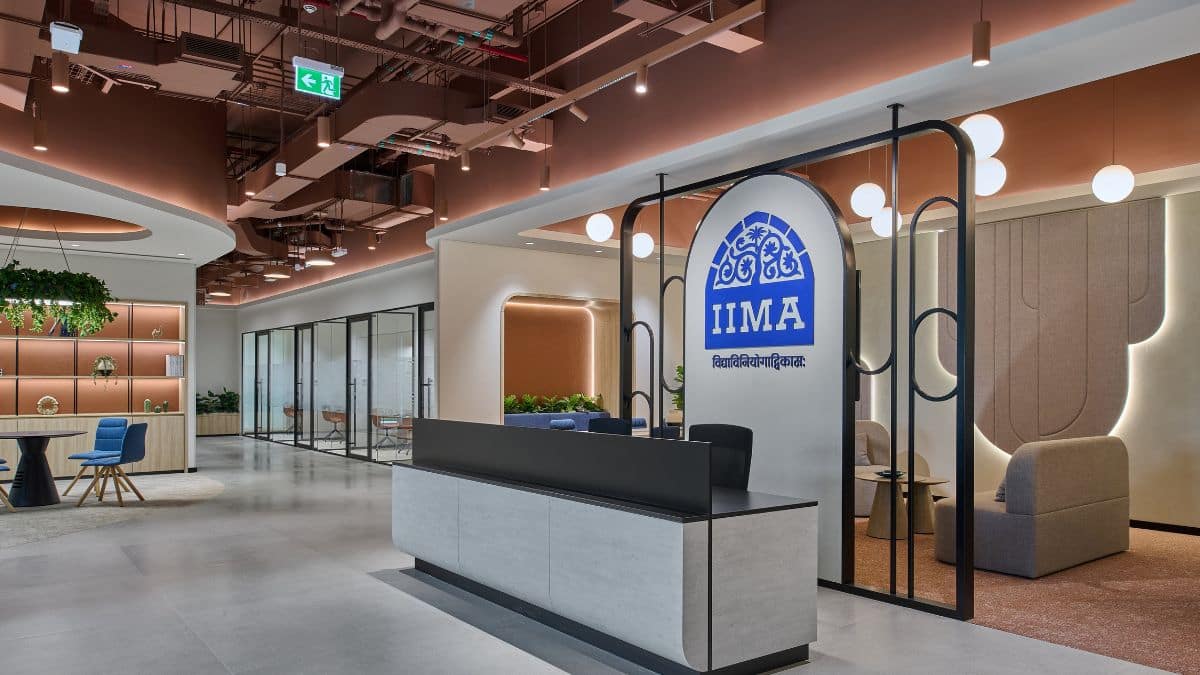 Indian Institute of Management- Ahmedabad Dubai Campus
How will the case study and start-up centres function?
One of the key objectives of IIM Ahmedabad is to make our students job creators, not just job seekers. More than 100 unicorns (a tech start-up valued at USD 1 billion or more) from India are from IIM-A. We want to create the same kind of imprint and skill building for our students at the Dubai campus. So, the reason to set up the Center of Entrepreneurship is not just to create the bridge between the two countries, but to offer courses and workshops for students outside. We also have a course on launching a startup in IIM-A and we want to offer a similar one here in Dubai.
The synergy between the programme and Center for Entrepreneurship is through IIM-A Ventures. Further, there is strong synergy between this centre and the Center for Case Writing. If we are preparing our students to take up roles in this region, they need to know about the organisations and their culture here. Therefore, we plan to write more case studies – not just for the UAE but also for the Gulf Cooperation Council (GCC).
Are faculty moving from the Indian campus or will new faculty be hired?
As of now, all the faculty members are flying in from Ahmedabad for sessions. The cities are just two hours apart. Faculty from Ahmedabad campus come here for a week or 10 days, conduct their sessions and go back. However, we have permanently moved four faculty members from IIM Ahmedabad to Dubai.
We plan to hire aggressively as we plan to launch new programmes – both in Ahmedabad and Dubai. But whoever is hired at either campus will teach in both Ahmedabad and Dubai.
What other courses or collaborations are in the pipeline?
As of now, we do not have any formal collaboration. It's just been a few months. But going forward, we definitely want to explore such opportunities.
How do you plan to market your courses?
The initial support from the government has been overwhelming. People compare IIM Ahmedabad with INSEAD and New York University’s Stern School of Business (NYU Stern). Hence, we are in the same league.
We are already seen as a high quality management institute. I hope the Dubai campus also creates the right kind of buzz among locals and students from different nationalities.
Also read ‘IIM Calcutta’s new programmes to include 40% AI-based content’: Director
We also want to do consulting and executive education for organisations and hopefully this will create the right reputation in the times to come.
IIM Ahmedabad never had to market itself because we gradually built our brand. Even for the Dubai campus, we are not in a hurry as it already has a strong buzz. We don't aim to market through conventional agents.
 Add as a preferred source on google
Follow us for the latest education news on colleges and universities, admission, courses, exams, research, education policies, study abroad and more..
To get in touch, write to us at news@careers360.com.
Next Story
]Latest Education News
]Related News
]PM Modi visits Sudha Gopalakrishnan Brain Centre on IIT Madras campus
IIIT Ranchi first-year BTech student dies by suicide, NHRC to probe alleged delay in medical treatment
SFI Mumbai condemns police ‘brutality’ against students, activists during anti-SIR protests, demands inquiry


