
Jadavpur University civil engineer’s work on vernacular architecture and climate resilience wins plaudits
Pritha Roy Choudhury | March 16, 2026 | 02:46 PM IST | 6 mins read
Cyclone Amphan pushed Aritra Majumder to study traditional building methods and climate change. A PhD scholar at JU, his work has already won international recognition
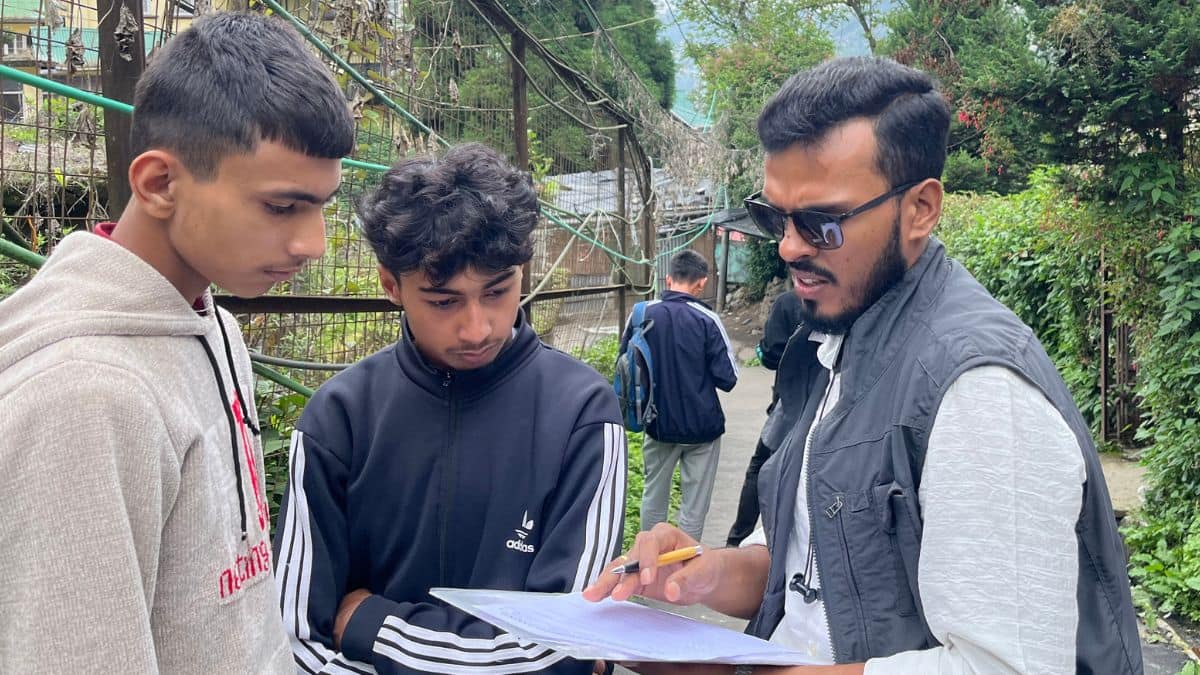
Witnessing the destruction caused by the Cyclone Amphan pushed Aritra Majumder, a senior research scholar at Jadavpur University, to rethink how homes are built. His research explores vernacular architecture and traditional construction techniques as sustainable, disaster-resilient housing solutions.
By studying locally-sourced materials and climate-responsive design, Majumder highlights ways to reduce carbon emissions while improving resilience in disaster-prone regions. His work has gained international recognition – he has published in highly-regarded journals and participated in conferences abroad.
The 2020 Cyclone Amphan devastated large parts of India’s east coast. Villages in the coastal belts of West Bengal had lost almost everything overnight. Homes simply vanished.
For Majumder, a senior research scholar at Jadavpur University’s civil engineering department, the experience marked a turning point that shaped his research career. With Amphan’s impending landfall, he went to the coastal town of Digha. Cyclones are increasing in both frequency and ferocity due to climate change; Majumder was “curious”.
Once it passed, he went travelling along the coast to see the damage it had left in its wake. What he saw was sobering.
“When we entered the coastal regions of Sundarban and Medinipur, people who had slept in their homes the previous night were suddenly homeless,” Majumder recalled. “The villagers could not even identify where their houses had once stood. That moment made me feel something had to be done.”
Majumder is in the process of finalising his doctoral thesis in civil engineering and is preparing to submit it within the next few months. His research focuses on a subject he believes could play a critical role in tackling climate change and disaster resilience: vernacular architecture.
Also read Experts propose 7 spots for university townships in education ministry’s post-budget webinar
Social initiatives at Jadavpur University
Cyclone Amphan occurred in the midst of another crisis – the Covid-19 pandemic. The pandemic, which claimed millions of lives globally, was where Majumder started participating in social initiatives. He was part of the Quarantined Student Youth Network (QSYN), started at Jadavpur University, which coordinated efforts to assist students stranded in different parts of the country due to travel restrictions.
“There was no political involvement. Students from many universities came together simply to help people,” Majumder said. “I was one of the organisers of the initiative.” He was also part of efforts to organise community kitchens with donations from across the world.
Majumder, a civil engineer by training, began to reflect on how infrastructure could help people survive natural disasters.
Climate change, he said, has increased the frequency of extreme weather conditions. “Earlier, such disasters were rare, perhaps once in a decade,” he explained. “Now they are happening much more frequently. The main reason is global climate change.”
Determined to contribute solutions through engineering, Majumder spoke to professors and senior researchers in the civil engineering department at Jadavpur University.
In 2021, while pursuing postgraduate studies, he began focusing on research related to sustainable construction and environmental responsibility — an area closely aligned with the United Nations Sustainable Development Goals.
One of the central goals guiding his work is the concept of ‘net zero carbon’, which aims to reduce carbon emissions to just balance out the amount removed from the atmosphere.
UN SDG: Vernacular architecture solution
Majumder’s research centres on vernacular architecture — traditional building methods developed by communities using locally-available materials and indigenous knowledge.
Unlike modern construction, vernacular structures are typically built without the involvement of professional architects or engineers, Majumder said.
Across India, these structures vary widely depending on geography and climate, such as
- In northeastern India, houses are often built on stilts
- In rural Bengal, mud houses, bamboo structures and thatched roofs are common
- In Kashmir, houses may be constructed with heavy stone materials
- In Himalayan regions, wood and stone combinations are often used
“These buildings are created through traditional knowledge passed down through generations,” Majumder explained.
Modern development has often replaced such structures with concrete housing models that may not always be suited to local environmental conditions.
Reducing carbon emissions
To examine the sustainability of traditional architecture, Majumder conducted a life-cycle assessment comparing vernacular buildings with modern low-cost housing.
The study also compared traditional structures with houses built under the government’s housing scheme, the Pradhan Mantri Awas Yojana.
The findings, he said, were striking.
According to Majumder’s research, carbon emissions from conventional low-cost housing can be three times higher than those of vernacular buildings.
“Vernacular architecture produces significantly less carbon emission compared to modern low-cost structures,” he explains.
His research suggests that traditional building techniques may offer valuable lessons for achieving a more sustainable and carbon-neutral future.
Vernacular Architecture: Just as stable
Majumder also examined whether these traditional structures could withstand environmental stresses.
Using a structural analysis software used globally, he tested the stability of vernacular structures against different load conditions according to Indian Standard codes for civil engineering.
The results showed that many of these structures can remain stable under various loads when properly constructed.
This challenges a common assumption that traditional housing is inherently weaker than modern construction, he said.
Field research across West Bengal
Majumder also conducted a “vulnerability study” across four different climatic regions of West Bengal – coastal, Ganga delta, plateau and hilly regions.
Majumder visited local communities across these regions to understand traditional construction methods. His work examines 17 different structural and environmental factors to evaluate resilience and sustainability. Fieldwork also involved discussions with local residents about how houses were built and maintained – mud-houses in Jaygaon village in North 24 Parganas and wooden structures in Kurseong, Darjeeling.
The findings again suggested that vernacular architecture performs surprisingly well in terms of both environmental sustainability and disaster resilience.
Research recognition
Majumder’s work has begun to attract international attention.
His research has been published in journals by Springer Nature, one of the world’s leading academic publishers.
In December 2025, he won an innovator award for his work in West Bengal, particularly for research conducted in the plateau region of Purulia district which has mud houses.
However, Majumder said the most meaningful recognition came when his research paper was published in an international journal. “For a researcher, publication in a reputed journal is even more significant than receiving an award,” he said.
He has presented papers at international conferences held within India – at Indian Institute of Technology (IIT) Bhubaneswar and Indian Institute of Engineering Science and Technology (IIEST) Shibpur.
His work has also connected him with scholars from more than 70 universities worldwide.
International collaboration
Majumder recently presented his research at the “Net Zero Future 2025” conference hosted by the University of Cape Town in South Africa.
Cape Town’s climate conditions are similar to parts of eastern India, making the region particularly relevant for comparative studies.
Following the conference, several researchers expressed interest in collaborating with him.
For now, however, Majumder’s focus remains on completing his doctoral thesis.
Alongside his research work, Majumder also teaches undergraduate and postgraduate students at Jadavpur University and collaborates with several research groups and laboratories.
As he prepares to submit his thesis, his goal is to expand his research and translate it into practical solutions.
“My first priority is to work in West Bengal, which is my birthplace,” he said. “Then I want to expand the work across India and eventually globally.”
He believes that vernacular architecture could become an important component in future climate-resilient housing.
Majumder also suggests the possibility of developing hybrid models that combine traditional construction techniques with modern engineering practices while using locally available materials.
Ultimately, he hopes policymakers will recognise the value of such approaches.
“If policymakers consider vernacular architecture seriously,” he said, “it could help us move toward a carbon-free nation and a more sustainable future.”
 Add as a preferred source on google
Follow us for the latest education news on colleges and universities, admission, courses, exams, research, education policies, study abroad and more..
To get in touch, write to us at news@careers360.com.
Next Story
]JEE Advanced 2026: Adaptive test questions ready; IIT Kanpur to pilot this year on own students first
IIT JEE Advanced 2027 will see the full rollout of the adaptive test – with dynamically generated questions – only after JAB approval; IIT Roorkee has okayed the 2026 trial run on IITK students
Sheena SachdevaLatest Education News
]Related News
]IIT Hyderabad begins PhD admissions for January 2027 session; apply by November 10
BITS Pilani revamps UG curriculum to prepare students for AI era: Vice Chancellor


