
Governor as Chancellor: Colonial-era role being used to ‘choke’ universities in opposition states
Musab Qazi | December 17, 2025 | 03:49 PM IST | 12 mins read
Not just VC appointment, tussle between governors and state governments impacts ‘routine matters’ in state universities, like teacher promotion, degree award, syllabus revision, exams
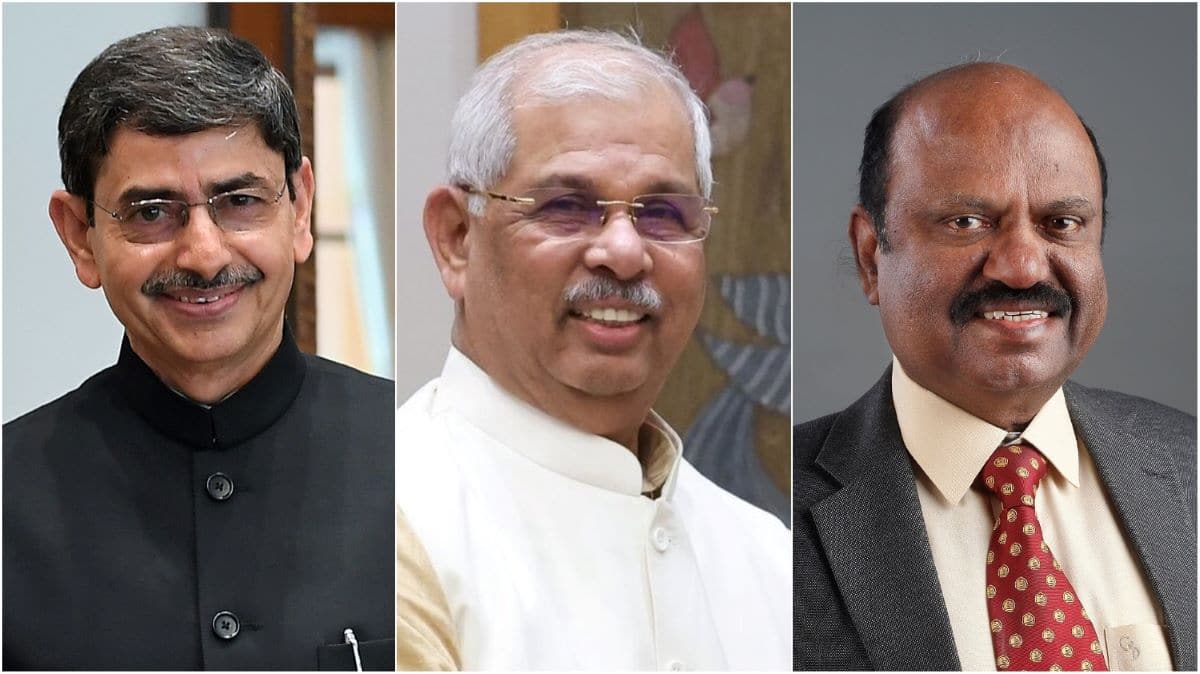
Last month, a five-judge bench of the Supreme Court (SC) opined that the courts can’t impose ‘one-size-fits-all’ timetables for governors to give their assent to state bills or ‘deem consent’ to the proposed laws when the deadline expires. The apex court’s latest view clashes with its earlier decision deeming 10 bills from the Tamil Nadu legislature pending with governor RN Ravi for a prolonged period to have been ratified. Calling the governor’s delay “erroneous” and “illegal”, the court had also instituted a three-month timeframe for the governors and the President to dispose of bills.
SC’s reversal is likely to further escalate the standoff between state governments and governors, which has roiled opposition-ruled states around the country over the past few years. While this clash has impacted myriad aspects of governance, nowhere has its ramifications been felt more severely than in higher education. With governors acting as ex-officio chancellors of public universities in their respective states, the universities in states like Tamil Nadu, Kerala, Telangana, West Bengal, Punjab and Himachal Pradesh have become the main stage of this tussle, serving as both the primary target as well as the lever of this power struggle.
Also read Decoding VBSA Bill 2025: Honorary chair, no teacher representation, external accreditation, fines
This conflict erupted when the governors, who have historically abided by the nominal nature of their top position at varsities, started behaving more assertively during the second and and third terms of the Narendra Modi government in appointment of vice-chancellors (VC) and other aspects of state universities’ governance. The state governments, in turn, attempted to clip their discretionary powers, only to be roadblocked by the very governors. In fact, all 10 bills held up by Raj Bhavan in Tamil Nadu were related to the state’s public universities. The bills, most of which sought to curtail the governor’s powers and enhance the elected government’s, were drafted in response to the DMK government’s constant bickering with Ravi.
While most of those involved with the universities – government officials, teachers, members of governing bodies – view the governors’ actions as part of a larger design by the BJP-led central government to concentrate power by centralising various components of the education system, some believe it to be a necessary intervention to ensure uniform standards.
To some state governments, these manoeuvres are a means of crippling their governing abilities more than achieving any policy or staffing goals. And if the governors’ actions seek to serve the ideological goal of “saffronising” universities – usually achieved by appointing VCs aligned with the ruling dispensation – they also open the door for patronage and corruption at Raj Bhavans, or, as they are now called, Lok Bhavans.
The stalemate between the opposition-led governments and governors has taken a toll on the state universities, many of which are facing delays and uncertainty over VC appointments, funding shortfall and vacancies in faculty positions. Routine academic activities like exams and research have also been hit at some places, while the proposed laws for establishing new universities are in limbo. Some of the new university heads brought by governors have raised eyebrows, inviting questions about their eligibility for the posts.
Governors’ role relic of the Raj
The practice of having governors as ex-officio chancellors of state universities is a relic of the British Raj. When the colonial power established the first three universities in Bombay, Calcutta and Madras in 1857, the governors of the respective presidencies were given charge as their heads. The arrangement continued after independence, with most states recognising governors as chancellors of their public universities in their statutes. This post comes with a variety of powers, the appointment of VCs being the most prominent among them.
This role, and how governors should exercise the powers attached, has long been a subject of debate and controversy. The Rajamannar Committee on centre-state relations, appointed by the Tamil Nadu government in 1969, had held that the governor should perform his gubernatorial as well as statutory functions, such as chancellor, on the aid and advice of the state government. The centre’s Sarkaria Commission, which studied the same subject in 1983, held that there’s no obligation on the governor to always act on ministerial advice. The commission, however, mentioned the “obvious advantage” in a governor consulting the chief minister or other concerned ministers. SC, too, has affirmed the discretionary powers of the governor in discharging statutory duties.
On the other hand, the National Commission to Review the Working of the Constitution, formed at the turn of the millennium and headed by Justice MN Venkatachaliah, envisaged a supportive rather than authoritative role for the governors. Punchhi Commission, in 2007, went a step ahead, recommending that governors shouldn’t be “burdened” with positions and powers which are not envisaged by the constitution and that the historic relevance for making governors university chancellors has ceased with changing times and circumstances. It had also suggested that governors should decide within six months whether to approve or reserve state legislative bills for presidential consideration.
While there have been previous disputes over the governors’ role in opposition-ruled states, the scale of the present crisis seems unprecedented.
The last notable instance of a governor and a state government coming to loggerheads was in 1984, when the late Congress leader Anant Prashad Sharma, as governor of West Bengal, appointed Santosh Bhattacharya the vice-chancellor of Calcutta University (CU) against the wishes of the Left Front government and the senate it controlled. During his volatile tenure, Bhattacharya persistently faced opposition from the state and the Left-aligned student and teacher bodies.
“The ruling party didn't cooperate with him and for four years, he endured hell running the university. They didn't allow him to work; he was stuck in the university on his own,” said a former CU Kolkata registrar.
State Universities: VC appointments
The appointment and removal of VCs and other university functionaries has been the main source of conflict between elected governments and governors across states.
For instance, in West Bengal, the former governor Jagdeep Dhankar had accused the All India Trinamool Congress (AITC) government of “illegally” selecting VCs at 25 public universities without his approval. The state later moved SC against the appointments of interim VCs in over a dozen universities by Dhankar’s successor, CV Ananda Bose.
Kerala has been embroiled in a drawn-out legal fight with Raj Bhavan over VC appointments at two state universities, Kerala University of Digital Sciences, Innovation and Technology (DUK) Veiloor and APJ Abdul Kalam Technological University (KTU) Thiruvananthapuram, which finally got their heads on Tuesday following the apex court’s intervention. The issue of reappointment of VC at another varsity, Kannur University, also had to be resolved by the top court in 2023.
The governor’s “interference” in the universities’ affairs is seen as an effort to steer these institutions rightward. An official from Kerala’s higher education department points out that an event by Shiksha Sanskriti Utthan Nyas (SSUN), a Rashtriya Swayamsevak Sangh (RSS) affiliate, in Kochi had multiple Kerala VCs in attendance.
“[Governor Rajendra Arlekar] has been stacking all university bodies with Sangh Parivar people. VCs have started attending RSS functions,” he laments.
“They have a simple criterion: those from [RSS] shakhas are appointed. There’s no consideration for merit,” adds a former office bearer of the Punjab Agricultural University Teachers Association (PAUTA).
Governor ‘playing politics’
The Kerala official, however, suggests that the governor’s actions, and inaction, go beyond ideological pursuit and are also meant to chip away at the state government’s powers by deliberately creating a “governance crisis”, where the state finds itself hamstrung. He cites Arlekar’s referring the Kerala State Private Universities (Establishment and Regulation) Bill, 2025, to the President as an example of this alleged strategy.
“This is a typical case of the governor playing politics. All the Indian states, except for Kerala, have private universities, more than 50 of which have come up in BJP-ruled states alone in the last three years. So, ideally, the governor should have approved the bill promptly, as the promotion of private universities is their policy, not the Left’s. Besides, Kerala’s proposed private universities’ law is not much different from the ones in force elsewhere in the country, including in BJP states, except for some more regulatory powers for the state and reservations for marginalised groups. Yet, the bill was sent to the President without any valid reason,” he said.
The official also suspects that the delay in implementing the reforms could be a ploy to prevent the large number of Keralites studying at private universities from returning to their state.
The universities are also useful as bargaining chips for governors looking to influence other facets of state governance. “Universities are caught between the governor and the state government. Thanks to the governor’s status as chancellor, their office has become a major tool to control the state’s affairs. The governor’s loyalists in the syndicate and university departments keep him apprised of the developments and nudge things on his behalf. The governor is able to exert his hold on the universities through the many discretionary powers accorded to him through the Karnataka State Universities Act, 2000,” said a Karnataka university’s syndicate member.
Yet, some of their behaviours seem to lack any ulterior motive, other than having nuisance value. The former CU official, for instance, suggests that the current West Bengal governor, CV Ananda Bose, a former IAS officer from Kerala, is driven by his own impulses and aspirations, rather than doing the centre’s bidding.
“Bose has appointed several people, but none of them are from RSS. His objective seems to be disturbing the TMC, but his appointees never cause any trouble to Trinamool’s student and teacher unions. The small unit the party [BJP] has at CU never grew under the new VC. It seems that Bose is trying to fulfil his own ambitions, rather than BJP’s. These are his personal, whimsical decisions,” he said.
Interestingly, it’s not just the opposition-ruled state governments that are perturbed by the governors’ interventions. As Careers360 recently reported, the government officials in Maharashtra, which has BJP at the helm, blamed their current as well as previous governors for the delay in filling the large-scale faculty vacancies in public universities. While Raj Bhavan wants more stringent norms for hiring teachers, the state officials have cast doubts on them.
Even as they conceded that the state governments aren’t above making politically-motivated appointments at universities, university and state authorities argue that they should still have the final say in their institute’s affairs. “The states would say that despite these vulnerabilities, the spirit of federalism dictates that if they are paying for these universities, they should have a larger say in the appointments, even if those appointments are political,” said the Kerala official.
Recruitment, research, funding stalled
The administrative tug-of-war has left the public universities in opposition-ruled states reeling. Many of them had to function without VCs and other key authorities for an extended period, which had a cascading effect on everything from exams to research to funding. This situation doesn’t bode well for the reputation of public universities, which are desperately trying to stand out in the national and global rankings.
“From inside the university, it feels as though the governor’s interventions are steadily pulling decision-making away from the academic bodies that have traditionally handled everything from appointments to exam schedules. Whatever the official reasoning may be, on the ground, it translates into a kind of administrative choke point where even routine matters need to wait for a clearance that may or may not come. We see this most clearly in the way VC appointments have been left hanging, leaving universities without stable leadership for long stretches,” said a faculty member at a Tamil Nadu university.
She adds that, in the absence of nominations, the university syndicate and senate meetings have been delayed, stalling syllabus revisions, affiliation processes, and research committee formations. With files stuck between the government and Raj Bhavan, funds for laboratories, hostels and maintenance haven’t been approved.
“These delays ripple outward: students get anxious, research scholars lose precious time, faculty cannot plan their academic year, and the university’s reputation takes repeated blows. It doesn’t feel like a political fight being played out in the media; it feels like everyday academic life being held up by uncertainty, with teaching, research, and administration all forced to wait for decisions that should have been routine," she said.
The situation is no better at the University of Kerala, Thiruvananthapuram, the epicentre of the state-governor conflict, where the in-charge Mohanan Kunnummal has suspended Registrar KS Anil Kumar over the latter’s opposition to a Bharat Mata portrait being displayed at an event.
“No syndicate meeting has taken place in the last six months, making 64 students wait for their PhDs. Similarly, more than 300 teachers’ promotions are pending. Proposals for change of research guides by 200 students haven’t been addressed yet. The infrastructure and other development projects at the university are stalled for want of funds. The semester exams, which should have been conducted in November, have been delayed,” said the Kerala official.
In Karnataka, according to the syndicate member, a clear divide has emerged among the universities – the ones favoured by the governor and the ones that aren’t. “The governor is far more generous towards those in his good books, rewarding them with funds and his presence. The others haven’t had appointments in years,” he said.
As for West Bengal, the former CU functionary claims that many of Bose’s appointees lack academic credentials for the top job at universities. He particularly mentions M Wahab, a 70-year-old retired IPS officer from Kerala who was made VC at Aliah University, Kolkata, as an example of a wrong pick.
“Universities are supposed to be led by good academics. When someone with low caliber and potential becomes VC, spirits are dampened, interest is lost and people think about moving out. There has to be a system of excellence with vertical movement for everybody. Universities can't simply be knowledge distribution centres; they have to be knowledge generation points. But that's not happening as they don't have the right leaders,” he said.
(with inputs from K Nitika Shivani)
 Add as a preferred source on google
Follow us for the latest education news on colleges and universities, admission, courses, exams, research, education policies, study abroad and more..
To get in touch, write to us at news@careers360.com.
Next Story
]Latest Education News
]Related News
]Maharashtra MBBS interns demand Rs 30,000 monthly stipend, warn of strike from November 2
J-K doubles MBBS, BDS interns' and FMGs' monthly stipend amid agitation
Medical interns in J-K restart agitation over stipend hike; allege government failed to honour assurance


