
IIT Madras develops ramjet-assisted artillery shells for Indian Army, extends gun range by 50%
Aatif Ammad | January 12, 2026 | 02:29 PM IST | 2 mins read
The ramjet-powered shell replaces base-bleed technology, enabling existing 155 mm artillery guns to hit targets at much longer ranges without platform changes.

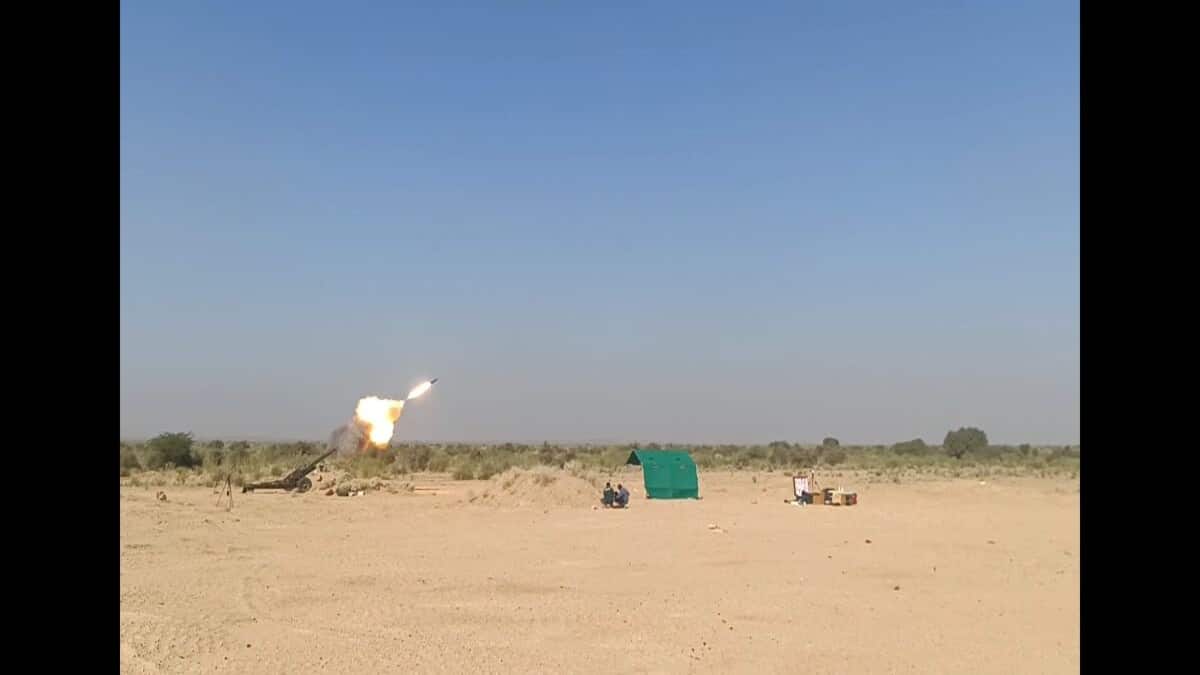
Researchers at the Indian Institute of Technology Madras (IIT-M) have developed and successfully tested ramjet-assisted artillery shells that can extend the firing range of conventional gun systems by nearly 50% without compromising lethality, marking a significant advance in India’s indigenous defence technology.
The innovation integrates a ramjet engine into an existing 155 mm artillery shell, replacing the conventional base-bleed unit.
Unlike rocket-assisted projectiles or aerodynamic upgrades, the ramjet provides sustained propulsion after the shell exits the gun barrel, allowing it to travel much farther while maintaining destructive effectiveness on target.
“The objective was to significantly enhance range without changing existing gun platforms,” the institute said.
The technology could substantially increase the reach of multiple artillery systems currently in service.
Also read IIT Madras develops ramjet-assisted artillery shells for Indian Army, extends gun range by 50%
The Bofors/ULH (39 calibre) gun’s range could increase from 24 km to 43 km, Dhanush (45 calibre) from 30 km to 55 km, Vajra (52 calibre) from 36 km to 62 km, and ATAGS (52 calibre) from 40 km to nearly 70 km.
The institute said the system offers a cost-effective alternative to missiles, retaining artillery’s flexibility and survivability while delivering deeper strike capability.
Trials with Indian Army
The project, initiated in 2020 in collaboration with the Indian Army, progressed through multiple stages of testing. Early trials using a 76 mm gun at IIT Madras validated the concept, followed by scaled tests on 155 mm guns.
Field trials conducted in September 2025 at the School of Artillery, Deolali, and subsequent tests in December 2025 at the Pokhran Field Firing Range demonstrated stable flight, clean gun exit and successful ramjet ignition.
“The trials confirmed that extended range can be achieved without diluting battlefield impact,” it said.
PA Ramakrishna of IIT Madras’s department of aerospace engineering, who led the project, said the technology could change battlefield dynamics.
Also read IIT Jammu joins hands with Skill-Lync to launch certificate courses in future mobility engineering
“If fully realised, this could allow artillery units to engage targets at much greater distances without the need for new gun systems or costly missile platforms,” he said.
Beyond artillery, researchers said the technology could also be adapted for rockets, with further projects underway.
The programme, the institute noted, reflects how mission-driven academic research aligned with operational requirements can strengthen national security while modernising existing military systems rather than replacing them.
 Add as a preferred source on google
Follow us for the latest education news on colleges and universities, admission, courses, exams, research, education policies, study abroad and more..
To get in touch, write to us at news@careers360.com.
Next Story
]Latest Education News
]Related News
]Jamia School, IIT Madras collaborate to launch online certificate courses for Classes 9 to 12
IIT Madras study reveals air pollution could help improve rainfall, urban floods forecasting
IIT Madras opens PhD, MS Research admissions for January 2027 session; apply by Oct 30


