
What are UGC Equity Regulations 2026 and why are they facing ‘general-category’ backlash?
Shradha Chettri | January 27, 2026 | 02:22 PM IST | 4 mins read
Opponents say UGC Promotion of Equity Regulations unclear on definition, don’t punish false complaints; claim on external oversight despite 2 civil society members
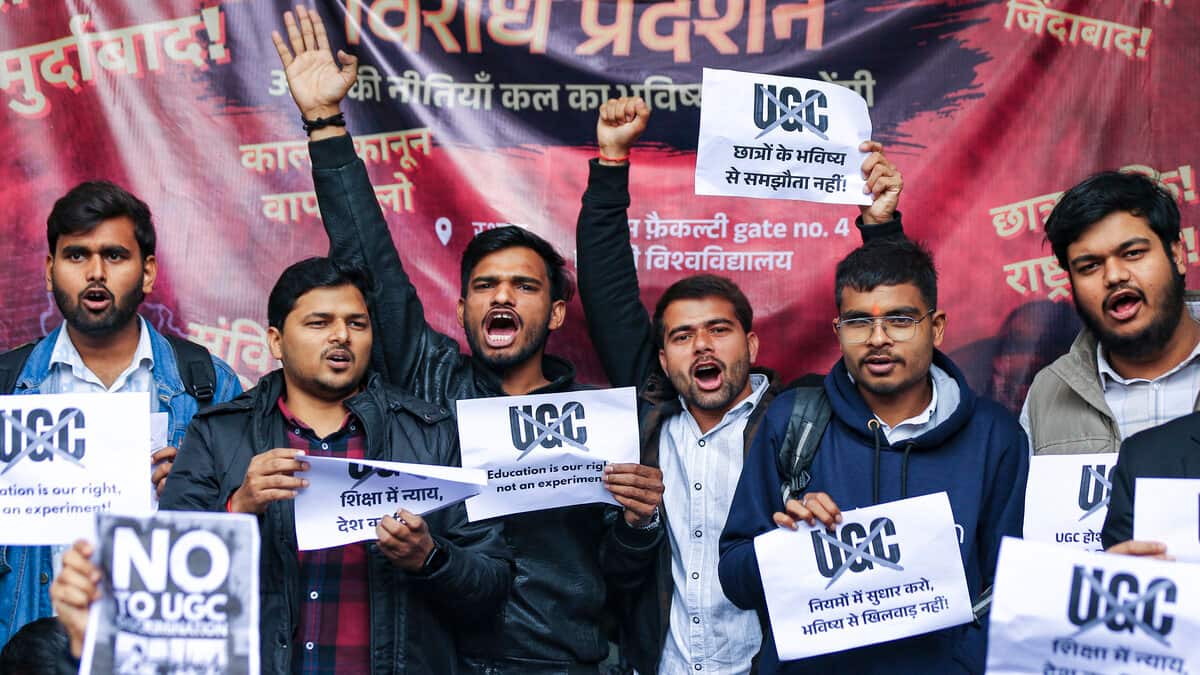
The Promotion of Equity in Higher Education Institutions Regulations 2026, notified by the University Grants Commission (UGC) earlier in January are facing upper-caste backlash. “General-category” opponents of the policy describe it as “state-sponsored apartheid”, mainly for not describing discrimination clearly enough and not penalising ‘false complaints’.
There is a demand for rollback of the UGC regulations on social media and a protest has been called against it. Live Law reports that a plea has been filed in the Supreme Court challenging the regulations.
A draft of the new regulations was made public for feedback in 2025 after the Supreme Court directed the UGC to submit the new regulations while hearing a plea by the mothers of Rohith Vemula and Payal Tadvi, who died by suicide in 2016 and 2019, respectively, allegedly due to caste bias. They are intended to protect students from historically-marginalised backgrounds long-excluded from formal learning – Scheduled Castes, Scheduled Tribes and Other Backward Classes – in higher educational institutions.
Objections were raised against the draft over the vague description of discrimination, non-inclusion of Other Backward Classes, the provision of taking action against false complaints among others. The UGC waited a whole year to revise and notify the final regulations on January 14.
Also read Under NTA, UGC NET a ‘general knowledge test’ – rewards rote learning, not analytical skills
UGC Regulation 2026: Equity committee
The UGC equity regulations 2026 mandate equity committees in all higher education institutions with representatives from Scheduled Caste (SC), Scheduled Tribes (ST), OBC, Persons with Disabilities (PwD), and women. Earlier, the number of committee members from SC, ST, and women was set at two.
The new regulations have removed a section on false complaints, along with provision for fines or disciplinary proceedings.
It was stated that the equity committee, upon receiving such information, has to meet the complainant within 24 hours to initiate action. Further the complainant can also submit the complaint in writing or by emailing it to the coordinator of Equal Opportunity Cell (EOC). The regulation draft only talked about filing a complaint through the online portal.
Along with this, the regulations also require all higher education institutions to have equity helplines.
What are the new UGC rules?: Claims Vs regulations
This time, the objections have been raised by those belonging to the “general category”, mainly upper-castes. They are campaigning on social media and have got “#Rollback UGC” trending on X.
The main objections against the regulations, shared widely, include:
- Presumption of guilt without proof
- No penalty for false or malicious complaints
- ‘Implicit discrimination’ is a vague term
The regulations used the phrase “implicit discrimination” while describing what constitutes discrimination. The UGC regulation document says: “Discrimination means any unfair, differential, or biased treatment or any such act against any stakeholder, whether explicit or implicit, on the grounds only of religion, race, caste, gender, place of birth, disability, or any of them. It also includes any distinction, exclusion, limitation, or preference which has the purpose or effect of nullifying or impairing equality of treatment in education and, in particular, of imposing conditions on any stakeholder or group of stakeholders which are incompatible with human dignity.”
The opponents have also cited the lack of “uniform SOPs across universities” as a problem and claim that the internal committees will have “no external oversight”. The actual regulations require equity committees to mandatorily include two representatives from civil society.
The regulations have specified timelines for the completion of the inquiry and submission of report.
“The Equity Committee shall thereafter submit its report to the head of the institution within 15 working days. A copy of the Equity Committee's report shall also be sent to the aggrieved person. Upon receipt of the report from the Equity Committee, the Head of the Institution shall initiate further action as per the rules of the HEI within 7 working days. However, if a case under the penal laws is made out, police authorities shall be informed forthwith,” the regulations state.
There are also videos of protests over the regulations, which have taken place in states like Uttar Pradesh against the regulations, including resignations from the membership of leaders from Bharatiya Janata Party (BJP).
Also read Teacher recruitment to scholarships – what SC wants universities to do for suicide prevention
UGC Equity Regulations 2026: Defining discrimination
The Left-wing All India Students Association (AISA) has welcomed the guidelines stating that it represents an improvement over the 2012 guidelines.
The group, however, has concern over certain aspects.
“The regulations expand the scope of Equal Opportunity Centres (EOCs) significantly, compared to the earlier Equal Opportunity Cells that functioned largely as advisory and monitoring bodies. The Regulations do not mandate that the EOC Coordinator or the chairperson of the Equity Committee belong to a marginalised community. Instead, the head of the institution is designated as the ex-officio chairperson. This arrangement reflects tokenism without real power and creates an inherent conflict of interest,” said a statement from AISA’s all-India president and general secretary.
The statement further adds that the representation of SC, ST, OBCs, and women in the equity committee, both among faculty and students, remains low, vague, and inadequately defined.
“Further, the regulations define discrimination in broad and abstract terms without enumerating concrete acts or instances of discrimination. This ambiguity shifts disproportionate power to institutions to interpret discrimination subjectively, allowing them to evade accountability and perpetuate caste bias under the cover of discretionary authority,” added the statement.
While these regulations are being confused with the UGC Act 2026 controversy, they aren’t immediately related. The UGC Act is yet to be repealed as the Viksit Bharat Shiksha Adhishthan Bill is with a joint-parliamentary committee.
 Add as a preferred source on google
Follow us for the latest education news on colleges and universities, admission, courses, exams, research, education policies, study abroad and more..
To get in touch, write to us at news@careers360.com.
Next Story
]LLB, LLM courses in English but for lawyers in lower courts, regional language command key to win cases
English-medium teaching in law colleges leave law graduates struggling in with vernacular arguments in lower courts; NEP 2020 recommends multilingual education, but English preferred in higher courts
K. Nitika ShivaniLatest Education News
]Related News
]J-K doubles MBBS, BDS interns' and FMGs' monthly stipend amid agitation
Medical interns in J-K restart agitation over stipend hike; allege government failed to honour assurance
'Spare India from anarchy': Indian-origin students, academicians condemn anti-EC protests


