
Samagra Shiksha set for major revamp; Dharmendra Pradhan pushes for outcome-driven, NEP-aligned framework
Shradha Chettri | January 9, 2026 | 06:43 PM IST | 3 mins read
Samagra Shiksha 3.0: Education minister says SSA scheme must move beyond ‘quality and equity’, become quality-focused; school operations must be societal responsibility
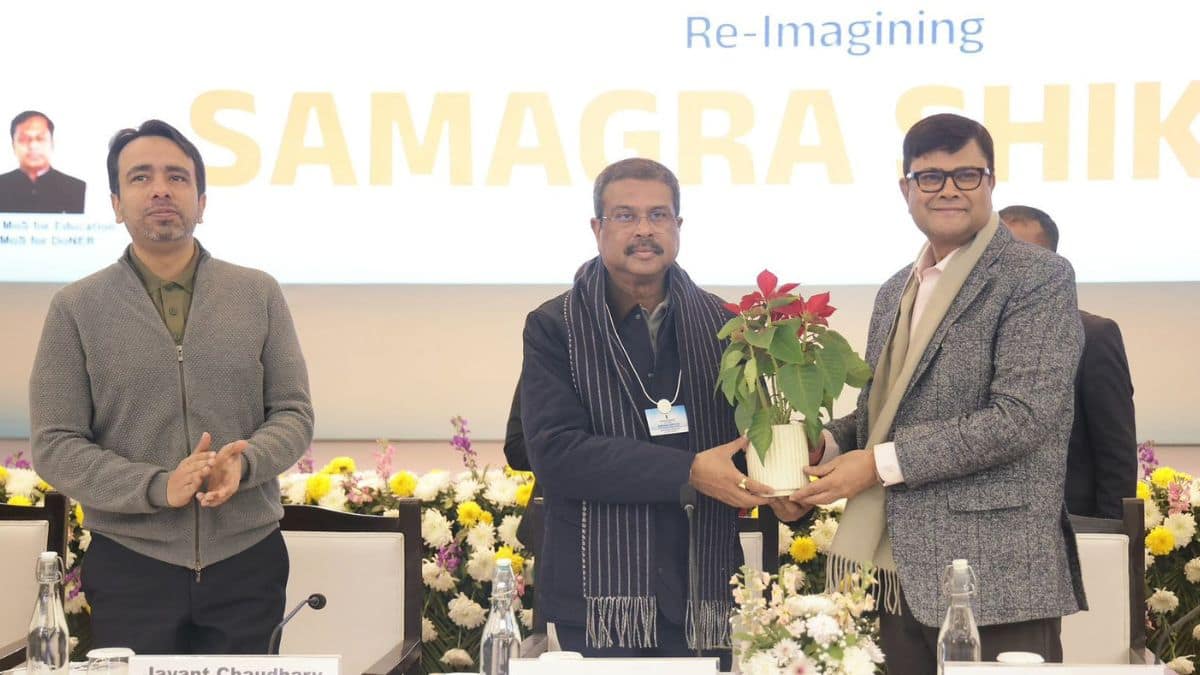
Samagra Shiskha, an important scheme covering the school education sector from pre-school to class 12, is set for a major restructuring. At a stakeholders’ meeting, education minister Dharmendra Pradhan emphasised that the scheme should move beyond “quality and equity” and transform into an “outcome-driven, quality-focused framework aligned with the objectives of National Education Policy (NEP) 2020”.
Launched in 2018-19, Samagra Shiksha brought three erstwhile schemes – Sarva Shiksha Abhiyan (SSA), Rashtriya Madhyamik Shiksha Abhiyan (RMSA) and Teacher Education (TE) – under one umbrella.
SSA aimed to universalise access to elementary education by providing financial support for the creation of school infrastructure as per the norms and standards specified in the RTE Act, 2009. RMSA was launched in March 2009 with the objective to enhance access to secondary education and to improve its quality.
The scheme essentially provides support for implementing the Right to Education Act 2009, with funding shared between the central and state governments, generally in a 60:40 ratio.
For northeastern and himalayan states the split is 90:10 and Union Territories receive central funding entirely.
To provide funds under these schemes, initially, education cess was levied at 2% from financial year 2004- 05. From FY 2007-08, an additional cess at 1% was levied to fund secondary and higher education. The reservation capacity for socially and educationally backward classes was expanded by 54%.
Further, to address needs of rural families and those Below Poverty Line (BPL), the 3% ‘Health and Education Cess’ was hiked to 4% from 2018-19.
Samagra Shiksha: ‘Collaborative effort’ of 11 states
Lauding the states’ participation on social media X, education minister Pradhan said, “Appreciate the enthusiastic participation and valuable suggestions of academic experts, senior officials of sectoral ministries, education minister and from the 11 participating states/UTs. This collaborative effort today and the pioneering ideas at this forum will pave the way for charting a clear roadmap for holistically strengthening our school education ecosystem, aligning them with the goal of Viksit Bharat.”
The meeting was also attended by minister of state for education Jayant Chaudhary.
Talking about the need to bring the ‘Amrit Peedhi’ out of the Macaulay Mindset and nurturing a human capital for Viksit Bharat, Pradhan said the focus of the scheme should now move “beyond mere achieving quality and equity”.
“We must transform Samagra Shiksha from a broad access scheme to an outcome-driven, quality-focused framework aligned with the objectives of NEP 2020,” said Pradhan.
He also appealed to the states and UTs to create a holistic annual plan for the academic year 2026-27. “When our ‘Concepts’ will ‘Converge’, our ‘Capacity’ will also get a boost,” he added.
Also read India has 1.44 lakh teachers in over 65,000 government schools with less than 10 students
Samagra Shiksha: ‘Return the schools’
Pradhan also stressed on the need for greater societal involvement in school operations. “We must return the schools to society,” he wrote in a post on X in Hindi.
“A large population of India expects holistic education from Samagra Shiksha. All states have their own experiences and best practices in the direction of building just society through education. To meaningfully transform numerous components such as enhancing learning outcomes, reducing the burden of exams, making education seamless, holistic development of schools, technology, digitisation, we must once again return schools to society,” he added.
He stressed that under the new model, the system and salaries should be the responsibility of the government, but the operation should be the society’s responsibility.
Chaudhary added that Samagra Shiksha 3.0 moves beyond reform to prepare students for work, life and a rapidly changing economy, by embedding skilling, vocational pathways, digital learning and inclusion within a multidisciplinary education framework.
 Add as a preferred source on google
Follow us for the latest education news on colleges and universities, admission, courses, exams, research, education policies, study abroad and more..
To get in touch, write to us at news@careers360.com.
Next Story
]Latest Education News
]Related News
]Maharashtra MBBS interns demand Rs 30,000 monthly stipend, warn of strike from November 2
J-K doubles MBBS, BDS interns' and FMGs' monthly stipend amid agitation
Medical interns in J-K restart agitation over stipend hike; allege government failed to honour assurance


