
DPS RK Puram principal: ‘CBSE board exams twice a year will have students spending entire year in tests’
Aeshwarya Tiwari | February 28, 2026 | 01:32 PM IST | 6 mins read
With school board exams, JEE, NEET, CUET, CLAT stacking up, DPS RK Puram principal warns emotional toll on students reaching tipping point; says NIOS a viable alternative
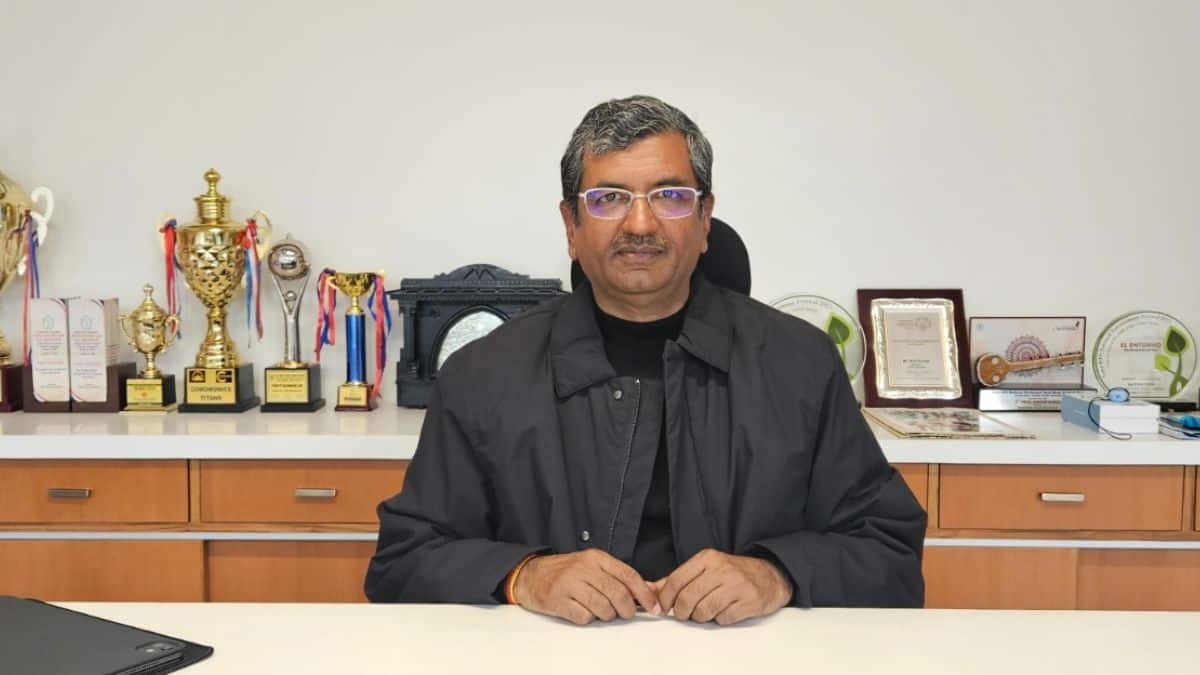
Anil Kumar, principal of Delhi Public School, RK Puram, New Delhi, speaks to Careers360 on the impact of artificial intelligence on learning, assessment reforms ushered in by the National Education Policy and the Central Board of Secondary Education, the “disconnect” between school education and high-stakes college entrance exams and how the CBSE’s decision to hold two board exams may lead to more stress, not less.
Having worked at DPS Faridabad and now at DPS RK Puram, what differences do you observe, and what is your vision for the school?
At their core, learners are the same everywhere; what differs is the ecosystem that shapes them. Educational institutions must respond to their unique social and cultural contexts while remaining future-ready. As I continue to understand DPS RK Puram, a key focus has been aligning education with the rapidly-evolving world. The establishment of the AI Innovation and Incubation Centre marks a significant step in this direction. Guided by the ethos of peace, progress, and prosperity and Vasudhaiva Kutumbakam, our vision is to nurture responsible global citizens.
With multiple curricula now available – CBSE, international boards – how do you guide parents in choosing the right curriculum?
There is no absolute hierarchy among curricula. Education rests on universal principles, whether one studies Newton’s laws or accountancy. While academic structures vary across countries, the essence of learning remains constant; the real difference lies in how knowledge is delivered, understood, and applied. Guided by the NEP, India has adopted a National Curriculum Framework, with CBSE increasingly shifting towards competency-based learning. This evolution is essential, as education must move beyond rote memorisation to foster application, inquiry, and critical thinking – skills vital for real-world readiness. In today’s globalised, technology-driven landscape, distinctions between curricula have also narrowed.
However, there is no single curriculum that suits every child. Each learner brings unique abilities, aspirations, and learning needs shaped by upbringing and family environment. It is neither appropriate to assess all children by one yardstick nor to declare any curriculum universally superior. Schools must therefore remain flexible and responsive.
In terms of assessment reforms, how do you see schools moving beyond rote learning and traditional examination patterns?
Over the past three years, CBSE has made noticeable progress toward a competency-based assessment framework. I was personally involved in the planning stages, and the original roadmap envisioned that nearly 50% of examination papers would assess competencies rather than rote recall by 2024-25. While the COVID-19 pandemic disrupted this timeline, resulting in a delay of approximately two-to-three years, the direction of reform remains clear and firmly in place.
That said, rote learning should not be viewed in absolute terms, as either good or bad. Foundational learning inevitably involves a degree of memorisation. For instance, recognising the letters of the alphabets or basic numerical concepts requires direct recall. This is also a form of knowledge acquisition. The key lies in balance ensuring that students possess a minimum core of factual understanding while gradually being guided toward application, analysis, and critical thinking.
Assessment reform, therefore, is not about eliminating memorisation altogether, but about moving beyond it. Once foundational knowledge is established, learners must be encouraged to interpret, apply, and question what they have learned.
Do you see AI as hindering students’ learning or creating new opportunities?
Artificial intelligence offers immense advantages, but its risks are equally significant. From an innovation standpoint, AI can accelerate progress in ways traditional methods cannot, accomplishing tasks in a fraction of the time and compressing the span of discovery.
Yet AI is a double-edged sword. While it enhances human capability, it can also dull cognitive effort. Instant solutions from autocorrect or AI-generated responses reduce the need for independent thinking. When outcomes are achieved with minimal effort, the mind often shifts into a passive mode, a lesser-known “dark side” of AI. Over-dependence risks diminishing the incentive to analyse, problem-solve, or think critically. Highly capable thinkers may leverage AI to push boundaries, but average cognitive engagement could decline, widening the gap between levels of intelligence. AI must remain a tool, not a substitute for human thought.
What does your AI curriculum include and how do students engage with it?
We have designed a structured curriculum in collaboration with Google and VVDN. At the introductory level, students are familiarised with widely-used AI tools and platforms such as OpenAI-based systems and Google’s Gemini, not merely as end-user technologies, but as enablers of creativity and problem-solving. These tools allow students to develop software, explore new programming approaches, and design solutions that address real-world challenges.
The emphasis is on creating meaningful outcomes that benefit the larger community, whether within the school, the neighbourhood, or society at large. Our objective is to empower students to move beyond consumption of technology and toward purposeful innovation.
Does the school offer merit-based scholarships?
Merit-based scholarships have always been an integral part of the DPS framework. In addition, students from the Economically Weaker Sections are enrolled in our institution under the provisions of the Right to Education Act and receive free education. Beyond this, we also support academically meritorious students through scholarship opportunities. While families with the means to pay fees are encouraged to do so, the school remains committed to ensuring that financial constraints do not hinder deserving students from accessing quality education.
What reforms do you believe are most urgently needed in the school education system?
If you ask me honestly, the school education system today calls for a comprehensive overhaul, a fundamental rethink. At its core, learning must allow freedom of inquiry and independent thought. Without curiosity, education becomes mechanical. This freedom, however, must operate within a clear structure; curiosity flourishes best when guided, not constrained.
A crucial yet often overlooked reform is teacher development. When educators remain learners themselves, curious, engaged, and evolving students learn naturally. This quiet shift can have a transformative impact.
In India, one of the most pressing challenges is the disconnect between school education and high-stakes competitive examinations. If entrance tests like JEE, NEET, CUET, and CLAT largely determine academic futures, the relevance of board examinations must be critically reassessed. The current system places immense pressure on students, compounded by parental expectations that may not align with a child’s aptitude or interest.
With millions competing for a limited number of seats, the emotional and psychological toll is significant. This raises a fundamental question: what is the true purpose of education? Until schooling, assessment, and higher education are aligned around clearly-defined objectives, meaningful reform will remain difficult. While the National Education Policy has begun this conversation, such systemic change will take time to fully unfold.
Also read CBSE 2026: Board tightens rules on cheating, makes it harder to pass; Class 10 gets new marksheets
What are your views on holding board examinations twice a year?
Personally, I believe we are becoming overly experimental without fully considering feasibility and instructional time. If students are subjected to repeated board exams, followed by multiple entrance tests, they risk spending their entire academic year preparing for assessments rather than engaging in meaningful learning. School education is not merely about examinations it is also about socialisation, experiential learning, and holistic development.
In this context, the National Institute of Open Schooling offers an alternative worth serious consideration. Its on-demand examination system allows students flexibility enabling them to appear for exams when they feel prepared. This significantly reduces stress and restores agency to the learner. Similar flexibility exists in global testing systems such as SAT, GRE, GMAT, and TOEFL.
A student spends nearly 12,00 hours in school over the years. If a substantial portion of that time is consumed by repeated testing, we must ask whether the system is truly serving the learner. If the goal is to reduce stress and promote genuine learning, flexible and learner-centric assessment models already exist, we simply need the willingness to adopt them thoughtfully.
 Add as a preferred source on google
Follow us for the latest education news on colleges and universities, admission, courses, exams, research, education policies, study abroad and more..
To get in touch, write to us at news@careers360.com.
Next Story
]Latest Education News
]Related News
]CBSE Board Exam Dates 2027 LIVE: Class 10, 12 subject-wise timetable at cbse.gov.in soon; passing marks
Board Exam Time Table 2027: AP Inter, TN 10th, 12th date sheets out; CBSE, RBSE, JKBOSE, TS schedule soon
HC upholds Delhi govt's policy on cash to EWS students for private school uniform


