
Five years of NEP 2020: SFI flags crisis in public education, unveils School Bachao movement
Aatif Ammad | December 29, 2025 | 08:26 PM IST | 2 mins read
Student body cites school closures, rising dropouts, infrastructure gaps; conclaves and protests planned across India
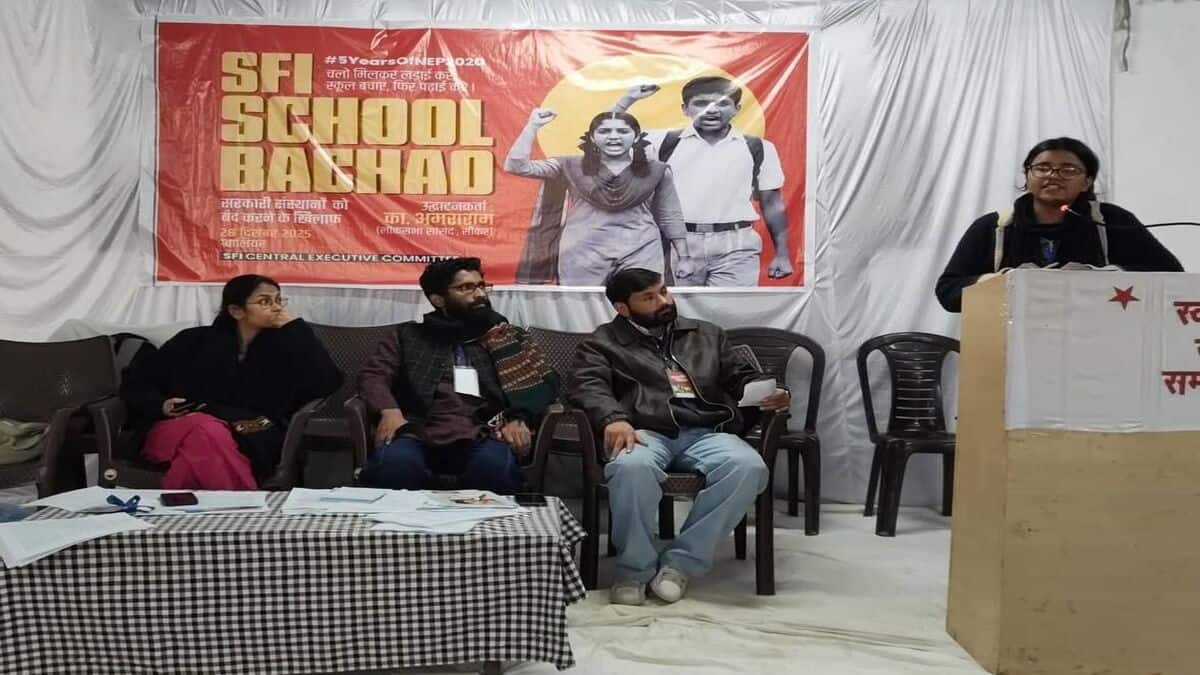
The Students’ Federation of India (SFI) marked five years of the National Education Policy (NEP) 2020, describing it as a policy that has significantly weakened India’s public education system.
SFI leaders Srijan Bhattacharyya (general secretary), Adarsh M Saji (All India President), and S Shilpa (Vice President) alleged that NEP 2020 promotes commercialisation, centralisation, and communalisation of education, disproportionately impacting students from poor and marginalised communities.
SFI leaders said that policy’s implementation over the past five years has coincided with large-scale school closures, declining public investment, and increasing dependence on private and edtech-driven models.
They argued that instead of addressing structural inequities, NEP 2020 has widened access gaps, weakened democratic oversight in education, and shifted the burden of learning costs onto students and families.
Nationwide conclaves against NEP 2020
The SFI central executive committee announced five major conclaves across India. These include upcoming programmes in Kolkata on the language formula, Hyderabad on edtech and exclusion, Delhi on the “destruction of reason,” and Chennai on uniformity versus diversity.
The fifth conclave took place in Gwalior on December 28 in the form of a students’ convention against the closure of public institutions, attended by over 200 delegates from multiple states.
School closures and rise of private institutions
SFI highlighted that the number of government schools in India declined by 8 per cent between 2014–15 and 2023–24, while private schools increased by nearly 15 per cent.
States such as Madhya Pradesh, Uttar Pradesh, Jammu and Kashmir, and Odisha witnessed sharp declines in public schools, largely affecting rural and tribal regions.
SFI alleged that closures under the guise of “school mergers” are pushing economically weaker sections out of the education system.
Infrastructure gaps and learning outcomes
The student body flagged severe infrastructure shortfalls, including lack of electricity, toilets, drinking water, computers, laboratories, and co-curricular facilities in thousands of schools.
It also referred to annual status of education (ASER) findings that show poor foundational learning levels, arguing that public education spending remains below the 6 per cent of GDP target set by NEP itself.
SFI said over 65 lakh students dropped out of school in the last five years, with nearly half being girls. It also pointed to a steady decline in schools covered under the PM Poshan (mid-day meal) scheme, particularly in Uttar Pradesh, Madhya Pradesh, and Assam, warning that nutrition-linked school attendance is at risk.
School Bachao movement and opposition to HECI Bill
Against this backdrop, SFI announced the launch of a sustained nationwide “School Bachao” movement, aimed at defending public education, protecting jobs of teachers and scheme workers, and building broad alliances. The organisation also strongly opposed the proposed Viksit Bharat Shiksha Adhishthan (HECI) Bill 2025, alleging it would centralise and corporatise higher education. SFI called for nationwide rallies, campus protests, and public mobilisation throughout January 2026.
 Add as a preferred source on google
Follow us for the latest education news on colleges and universities, admission, courses, exams, research, education policies, study abroad and more..
To get in touch, write to us at news@careers360.com.
Next Story
]Jammu and Kashmir: Srinagar to get first state-of-the-art school for specially-abled children
Srinagar is set to get its first state-of-the-art school for specially-abled children, Abhinandan School, aimed at visually and hearing-impaired students across the Kashmir division. The initiative comes amid declining enrolment of children with special needs and rising spending on inclusive education in Jammu and Kashmir.
Aatif AmmadLatest Education News
]Related News
]Anne Carson wins Nobel Prize in Literature 2026 for ‘her bold, inventive oeuvre’
NMC tightens medical advertising norms; bans AI-generated testimonials, unverified claims
NCAHP notifies policy for state bodies to regulate allied health science courses, colleges, AHP registration


