
Operation Kayakalp: ‘Jarjar’ schools in UP a blind spot – with crumbling buildings and children left behind
Sheena Sachdeva | March 9, 2026 | 04:31 PM IST | 8 mins read
Uttar Pradesh’s most dilapidated schools needed Operation Kayakalp’s infra boost but were bypassed. Now, these are most vulnerable to closure; with low funds, maintenance is a struggle.
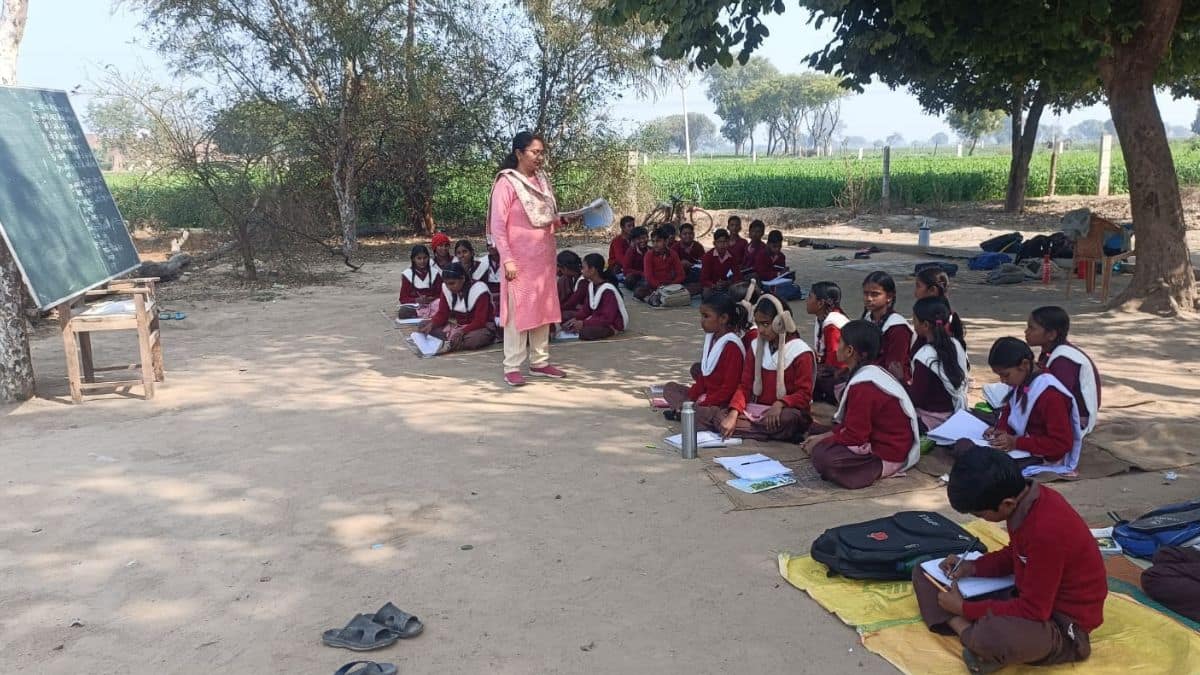
“Three years ago, a lintel beam fell inside a room in our school and it was declared unsafe for children. Ever since, we’ve been teaching under a tree,” said Preeti Singh*, a teacher in the primary section of Purva Madhyamik Vidyalaya - Madhi, in Shamshabad block of Agra district. Uttar Pradesh’s initiative for upgrading school infrastructure, Operation Kayakalp, hasn’t reached her school.
The existing Shamshabad school was declared “jarjar” in 2022. Operation Kayakalp had already been launched in 2018 but no building replaced the condemned one, leaving 83 children to attend classes in the open. “What is the purpose of Operation Kayakalp for us when we have to teach under a tree?” asked the teacher.
This is not the only one. Numerous government primary schools with “jarjar” buildings have had to find other homes, often in single rooms of buildings intended for other purposes.
Prathmik Vidyalaya Mohammadpur, Kheragarh, also in Agra, is operating from the village’s panchayat office; Prathmik Vidyalaya Faziatpura is in a dharamshala.
“Jarjar” schools have now become the centre of another problem – school mergers or, as the affected teachers and communities like to describe them, school closures. Teachers say that long-neglected government schools lost students to private institutions. Once the student count declined, they were merged with other schools, forcing even the students who had remained – usually from the poorest of families – into private schools or out of the system altogether.
Also read Kanpur: A year after Yogi Adityanath’s school mergers, many pushed out of mainstream education
UP Schools: Operation Kayakalp
Much advertised, Operation Kayakalp was launched with the laudable goal of upgrading school infrastructure to meet a set of 19 standards. These included ones addressing safety, accessibility, sanitation, drinking water, electricity, furniture and even “aesthetics”.
But according to teachers in rural schools across Agra district, the flawed implementation of the scheme and years of neglect not only left the schools without buildings but also most vulnerable to closure under the CM Composite School scheme, which seeks to merge smaller primary, upper-primary schools with secondary and higher-secondary (intermediate) ones to create K-12 composite institutions.
Brijesh Dixit*, a teacher from Agras said, “Out of 19 parameters, many schools just have one to two parameters that have been completed, especially in rural schools. Teachers are immensely suppressed by the administration that they are afraid to speak up about this issue.” That is also why the names of all teachers quoted in this story have been changed.
Ram Chand*, teacher at Prathmik Vidyalaya Mohammadpur, Kheragarh, Agra, said his school has been running from the panchayat office since mid-2024 when its building was declared unfit. It is about 600 metres from its original location.
The Faziatpura school’s 72 students now attend classes in two rooms of a dharamshala – a rest-stop for pilgrims. They moved after one of the school walls collapsed a year ago.
Schools in UP: Unsafe buildings
Teachers in schools across Agra informed that their students are studying in open spaces, verandahs and temporary structures after school buildings were declared unsafe after years of neglect. Repeated appeals to the administration for new buildings have gone unheard.
“Students are studying without any building in an open space where there are many snakes. It's harmful for children. We have written to the higher district and gram administration. They assure us that a new building will be allotted, but neither has the previous building been demolished nor a new one sanctioned,” said Singh about Shamshabad.
As per norms, a primary school should consist of four classrooms, an office, a verandah and a kitchen. However, several schools lack even one usable room.
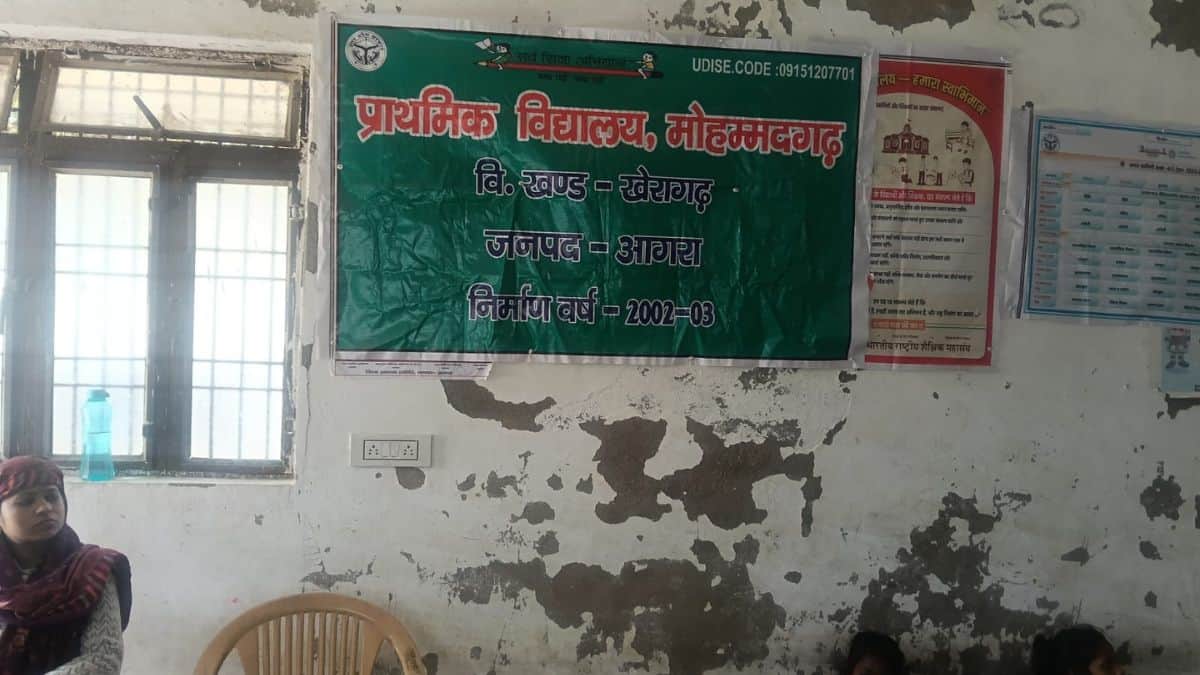 Prathmik Vidyalaya Mohmmadpur, Kheragarh, Agra school has been running from the panchayat office since mid-2024 after the school was declared 'unfit'. (Image Credits: Special Arrangement)
Multiple grades, travel issue
The shortage of safe classrooms has forced teachers to compress multiple grades into a single space. “Classes 3-5 are running from one room and Classes 1-2 are made to sit in the verandah. For both teachers and students, travel is also an issue,” said Chand.
Distance from the original school premises has emerged as another challenge, especially for young children. Hari Singh* from Faziatpura said the temporary space from which the school is operating is 500 metres away from the village.
“We have been teaching from the village’s dharamshala for the past one year. During extreme rainfall and harsh weather, travelling becomes difficult for students because it is slightly far from the village.”
The uncertainty over new construction, teachers say, has added to their administrative burden. While assurances are repeatedly given, no timelines are communicated, leaving both teachers and students in prolonged limbo.
Shift to private schools
The lack of functional school buildings has, in several cases, led to relocation and eventual closure of government schools. Teachers say that when schools are shifted to distant or temporary spaces, enrollment takes a hit.
“If we get our own school building, student strength will increase, the convenience of our own space and travelling for students will also be solved,” said Chand, pointing to how infrastructure directly affects attendance.
The absence of clear timelines for reconstruction has deepened uncertainty on the ground. “No time is given, but a hope is given that a school will be given soon,” another teacher said.
UP Schools: Ripe for closure
Sushant Singh, president, Kheragarh Teacher Association, shared data from 2019–20 where out of 155 schools in the region, 31 closed under the policy of forming composite schools. During this, nearly 100 teaching posts were cut.
Teachers’ associations of the state argue that the policy has had serious consequences for both children and staff. Singh added, “The government gave school closures a fancy name of merger and pairing. But the practical reality is that these closures have impacted children from extremely low-income backgrounds. Even walking 500–600 metres is difficult for them.
Due to this, many are pushed into private schools. In Khandoli block of Agra district, a primary school building’s wall collapsed in July, 2013. “For nearly a year, we taught students in a nearby vacant plot. After years of complaints, the school was shifted to a panchayat room in 2018,” a teacher said.
“Earlier there were around 40–50 children. Over the years many dropped out, moving to private schools nearby. Currently the school has 30-35 students enrolled.”
Last year, after over a decade of such ad hoc functioning, the school was merged into a middle school located about 1.5 kilometres away. But this merger has remained on paper, as a purely bureaucratic exercise. Primary classes continue in the panchayat room and the merged school is too far from home for 6-10 year-olds – the age group that attends Classes 1 to 5.
“Students won’t go to a different village altogether because it is 1.5 km away from the original school. Now parents have moved their wards to private schools nearby,” the teacher added.
The 25% freeship quota in private schools for economically weaker sections and disadvantaged groups, introduced by the Right to Education Act 2009, has made the shift easier.
Decrease in enrolment is especially hard on teachers. Over the past few years, UP has run multiple enrolment drives and taken punitive action where numbers fell. Singh alleged that teachers are harassed and, in some cases, have their salaries docked if enrolment drops.
The combined effect, teachers say, is a cycle where poor infrastructure leads to decline in enrollment, which is then cited as justification for further consolidation. The state administration, however, maintains that no school has been closed.
Uneven upgrades, inadequate funds
In 2020, UP’s gram panchayats declared that all 19 of Operation Kayakalp’s infra targets had been met across schools.
Teachers disagree. “Under Operation Kayakalp, the school infrastructure has improved, but many places still have issues,” said Ayush Kumar* of Prathmik Vidyalaya Muradnagar, Ghaziabad. “But this cannot be a one-time thing. The utilities are used everyday, they need continuous maintenance.” He added, even during 2020, not all parameters were fulfilled in all schools. There were problems somewhere or the other.”
Teachers pointed out that after the initial phase of development in 2020, maintenance has been largely neglected. While schools receive development grants from the state government under Samagra Shiksha Abhiyan – based on enrolment – institutions with under 100 students get just Rs 25,000 annually. “This amount is too little to maintain the school, whether for cleaning, electricity repairs or basic infrastructure,” Kumar added.
After the initial burst of development in Operation Kayakalp’s launch phase – some gram panchayats spent as much as Rs 20–25 lakh per cluster – interest has tapered off and the annual maintenance allocations are insufficient. “How are we expected to maintain infrastructure worth lakhs with Rs 25,000 a year?” one teacher asked. They demand that beyond the composite grant, the government assumes responsibility for periodic repairs, whitewashing and upkeep.
Also read From carpentry labs to language classes, NEP promises big but are Indian schools ready to deliver?
Whatever breaks stays broken
Despite visible improvements in some urban schools, teachers say basic amenities such as functional toilets and water supply remain inconsistent.
“In my school, the last major construction was done in 2018 through the gram panchayat. The older building’s roof leaked and was repaired properly. But the toilets were neither repaired nor properly built,” said Laxmi Tyagi*, head teacher in a school in Lucknow.
Last September, the school’s boundary wall collapsed due to heavy rainfall. “No budget was allocated for rebuilding it. We somehow reconstructed the wall through our own effort and resources,” she stated. Similarly, in the school, a disabled toilet was built during the campaign but it’s mostly a prop. “It was built just to complete the parameter. I had to spend from my own pocket for minor tiling and repairs so that children could at least use it. But the remaining work was never done,” Tyagi added.
Brajesh Dixit*, a teacher from Kheragarh, said that at least on two-three parameters, the Operation Kayakalp was poorly-implemented across the state. “Many schools still lack kitchens, properly functioning toilets and playgrounds. Several parameters exist only on paper.”
Water supply is another persistent issue. In a Nyay Panchayat of Agra district, ground-water deterioration has left four-five schools without water supply. “We have written to the administration multiple times,” said Dixit. “It has been over a year and there has been no response.”
*Names of all teachers changed to protect identity
 Add as a preferred source on google
Follow us for the latest education news on colleges and universities, admission, courses, exams, research, education policies, study abroad and more..
To get in touch, write to us at news@careers360.com.
Next Story
]‘Mini Sikkim’: This CM Shri school bets on merit, mountains, and morning yoga to build future leaders
Launched as a pilot project a year ago, the fully-residential CM Shri school is blending vocational training and NEP ideals with AI, VR, industrial visits, ITI workshops; aims to be Sikkim’s largest school
Shradha ChettriLatest Education News
]Related News
]CBSE Date Sheet 2027 LIVE: Class 10, 12 board exam schedule soon; passing marks, paper pattern
Delhi CM inaugurates school, technical training centres; lays foundation stones for projects


