
From Nipun Bharat to CM Composite School, UP bets big on learning overhaul, basic education secretary explains
Sheena Sachdeva | February 24, 2026 | 02:13 PM IST | 9 mins read
UP secretary of basic, secondary education on composite schools, how filling teacher vacancies and vocational courses hold key to cut dropout rates, mergers, literacy drive and more.
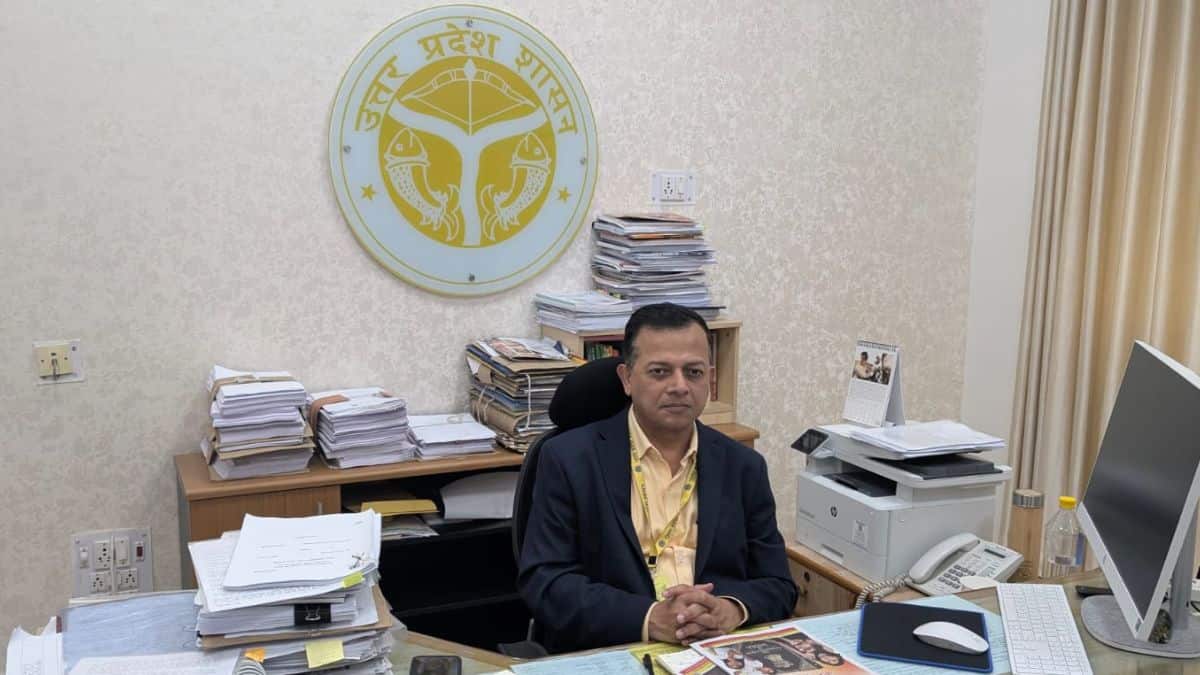
As principal secretary of basic and secondary education in Uttar Pradesh, Partha Sarthi Sen Sharma oversees the functioning of 2.62 lakh schools, public and private, in the largest state school system in India. Appointed to the post last year, Sharma speaks to Careers360 about the focus on foundational reading and numeracy, managing dropouts, improving learning quality, vocational education, composite schools and more. Edited excerpts:
UP has seen the highest drop in count of schools since 2019-20. Activists say they’ve been closed due to mergers and that’s ‘anti-education’. How is the government addressing the needs of students?
No school has been closed because of a merger or anything. This is absolutely wrong that any schools have been closed. The government of UP is totally committed to provide education to every child from age 8 to 14 years. There is absolutely no question of closing any school.
Until last year, you were in the health department. What has been your experience with the school system?
I had been in the school system earlier also. However, things have changed in the intervening years. While some things remain the same, there is definitely more emphasis on the quality of education now. We have crossed the stage where access to education was the main concern. Now, the main focus is on quality of education, on vocationalisation, and taking education to the secondary level.
What are the major challenges and immediate priorities of your department?
The National Initiative for Proficiency in Reading with Understanding and Numeracy (NIPUN Bharat Mission) and functional and numerical literacy remain an issue for basic education. We believe that if in Classes 1 and 2 children are not confident and competent about functional and numerical literacy, they will later face problems in learning. So, our main focus is on this part of basic education. Second is competency-based learning at every level, especially in secondary education. In basic education, there have been projects like Samagra Shiksha and Sarva Shiksha Abhiyan and others. Now, more emphasis is required on secondary education as well as on vocational education.
Government of UP has come out with an ambitious scheme – CM Composite School – launched last year, in which we have started with 150 schools throughout the state which will be integrated pre-primary-to-Class 12 schools. That is one high-focus area.
Further, in implementing the National Education Policy and in vocationalisation of education in UP, we face the challenge of handling the cadre of teachers. It is a huge state with a huge cadre and people have their own HR constraints. Hence, to manage a huge cadre of teachers like this becomes a challenge. So, our emphasis will be to fill up the teacher vacancies in conjunction with the commissions and to build their capacity, competence and confidence, because at the end of the day, they would be teaching in the schools. Our aim is to ensure that we have the required number of teachers and to give them an environment in which they can do their job.
Also read PARAKH Rashtriya Sarvekshan: Even among top schools, 30% lack resources, 50% need repairs
What has been the progress on CM Composite Schools?
The CM Composite Schools were launched to address the fragmentation of our school system especially in Class 5, Class 6 to 8, then Classes 9 and 10. During these classes, many students drop out. Hence, we planned to build composite schools that will be from “minus 3 to plus 2” [pre-primary to Class 12], like a Kendra Vidyalaya.
Right now, we are building two schools per district. But the idea is to eventually have one such school in each cluster or panchayat. The idea is that instead of taking the school to each doorstep, now with better transport and better communication facilities, there can be good, integrated schools. Teachers feel comfortable working in a bigger ecosystem and the learning is better.
From January onwards, 1.3 lakh primary schools have gone under NIPUN School assessment. How is that panning out?
It is happening right now as we speak. The assessment will happen till February 14. One change made this year was to make the NIPUN Assessment mandatory for all parshadiya [municipal] or government schools.
The reason for the assessment is to find out what exactly the schools have done under the mission. The assessment is required so that the schools can come out with their own improvement plans. Hence, we decided to go for all schools with at least two teachers for this assessment. Also, it is done through D.EL.Ed trainees who are being trained at District Institutes of Education and Training (DIET).
A team of two trainees goes to each school for the assessment. After the assessment, the compilation takes time. While we expect the result to be out by March, we have not done such an assessment at such a scale previously. We want to do a fair assessment and so, there’s no pressure on anybody.
There are 1.94 lakh teacher vacancies in primary and secondary schools. How has that been addressed ?
In 2024, the government of UP had launched Uttar Pradesh Shiksha Sewa Chayan Aayog, a commission for teacher recruitment in the state which will henceforth be recruiting all teachers, for both basic and secondary.
For the government inter-college vacancies, we have already sent our requisition to the Public Service Commission and they have also come out with their advertisements and the exams. However, for the rest of the hirings, we are in the process of sending the requisition to the newly-constituted commission, created to integrate all the recruitments under one body.
The school drop-out rate in UP is still one of the highest, according to the response to a question asked in parliament. How is the government planning to address this issue?
UP does not have the highest drop-out rate. The emphasis on quality education is the main thing. We believe that if the education quality improves, then the kids' learning will automatically improve in school. Also [important is] the involvement of parents in a child's education so that they know whether a student is learning or not. Our main emphasis on Mission NIPUN and quality of education is precisely to address the dropout rate. If you see over the years, the dropout rate in secondary –not only in UP but nationally – will be higher than in primary education. This is because the country did not expand secondary education in the same way as primary education; Sarva Shiksha Abhiyan and the Right To Education Act were for elementary schools.
However, now is the time where we have to expand our outreach for secondary schools so that the dropout rate after Class 8 and Class 12 falls. Also our main emphasis in the next School Chalo Abhiyan, apart from Class 1, would be on Classes 6, 9 and 11 because that is when a large number of dropouts happen. When the students transit from Class 5 to Class 6 is when they change schools.
So, our emphasis this time will be on Class 5 teachers; we want to ensure that all students graduating from their classes are enrolled somewhere. Similarly, we are emphasising on the Class 8 teacher to ensure that all the students who emerge from [middle school] get enrolled somewhere in Class 9.
Last year, the UP government launched a “learning by doing” programme under SSA. What has been its impact?
Learning-by-doing is basically to prepare students for the future in vocationalisation. The programme is a new concept which came out of NEP 2020. It has been introduced in a number of schools in Classes 6 to 8.
It is going well. We have tied up with Indian Institute of Technology (IIT) Gandhinagar for this programme. Through this, we expect students to become more confident, adept in their hand skills and experiential learning.
What are the plans for vocational education in schools?
In basic and elementary education, the scope of vocational education is much less because at that time we want them to study up to Class 8, also mandated by RTE. We have just introduced a “learning by doing” programme.
Vocationalisation actually takes stage in secondary education. To address this, the department of secondary education has tied up with the UP Skill Development Mission (UPSDM), under a project called Project Praveen to provide free, certified, and vocational training to Classes 9-12 students. Started in 2022, UPSDM engages their partners to teach our students different vocational learning subjects, which is our main emphasis.
The project started with 179 schools, with a second phase of 1,200 schools and third stage including 1,200 more. In 2026, we should be able to take it to all government schools. We aimed to implement it in all schools but it was rolled-out in a phased manner because there was a constraint in the availability of trainers.
UPSDM has empanelled training partners which allocate trainers for particular skills to the schools. These skills are picked through a need-assessment done for each school. There is a complete matrix, including each school’s trade and its allocated training partner. There are around 16 or 18 trades, including junior technician, computer hardware, general duty assistant, healthcare general duty assistant, beauty wellness, back office associates, retail and others. We have seen healthcare, electronics, beauty and wellness receiving a lot of demand. Also, some media and entertainment skill courses also include drawing and painting.
In 2024, the government launched a digital app to curtail absenteeism for teachers. Did this have an impact?
In secondary education we already have an online attendance system for both teachers and students. However, for basic education, there were certain concerns. We formed a committee under me to address the concerns of teachers and then to implement the app rather than the other way around. We took the teacher unions into confidence and constituted a committee to make the app. We are looking into this and plan to roll it out by 2026-27 academic year.
Also read Bihar: Online attendance via e-Shikshakosh a ‘burden on teachers’ but has curbed absenteeism
What are the key changes in basic and secondary education?
In the last four to five years, we have done broad changes in five major areas in school education. Firstly, Operation Kayakalp to improve the physical infrastructure; second is Mission NIPUN to improve the functional and numerical literacy; third is the introduction of smart classes and Information and Communication Technology (ICT) in schools; fourth would be Project Alankar to improve secondary-school infrastructure; and fifth will be the CM Composite school, started in 2025.
 Add as a preferred source on google
Follow us for the latest education news on colleges and universities, admission, courses, exams, research, education policies, study abroad and more..
To get in touch, write to us at news@careers360.com.
Next Story
]Latest Education News
]Related News
]CBSE Date Sheet 2027 LIVE: Class 10th, 12th time table soon on cbse.gov.in; sample papers, grading system
AP Inter Time Table 2027 LIVE: BIEAP 1st, 2nd year schedule soon at bie.ap.gov.in; marking scheme, rules
Board Exam Timetable 2027 LIVE: UP, TN 10th, 12th exam dates out; BIEAP, Maharashtra exam schedule


