
‘Content-heavy to context-driven’: Great Lakes Chennai launches PGPM with consulting, data science majors
Aeshwarya Tiwari | December 17, 2025 | 02:42 PM IST | 8 mins read
GLIM Chennai’s two-year PGDM applications double in four years; COO wants NIRF rankings to include case studies, consulting output in research metrics for B-schools
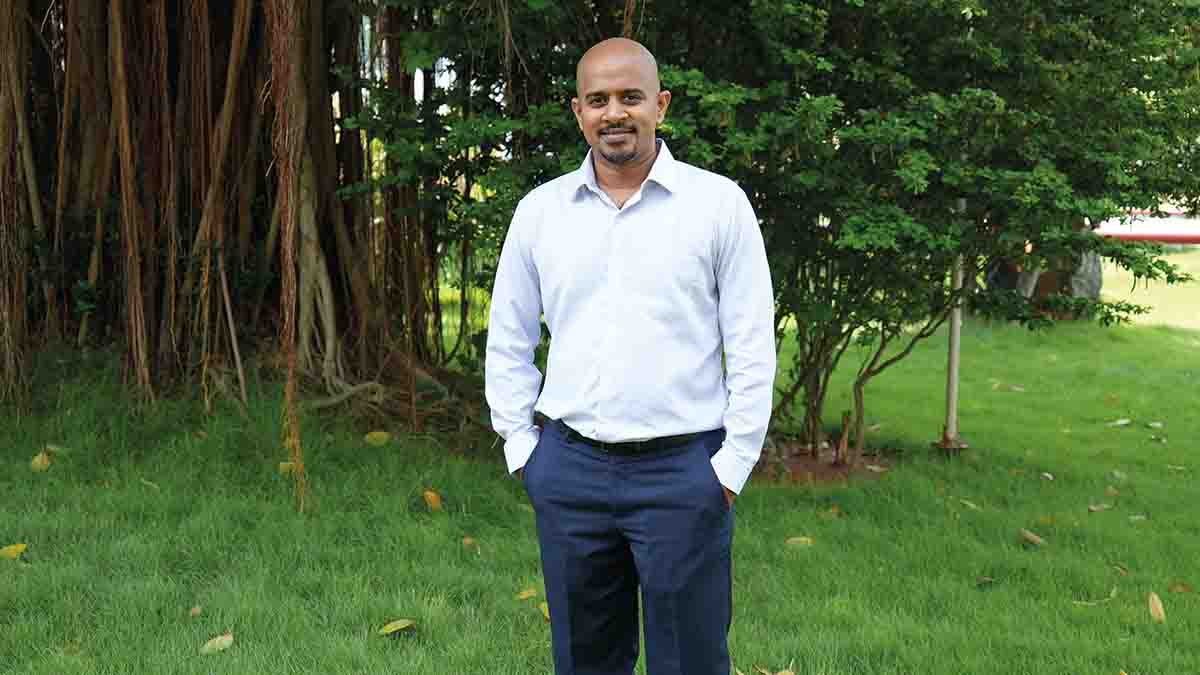
Gautam Lakhamraju Chief operating officer, Great Lakes Institute of Management, Chennai, shared how Great Lakes has “moved management education from being content-heavy to context-driven”, the latest trends in placements and what NIRF needs to change for a fairer assessment of standalone B-schools. He has updated its one-year PGPM and the two-year programme has seen applications nearly double in four years, in an email exchange with Careers360. Edited excerpts:
How does Great Lakes’ one-year PGPM programme compare with the two-year one?
The one-year PGPM and the two-year PGDM cater to professionals at different career stages and learning needs.
The one-year PGPM is a truly accelerated, future-ready programme for professionals with a minimum of two years of work experience and it allows them to get back into the industry within a year, minimising the opportunity cost while transforming their career. The latest PGPM 2.0 update makes it even more relevant for the evolving business world. We’ve reimagined the curriculum to mirror how business decisions are made today: integrated and data-driven. Apart from traditional functional specialisations, the programme offers new industry-focused specialisations in consulting, data science, product management, and analytics – areas that will be in demand over the next decade.
Students can pursue dual majors while building functional grounding in marketing, finance, or operations.
The two-year PGDM, meanwhile, serves as a career accelerator for early-stage professionals and fresh graduates. It provides the time and structure to build foundational skills, explore multiple domains, and gain real-world exposure through internships and live projects. The programme focuses on building a strong analytical core while developing business communication, problem-solving, and collaboration skills that employers consistently rate highest in first-time managers.
By the time they graduate, they don’t just have a management degree, they have industry exposure, personal coaching, and placement readiness that puts them a step ahead of peers, entering the job market for the first time. The programme has gained immense traction with the applications nearly doubling over the last four years and also attracting marquee recruiters.
What are the most pressing challenges facing management education in India?
The biggest challenge for management education today is staying contemporary and relevant to the industry needs. Businesses are evolving at a pace that traditional academic structures struggle to match, driven by rapid digitalisation, data-led decision-making, sustainability goals, and the demand for adaptive leadership. The question is no longer “Can students analyse a problem?” but “Can they solve it with context, speed, and empathy?”
At Great Lakes, we’ve addressed this challenge by completely reimagining our programmes to reflect the realities of modern business. The new PGPM 2.0 is a case in point. The curriculum integrates Impact Skill Labs that strengthen communication, storytelling, and data visualisation – all essential for managerial influence. Students also benefit from one-on-one faculty mentorship and constant CXO engagement from companies such as McKinsey, Accenture Strategy, and PayPal.
They also engage in experiential projects and empirical studies that translate theory into tangible results. This design ensures that participants don’t just learn frameworks, they practise decision-making and build the necessary skills to thrive in the corporate world. In short, our approach has been to move management education from being content-heavy to context-driven. The world doesn’t reward what you know; it rewards what you can apply. And that’s exactly what our programmes are built to do.
How do standalone B-schools balance case-based learning with research?
It’s not a trade-off. Case-based learning builds agility, the ability to think through ambiguity and make decisions with incomplete data. Research builds depth, it keeps teaching rigorous and future-focused. The best management education blends both.
At Great Lakes, we’ve made that integration deliberate. The redesigned PGPM 2.0 and PGDM combine industry-driven cases, live projects, and experiential learning with faculty research and empirical studies that ground classroom discussions in real evidence. Many of our cases come directly from faculty research or corporate collaborations, ensuring that what students analyse is current and practical.
Standalone institutions like ours may not match the scale of multidisciplinary universities, but we have the agility to make research applied and teaching relevant. That’s how we ensure students don’t just learn about business transformation; they learn from those creating it.
Also read FORE Delhi director: ‘Indian B-schools have become overtly placement-driven’
Do you see major changes in placements after the Covid-19 pandemic?
Yes, quite a few, and they reflect how the job market itself has evolved post-covid. Over the past few years, we’ve seen a couple of clear shifts.
First, a diversification of roles and sectors. Earlier, placements were concentrated around traditional consulting, IT, and BFSI. Today, we’re seeing far greater representation from product management, digital business, analytics, FinTech, HealthTech, and manufacturing. Recruiters are looking for candidates who can bridge business and technology, which aligns well with our focus areas under the revamped PGPM 2.0.
Second is a stronger movement toward strategic and tech-led functions. Consulting continues to be the top recruiting domain, contributing to over half the roles offered to the recent PGPM cohort, but there’s a noticeable rise in data-driven, cross-functional roles, such as business analytics, operations transformation, and digital strategy. Employers today value problem-solving ability and comfort with technology as much as functional depth, and our programmes are designed with that reality in mind. Overall, the post-COVID placement landscape has become more dynamic, but also more meritocratic.
The bigger impact as we speak will be due to the transformation of the business landscape due to the rapid adoption of generative AI across industries. The democratisation of knowledge and intellectual resources means that the candidates who will thrive are those with cross-disciplinary thinking, creativity and strong interpersonal skills, precisely the capabilities our programmes are built to nurture.
What kind of policy changes could help B-schools like yours become more globally competitive?
For India’s B-schools to compete globally, policy needs to shift from control to enablement. Institutions like Great Lakes already benchmark programmes internationally, are globally-accredited on par with the leading schools in the world, and work closely with industry; what we need is greater autonomy to innovate faster.
There has been progress on this, with top-tier schools, including Great Lakes, getting reasonable autonomy from AICTE [All India Council for Technical Education] based on being in the NBA top tier of accreditation but we can benefit from further flexibility. Simplifying approvals for new formats, global collaborations, and joint certifications would let schools respond to emerging business and technology trends in real time. Policies should also encourage faculty exchange, international research partnerships, and recognition of global accreditations, such as AACSB, AMBA or EQUIS, all of which raise academic credibility and global visibility.
More than regulating the inputs, the role of the regulator should be in terms of supporting and measuring outcomes. Simply put, quality institutions don’t need more regulation; they need flexibility with accountability. The next leap for Indian management education will come from that balance.
Separately, there has to be investment in research, both by the public sector and private sector. Research is expensive given the resources required and beyond encouraging research by measuring it in rankings, there has to be actual monetary investment in improving the quality and impact of research.
Do you feel the National Institutional Ranking Framework reflects the strengths of standalone B-schools like Great Lakes?
The NIRF framework does a commendable job of benchmarking institutions across teaching quality, graduation outcomes, and infrastructure. However, when it comes to standalone b-schools, it doesn’t always capture their full value proposition. These standalone b-schools often excel in pedagogy, experiential learning, and industry engagement, which are areas that translate directly into strong career outcomes. The key stakeholders, the students and the recruiters, care about these outcomes and the rankings should ultimately reflect it.
The challenge arises in two areas: research and perception. The research parameter, which accounts for nearly a third of the score, is heavily weighted toward publication volume and citations. This naturally benefits large, multidisciplinary universities with established research ecosystems, rather than focused B-schools whose output is often practice-oriented, such as case studies, consulting projects, or industry reports.
I think there has to be flexibility in evaluating the output more holistically rather than having one measure that fits all. For example, in management, the focus is on practical applications and impact, while in a science or engineering department, the focus may be on more basic research.
Perception is another complex factor. It is quite opaque, subjective and tends to reinforce historical awareness and legacy rather than current performance, making it harder for newer or independent b-schools to gain recognition despite delivering strong outcomes.
What changes would you recommend?
Three broad shifts could help.
First, the research metric should be customised for each type of institution. For example, in management education , it should evolve to include practice-based outputs such as policy papers, consulting output, and case studies alongside academic publications. This would ensure that applied knowledge creation, which is core to management education, receives due credit.
Second, the perception component could become more transparent or replaced with objective criteria. Rather than conducting opaque surveys, it’s best if this weightage is assigned to measurable and verifiable outcomes for students. If recruiters are willing to put their money on hiring from certain schools more than others, we can safely assume that those schools are perceived better rather than based on non-transparent surveys which frequently lead to inconsistencies.
Finally, introducing discipline-sensitive weighting or separate categories for standalone institutions would make comparisons more meaningful. A management institution should not be judged by the same research lens as a large university or a science school; instead, excellence in teaching, corporate engagement, and learner outcomes should be given proportionally higher weight.
 Add as a preferred source on google
Follow us for the latest education news on colleges and universities, admission, courses, exams, research, education policies, study abroad and more..
To get in touch, write to us at news@careers360.com.
Next Story
]Institute of Rural Management Anand enters a new era with fresh campus, MBA courses, curriculum
The newly-established Tribhuvan Sahkari University on the IRMA Anand foundation has launched three MBA courses focused on agribusiness management, cooperative banking and finance, and cooperative management’
Sheena SachdevaLatest Education News
]Related News
]NEET PG Counselling 2026 LIVE: MCC round 1 college reporting from October 26; MD, MS cutoffs
Kerala University VC says no move to ban student politics, stresses need to curb violence
NIIT University holds 16th convocation, announces 100% placements for 2026 graduates


