
Hare School Kolkata principal: ‘India’s first football match was played on this field’
Pritha Roy Choudhury | March 8, 2026 | 12:34 PM IST | 4 mins read
Established by David Hare, the Hare School has alumni like Jagadish Chandra Bose and PC Roy; was a pioneer in imparting Western education. It now grapples with staff crunch, crumbling infrastructure
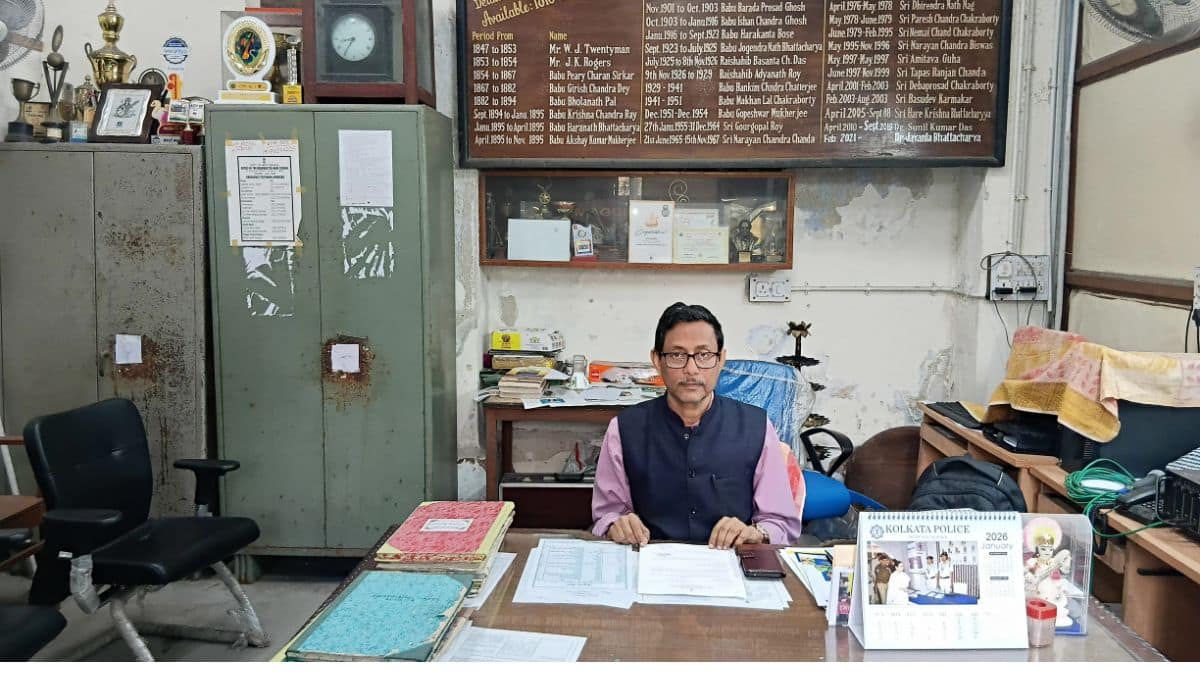
Kolkata: Hare School, one of the oldest schools in Asia imparting Western education, continues to play a significant role in shaping generations of students. In a conversation with Careers360, teacher-in-charge of Hare School Debasis Mondal spoke about the institution’s rich legacy, its evolution over time, and the challenges it faces now. Edited excerpts:
Hare School was the first in Asia to impart Western education. Could you elaborate on this?
The school was established in 1818. David Hare, a Scottish watchmaker, started the school society in 1817. He wanted to introduce Western education in India. Initially, there were a number of small schools under the school society, like Pataldanga Pathshala, Shimla School, and another school in the adjoining areas. In 1818, the David Hare School was established and has always been a boys’ school.
David Hare also established Hindu School in 1817. Hare School was established with the thought that students from all walks of life could be part of it.
What is the student strength of the school?
Presently, we have 1,074 students from Class 1 to Class 12. We have two sections for each class and there are 90 to 100 students in each. For Classes 11 and 12, we have three sections – Science, Arts and Commerce.
What makes Hare School unique in the history of education in Asia?
Hare School is the first school in Asia which started imparting school education in a westernised system. Initially, subjects were taught in English, and later both in Bengali and English. Now it is a complete Bengali-medium school.
The school became Bengali medium after India’s independence. The government had asked us to offer classes in English medium, but we did not agree. Hare is a very old school – the building is old, and we do not have enough rooms as well. We cannot add rooms as it is a heritage building. We also do not have enough teachers. Some government schools could start English-medium sections because they got the required teachers.
What kind of teacher shortage?
We are facing a shortage of teachers in all subjects. The sanctioned posts are around 50, but at present we have only 25 permanent teachers. Some are retiring, but there are no new recruitments.
There was recruitment in 2017, but not for conventional government schools. It was for newly-set up schools like integrated and model ones. These schools were established in collaboration with the central government. We also got one teacher then, but that did not suffice our needs. All those schools have affiliation with the West Bengal Board. The centre only funded them under the Samagra Siksha Abhiyan.
Can you mention some notable alumni?
Yes, there are many. I can name a few such as Jagadish Chandra Bose, the physicist and biologist; Girish Chandra Ghosh, Pramathesh Barua and many more. The school has also produced Prafulla Chandra Roy, the chemist and founder of Bengal Chemicals, and Radhanath Sikdar, the mathematician who calculated the height of Mount Everest. Another notable alumnus is Nagendra Prasad Sarbadikari, who is also known as the father of Indian football. The football ground one sees while entering the school is named after him.
What about the laboratory and infrastructure facilities at the school?
Our laboratories are well equipped. We have labs for all science subjects, visual arts, and a language lab where we have language-specific books, and students learn recitation, various forms of drama, and pronunciation. Students also write their own scripts for drama. We also have a history and math lab.
What is the socio-cultural diversity of the students?
We have many students whose origins are in Bihar, Jharkhand, Odisha, and Assam. We also have a student with roots in Andhra Pradesh. Last year, we had a Malayali student with roots in Kerala. The mother tongue has now kind of become Bengali for all.
Also read Reels, Gaming, Burnout: How schools, parents are drawing India’s smartphone generation back to books
What are the major attractions of the school?
Our school is known for its education. The biggest attraction is the football field — ‘Nagendra Prasad Sarbadhikari Krirangan’. The first football match of the country was played on this field.
The state government provides around 16 scholarships, including Shikhasree, Aikyashree, and Swami Vivekananda Merit Scholarship. For mid-day meals, we have tied up with several NGOs.
Any challenges faced by students?
One of the major challenges is that the Commerce stream has only one teacher. The problem is that he is also a Booth Level Officer (BLO), so students miss their classes when there is an election.
 Add as a preferred source on google
Follow us for the latest education news on colleges and universities, admission, courses, exams, research, education policies, study abroad and more..
To get in touch, write to us at news@careers360.com.
Next Story
]Maharashtra Budget: Key scholarship scheme loses 82% funds; cuts across schemes for poor students in higher ed
Tuition Fee Scholarship loses over 82%; others face massive cuts; one for law, teacher training wiped out. Also in Maharashtra CM’s budget 2026 – 10 ‘educational cities’, foreign campuses, public health institute in Nagpur
Musab QaziLatest Education News
]Related News
]Board Exam Time Table 2027: TN 10th, 12th, AP Inter date sheets out; TS, CBSE, RBSE, JKBOSE schedule soon
CBSE Board Exam Dates 2027 LIVE: Class 10th, 12th subject-wise timetable soon at cbse.gov.in, LOC submission
Andaman schools shut on October 27; Odisha districts on October 28, 29 amid ‘Cyclone Arnab’


