
PM SHRI Schools: Leaking roofs, broken computers, mounting paperwork – and more visibility than depth
K. Nitika Shivani | February 26, 2026 | 11:01 AM IST | 12 mins read
To some government schools, the PM SHRI tag has brought funds, administrative order, also more scrutiny and rules; but standard of learning remains same
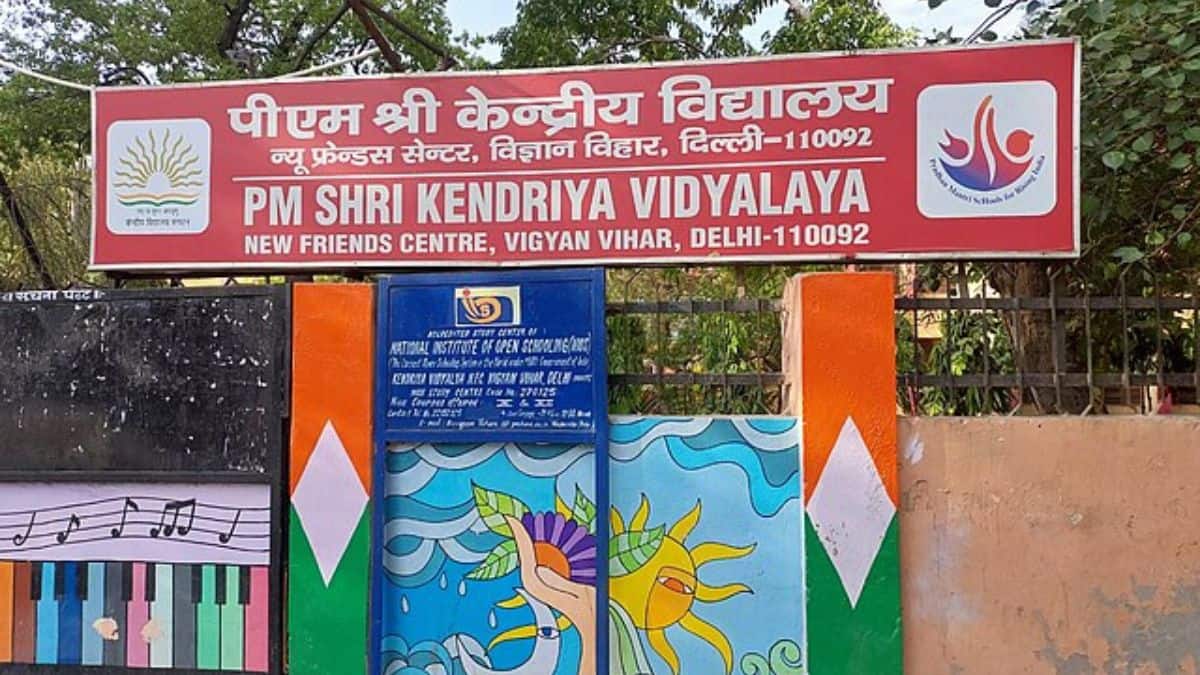
PM SHRI Scheme: “What changed was not the style of education,” said Manjula Ravina*, a teacher at a PM SHRI school in a remote part of Karnataka’s Ballari district. “What changed was who we answer to. Earlier, we answered to parents, local officers, and our own professional judgment. Now everything moves upwards like reports, photographs, dashboards. Teaching became secondary.”
The PM SHRI schools are a key initiative by the central government for schooling. Launched in 2022, the Pradhan Mantri Schools for Rising India are intended to serve as “model” government institutions, exemplifying the reforms proposed in the National Education Policy (NEP 2020). Existing government schools, including centrally-run Kendriya Vidyalayas (KVs), Jawahar Navodaya Vidyalayas (JNVs) and state-run schools, were picked for conversion into PM SHRIs. Ravina’s school was a regular Karnataka government school till it was converted into a PM SHRI in 2023.
But what has the tag meant for regular state government schools converted into PM SHRIs? As a teacher at a PM SHRI in Andhra Pradesh put it, “The branding works. Parents believe that this school will be better for their child’s future. But in reality, most of these schools are not very different. Except for a few new textbooks and a meal once in a while, there is very little change. That has been my observation, she concluded.
“PM SHRI was meant to be aspirational — a promise to turn selected government schools into national exemplars aligned with the National Education Policy,” said Dhrithi Manu*, a PM SHRI teacher in Karnataka.
“But nearly three years on, it has become a test of how far centralisation can go. Unlike earlier programmes which tried to strengthen government schools as a system, PM SHRI works through selection and conditions. States have to sign agreements, align curriculum, and follow centrally designed formats to receive funds. Schools are not strengthened as a right anymore; they are chosen, monitored and rewarded for compliance. In some places this has brought order and visibility. In others, it has brought anxiety, paperwork and a silence where questioning used to exist.”
Another teacher described the transformation more bluntly: “It became a kind of Modi mahal. Big boards, big words, but very little space to ask whether the child is actually learning.”
Becoming PM SHRI
The PM SHRI scheme seeks to upgrade a limited number of government schools into model institutions. Schools run by the central, state or union territory governments, and local bodies are eligible.
At the block or urban local body level, a maximum of two schools can be selected, one elementary and one secondary or senior secondary, subject to an overall national cap of fourteen thousand five hundred schools. In reply to a question raised in parliament, the government said there are currently 14,500 PM SHRI schools.
First, states and UTs sign a memorandum of understanding with the centre outlining their commitments; second, an eligible pool of schools is identified and these schools compete to meet prescribed criteria, which are verified through physical inspections. The final list is approved by an expert committee in the ministry of education headed by the secretary for school education and literacy.
PM SHRI Schools: Curriculum, compliance
Domain & Focus | Key compliance action |
Curriculum & Pedagogy How children learn |
|
Inclusive & Multi-lingual Education Language and access for all |
|
Green & Sustainable Practices, Green school programme Environment-friendly schools |
|
Digital & Vocational Education Skills and technology |
|
Infrastructure & Safety Physical facilities |
|
Convergence & Management Coordination with schemes |
|
The PM SHRI initiative has been linked to the main school education scheme run in the country, the Samagra Shiksha Abhiyan. In the 2026-27 union budget, the centre earmarked Rs 7,500 crore from PM SHRI and Rs 42,100 crore for SSA which supports lakh of schools.
Opposition-ruled states with reservations about the NEP 2020 have been arm-twisted into signing agreements with the union education ministry which has withheld crucial SSA funds from holdouts like Tamil Nadu, Kerala, West Bengal and previously, Punjab.
Also read How randomised controlled trials hollowed out Indian education
PM SHRI Schools: What changed?
A principal at a PM SHRI school, originally a regular Karnataka government school, who requested anonymity, said the administrative focus of the PM SHRI framework often misses the most basic realities of schools.
“We have monthly and quarterly meetings to discuss ‘progress’, and we spend a huge amount of time submitting reports. But the real problems are far more basic,” the principal said. “Water facilities and clean toilets remain the biggest challenges… There are leaking water pipes that drip straight into classrooms when it rains. These are not small issues, but they rarely feature in review meetings.”
According to the principal, very little has changed on the ground beyond paperwork and assessments. “The syllabus keeps getting revised, reports are more detailed, and there are more exams and assessments to conduct. But infrastructure has not kept pace. We have computers that are still not functional because at least half of the systems are faulty. They need stronger electricity connections and reliable internet. Without that, it is only a showcase… We are told everything is available online, but that assumes the network actually works.”
Staffing constraints deepen the problem. “Clean toilets are a permanent struggle because there are simply not enough non-teaching staff. Even teaching staff shortages continue. On top of this, assessments now require materials for activities, art, and project work. Teachers often end up paying out of their own pockets. We send emails detailing our expenditure and request funds, but the system is so rigid that meaningful change is very difficult to bring about.”
However, the principal said the scheme has worked in a limited number of cases. “Out of maybe 50 schools, around 15 are doing well,” she said. “Where funding, leadership, staff strength, electricity, water, and internet connectivity come together, you can see real improvement. Those schools show that the idea itself is not wrong. The problem is that the conditions needed for the scheme to actually work are not in place everywhere.”
PM SHRI Scheme: Upgrade to oversight
The only change that’s universal is an unprecedented level of monitoring, tying quarterly funding to strict compliance, digital reporting and visible implementation of prescribed components, from smart classrooms and vocational modules to attendance dashboards and infrastructure audits.
A government school teacher in Telangana described the pressure as constant and impersonal. “If something is delayed or not done exactly as the format demands, the question is never about why,” the teacher said. “The question is whether the next instalment will be held back. We are accountable to a system we had no role in shaping, and no space to question.”
In Maharashtra, a teacher from Pune who worked as a guest lecturer at a PM SHRI before resigning in 2023, said PM SHRI has also absorbed schools with unresolved structural problems. “Schools with teacher shortages, broken toilets or poor access were renamed and photographed,” the teacher said. “On paper they became model schools. On the ground, nothing fundamental changed at all but the paperwork doubled.”
The administrative burden, the teacher added, was relentless. “I was expected to teach, manage digital uploads, verify infrastructure data, track enrolment, prepare inspection files and respond to calls from multiple offices,” the teacher said. “It was not education. It was survival.”
A senior teacher from a PM SHRI school in northern Karnataka said the scheme blurred professional boundaries. “Earlier, my job was to teach and mentor students,” the teacher said. “Now I am also a data operator, a compliance officer and a public relations worker for the school.” She added that the emphasis on visibility had changed priorities. “They want photos, dashboards and proof of activity,” the teacher said. “They don’t ask what the child understood after the class.
State power, state pushback
Resistance to PM SHRI has been most explicit in Tamil Nadu, where the state government has refused to sign the memorandum required for full implementation of the scheme. State officials have argued that PM SHRI links routine school funding to policy compliance, particularly on curriculum alignment and language provisions, thereby narrowing the space for state-level educational autonomy.
In districts such as Madurai, Tiruvannamalai and Dharmapuri, teachers said the uncertainty around funding and compliance has filtered down to schools even without formal implementation. A teacher and former policy expert in Tamil Nadu described PM SHRI as “a loyalty test disguised as reform.”
“Statistically, you can always show improvement,” the expert said. “But when compliance becomes compulsory, questioning becomes risky. Education cannot function where fear replaces debate — and that fear travels from the Secretariat to the staff room.”
Kerala, too, has taken a slower and more cautious path. The state has paused aspects of implementation, arguing that its public schools already meet or exceed many of the benchmarks PM SHRI claims to introduce. A teacher from Kottayam said the concern was less about infrastructure and more about equity. Selective funding, state officials argue, risks hollowing out systems that were built on universal access rather than model-school exceptionalism, she said.
Elsewhere, the response has been more muted. In Puducherry, teachers said PM SHRI brought additional reporting requirements but did not significantly alter classroom standards. “It was good before, it is good now,” one teacher from South Puducherry said. “There is more paperwork, but also more predictability.” Similar assessments were reported from parts of Maharashtra and Goa, where teachers described the scheme as administratively heavier but academically neutral.
A teacher who moved briefly from Uttar Pradesh to work in a PM SHRI school in another state offered a sharper assessment rooted in regional governance patterns. “There is a reason why so many PM SHRI schools are concentrated in Uttar Pradesh and Bihar,” the teacher said, referring to districts such as Sitapur, Bahraich, Gaya and Purnea. “These are systems that have not historically pushed back. Funding is easier to reroute and rebrand when schools are used to following orders rather than questioning them.”
Changes for PM SHRI students
“They ask for Aadhaar again and again,” said Lakshitha, a secondary student in a PM SHRI school in Raichur. “They ask how many people are working in the family, how many are at home. Sometimes classes stop just for this, and the period goes.”
Several students said the emphasis on data collection has become a routine part of school hours, often cutting into teaching time. Teachers, they noted, appear under pressure to complete forms and verify records, even during regular classes.
Infrastructure upgrades, a key promise of the scheme, are visible but inconsistently functional. Smart classrooms and digital laboratories have been installed, students said, but only a limited number are operational at any given time. “Only one or two rooms actually work,” said Banu who attended a rural PM SHRI in north Rajasthan till 2025. “If a teacher wants to use the smart board, we all move to that classroom.”
As a result, access to digital learning depends on scheduling and logistics, with students rotating spaces rather than technology being integrated across classrooms.
At the same time, students collectively from various states acknowledged tangible administrative improvements. School days begin and end more predictably, mid-day meals arrive on time, and classrooms appear better maintained. “The timetable is clearer, meals come on time, and classrooms look better,” one student said. “But teaching feels the same.”
Also read CBSE 2026: Board tightens rules on cheating, makes it harder to pass; Class 10 gets new marksheets
Central schools: KVs and JNVs
Many Kendriya Vidyalayas and Jawahar Navodaya Vidyalayas were automatically folded into PM SHRI, officials said, because they already function under central administration and a uniform national framework.
Yet teachers in Kendriya Vidyalayas across Karnataka said long-standing problems remain largely untouched. “There are vacancies that stay unfilled for months, guest teachers handling core subjects, and very uneven monitoring,” said a KV teacher posted in a semi-urban district. “Access is ensured. But quality still depends entirely on who is standing in front of the classroom.”
Another KV teacher in north Karnataka said PM SHRI had little practical impact. “The name has changed, the reporting has increased, but classroom realities are the same,” the teacher said. “If a teacher is motivated, students benefit. If not, no scheme fixes that.”
In Jawahar Navodaya Vidyalayas, which operate as fully residential schools, administrative discipline is visibly stronger. Teachers said schedules, meals and academic calendars run on time. Some teachers noted that the residential model also intensifies pressure. “Students live, study and are monitored in the same space,” a teacher in a Karnataka JNV said. “There is order, but very little breathing room.”
PM SHRI Schools: Showcase or reform?
“In Goa, what PM SHRI has really become is a showcase that mistakes visibility for depth,” said Jessica, a former PM SHRI teacher who now works with an education-focused non-governmental organisation. “Equipment is introduced every year, new rooms are shown, photographs are taken, but no one checks whether that equipment still works a year later, or whether teachers are actually trained to use it. Maintenance is invisible, and that is where systems quietly fail. Reform cannot be a photograph. It has to be something that survives long after the inspection team leaves.”
On the contrary, several teachers acknowledged that PM SHRI has brought administrative order to schools that were previously poorly managed.
“In badly run schools, this kind of structure helps,” said a school administrator from a PM SHRI school in Andhra Pradesh. “Attendance improves, meals are regular, equipment arrives, and timelines are followed.” She also added that the scheme made neglect visible. “Earlier, nobody noticed broken systems because nothing was tracked,” the teacher said. “Now at least problems are documented, even if they are not always fixed.”
Some teachers also said PM SHRI created accountability where there was none. “Earlier, delays were normalised,” said a teacher from Sindhanur. “Now there is pressure but sometimes excessive and somehow it also forces action.”
 Add as a preferred source on google
Follow us for the latest education news on colleges and universities, admission, courses, exams, research, education policies, study abroad and more..
To get in touch, write to us at news@careers360.com.
Next Story
]Latest Education News
]Related News
]Board Exam Time Table 2027: AP Inter, TN 10th, 12th date sheets out; CBSE, RBSE, JKBOSE, TS schedule soon
CBSE Board Exam Dates 2027 LIVE: Class 10, 12 subject-wise timetable at cbse.gov.in soon; passing marks
HC upholds Delhi govt's policy on cash to EWS students for private school uniform


