
IISER Bhopal discontinued BS-MS course over placement issues, offering BTech-MTech degrees: Director
Sheena Sachdeva | June 1, 2026 | 11:32 AM IST | 7 mins read
IISER Bhopal launches new data science dept, plans those for AI, advanced materials, drones and sustainability; science streams retain BS-MS, engineering shifts to BTech-MTech
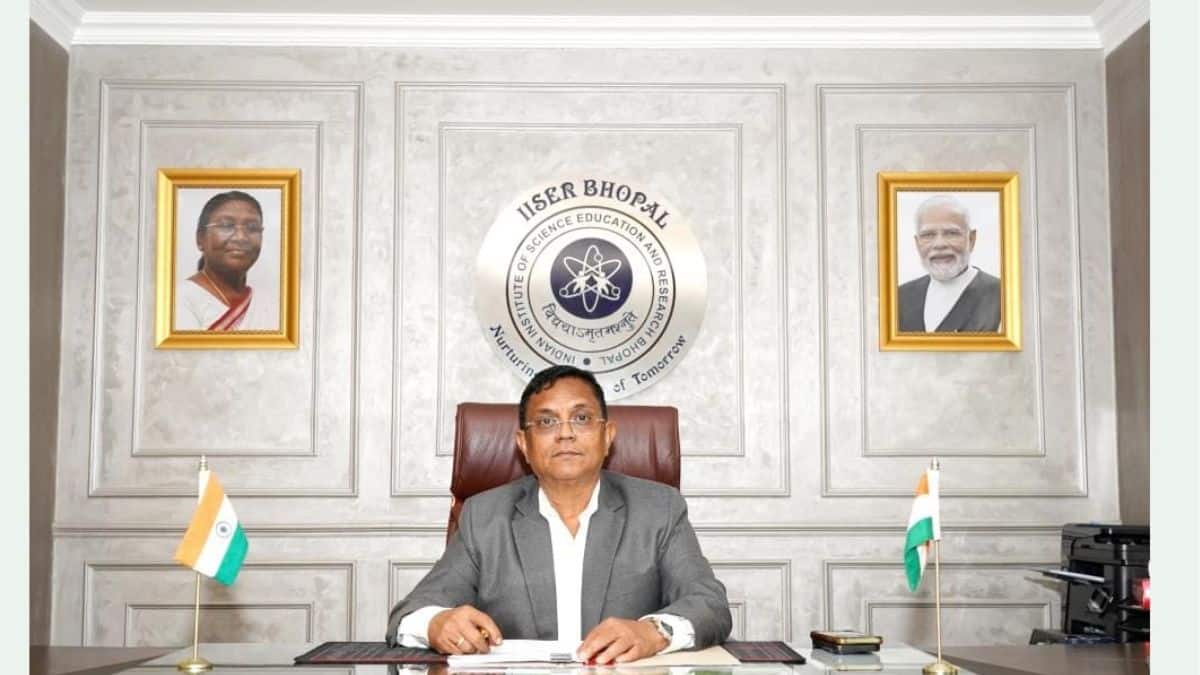
Indian Institute of Science Education and Research (IISER) Bhopal has recently converted its BS-MS degree into a five year BTech-MTech programme citing placements. Its director, Gobardhan Das, speaks to Careers360 on new courses and departments, placements and more. Edited excerpts:
Q. IISER Bhopal has been expanding into engineering programmes. How do you ensure that engineering education here remains deeply rooted in fundamental science rather than becoming application-heavy?
The IISER is established mainly for fundamental science. If you look at engineering also, it's not only technology – every technology emerges from fundamental science. We are actually looking for the fundamentals of any engineering subject.
We are doing research, giving training in, teaching mostly fundamentals, not just to make our students technically competent, but to also make them understand the fundamentals.
Therefore, our students are not only technologically ready and can perform on the job, but can also improvise the method or technology. This makes us unique.
Q. When was the BS-MS programme started? How have the placements been?
Our BS-MS degree is for natural sciences – physics, chemistry, biology, mathematics, art and environmental science. The degree started in 2018, since IISER Bhopal’s inception and we will be continuing it.
Our engineering department also used to give the BS-MS degree. But now we are discontinuing it and implementing BTech-MTech, just for the engineering school. Since its first batch graduated, I stumbled with a couple of problems with students facing issues with placements who wanted to remain in the country and couldn't get placed. Many others faced problems as the industry recognised BTech or MTech.
Also read BS-MS to BTech, AI, data science: Why India’s top IISERs are going beyond traditional degrees
Our BS-MS students are trained for research. In most cases, they go for higher education, pursuing PhD. They go abroad, or they go to a good institution within the country, like Indian Institute of Science (IISc) Bangalore, Indian Institutes of Technology (IIT), or other good research laboratories.
Also, students who get placed abroad are now coming back. Many of them are faculties in IITs, IISc Bangalore, other IISERs and central institutions.
Q. With research funding being cut, has this impacted IISERs overall? How have the science research focussed IISERs fared so far?
IISER faculty are extremely smart and well performing scientists. We are at the top. Our scientists attract extraordinary funding. I can proudly tell you that there is no barrier to funds. The Ministry of Education gives generous funds which are sufficient.
Last year, we filed 78 patents and some of them are already in the market. These are the kinds of cutting-edge science we are doing.
Q. The institute has announced initiatives in AI and cognitive engineering. How are these programmes translating into placements, research output, industry collaboration?
This is the age for artificial intelligence (AI). IISER Bhopal is one of the places where we are actually leading in AI, especially in medical and mining areas. We are doing excellent science, and we have several patents and products. We are also in the process of raising Rs 300 crore for a center on AI and are collaborating with medical colleges.
Q. What curriculum changes has the institute done to ensure students are skilled in AI-led disruptions?
We are introducing AI in several subjects and departments, including medical sciences, mining, environmental health and others. We have recently started a department on data science as well. From next academic year, all these subjects will be added in the curriculum as we are in the process of curating them.
Q. What changes have you made under NEP 2020?
We have added the provision of early exit. But so far, we don't see anybody who is taking exit or taking entry.
Q. There has been a push in India to teach technical courses in regional languages. What is your view on bilingual engineering, and has IISER explored this option?
I fully agree with bilingual courses for not only engineering sciences, but for all subjects. If you import something, some instrument from Japan, you'll see that the details of the product are not only written in English but in Japanese.
I believe if my language is Hindi, I should be taught in Hindi or my national language and my second language should be English. But our products, our talents, not only here but everywhere, in national conferences, should be bilingual.
I fully support it. Not only IISER Bhopal, other IISERs and institutions also have to opt for bilingual teaching and training the students.
Q. With increasing academic and career pressures, what systems have IISER Bhopal put in place to support student mental well-being?
In every institution, not only engineering colleges or IISERs, mental health is a problem. We have to find a solution. At IISER Bhopal, we have very good psychologists and counsellors.
Our teachers are friendly and discuss problems with their students. We also have many club activities, like stargazing, physics club, mathematics club, bird watching club and others. We encourage them to engage with various other activities like social work along with their studies. This helps subside several issues.
On the campus, faculties, students, our children, and teaching staff live like a family. Therefore we know and talk to each other, and listen to each other. At IISER Bhopal there are no such incidents. I think our students are happy.
Q. What new courses are in the pipeline?
There are several things in the pipeline. One is a new department of Advanced Material Science. We are the only institution in the country working in this area. We are making quantum grid diamonds, single crystals, and are engaged in semiconductor research. All this together means we are well equipped. We have experts for the material science department which is going to be one of the best in the country.
Another department we plan for is sustainability. It has many components, including energy, production of energy, storage of energy and hydropower. We are working on it.
We are also establishing a centre on minerals. We have a team that has gone to several places and discovered critical minerals. The amount of deposition we have is probably more than sufficient for the country to use, and we may not have to import or may be able to reduce importing. I should not claim that definitively, but we are closely working with the Madhya Pradesh government. We have found several important minerals that will be very helpful for the country.
We also want to develop a centre on drones. We are trying to produce indigenously-made drones. If you look at most drones today, those who are making them are importing parts and then simply assembling them. We have taken it as a challenge to start from hardware to software and make everything ourselves. Soon we will be able to achieve 100% indigenous technology for our drones, which can be used by various government agencies.
Another centre is Biotronics. Medical equipment and medical devices are largely imported. We are closely working with many hospitals, including All India Institute of Medical Sciences (AIIMS) and regional hospitals, and we are developing several devices. Many of these devices have already been patented, and we are testing them for real applications in hospitals.
In addition, IISER Bhopal is going to establish one of India's largest research parks where many start-ups will be able to incubate their ideas and products. This is similar to research parks that some IITs already have. For this, we are likely to secure Rs 400 crore from CSR funds.
Q. IISERs are more research focused and less industry-facing. How is your institute strengthening its industry partnerships and also on the curriculum side, are there any internships or industry projects ?
Our mandate is research and we are good at it. The question is translation. Every product you see has to come from fundamentals. We are doing basic science, and that basic science, today or tomorrow, has to be translated. This is where we are putting our effort, not only through tech degrees, but also institutional mechanisms. We have an incubation center through which we are incubating ideas and our products that can be mission-building for society.
People know us as a research institute, but some of our research can turn into products. Therefore, the research that we are doing is being translated into tangible outcomes. That is a win-win situation.
Also read ANRF PAIR Programme gives Rs 100 crore to just 7 hub-spoke networks, rest get Rs 2 crore grants
Q. IISERs attract a highly competitive pool of students. How is IISER Bhopal working to improve diversity – regional, socio-economic, and gender among its student population?
IISER Bhopal has a representation from all states. There could be some skewing from two or three states, but we do have representation from all. In terms of gender, we are almost at a 50-50 male-female ratio.
The IISER Aptitude Test (IAT) is a very tough exam. Seven IISERs together test around 12 lakh students. Essentially, one student out of 100 gets admission. It is highly competitive, and the students who come in are very smart. They are the future of our country. It is our responsibility to give them the right teaching, train them, and enable them to deliver on important missions.
 Add as a preferred source on google
Follow us for the latest education news on colleges and universities, admission, courses, exams, research, education policies, study abroad and more..
To get in touch, write to us at news@careers360.com.
Next Story
]JoSAA Counselling 2026 LIVE: Round 1 registration, choice filling begins; list of engineering seats offered
JoSAA Counselling 2026 Registration LIVE: Apply for round 1 choice filling on jeeadv.ac.in. Updates on scorecard link, cut-offs, toppers list, josaa counselling, admission process and other details.
Suviral Shukla


