
IIT Madras gets built-in-India ‘Param Shakti’ supercomputer with aim to boost scientific research
Aatif Ammad | January 8, 2026 | 02:43 PM IST | 1 min read
The government-backed supercomputer at IIT Madras is aimed to support large-scale research in aerospace, climate science, materials and drug discovery.

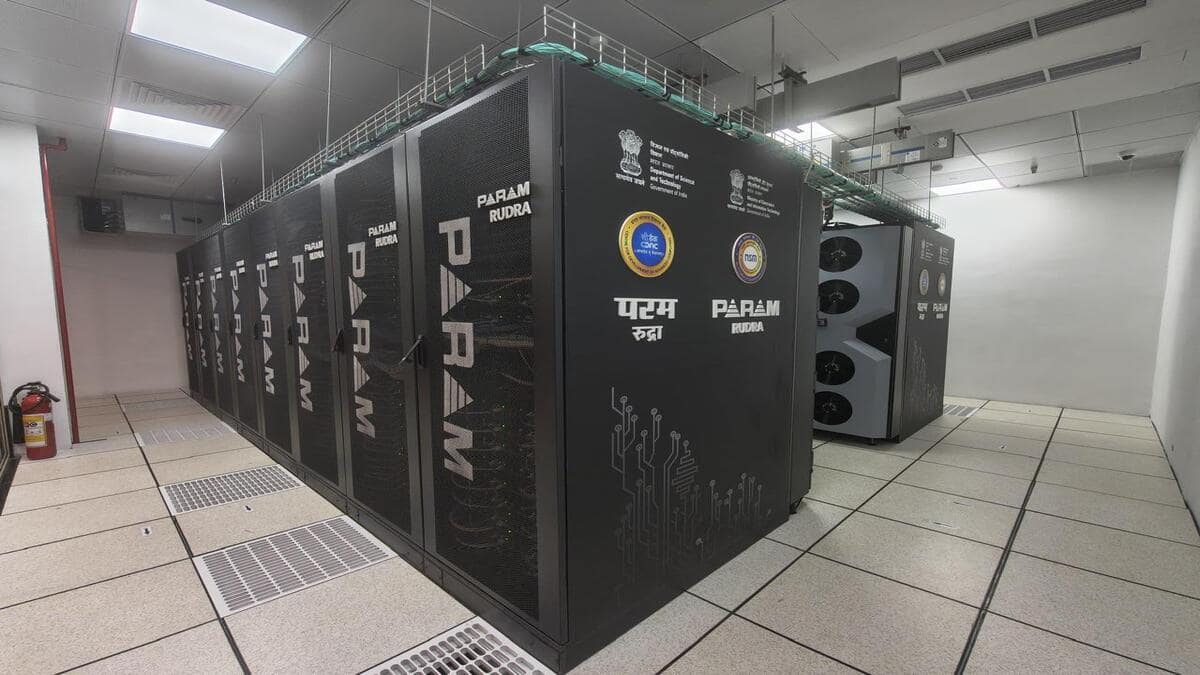
The Ministry of Electronics and Information Technology (MeitY) has inaugurated ‘Param Shakti’, a 3.1 petaflop indigenous supercomputer at the Indian Institute of Technology (IIT) Madras. It has been developed and implemented by the Centre for Development of Advanced Computing (C-DAC).
Built entirely in India, the facility delivers a computing capacity of 3.1 petaflops, meaning it can perform over 3.1 quadrillion calculations per second, placing it among the most powerful academic computing facilities in the country and is expected to help researchers solve complex problems much faster, cutting down years of experimental work.
The new system at IIT Madras aims to support research in aerospace, climate studies, materials science, drug development and advanced manufacturing, helping India compete more strongly at the global level, a press note on the development said.
The facility has been funded under the National Supercomputing Mission (NSM), jointly led by MeitY and the Department of Science and Technology (DST).
Also read Dual-track MTech, ‘product Phds’: IITs plan large-scale PG, research revamp
Along with the computing cluster, the infrastructure includes round-the-clock power supply, advanced cooling systems and energy-efficient data centre operations.
IIT Madras, Govt: National Supercomputing Mission
Addressing students and faculty, S Krishnan, secretary, MeitY, said that under the National Supercomputing Mission, the government is supporting application-driven research at scale, with 37 supercomputers already installed nationwide and more planned, strengthening India’s research and innovation ecosystem.
He said the effort was aimed at making research systems that can “operate at a scale that makes a real difference.”
V Kamakoti, director, IIT Madras, highlighted MeitY’s long-term role in advancing computing and digital infrastructure in the country, including initiatives like the National Knowledge Network.
He urged students to focus on writing energy-efficient code, effective sharing of GPU resources and developing indigenous technologies to support the vision of Atmanirbhar Bharat.
 Add as a preferred source on google
Follow us for the latest education news on colleges and universities, admission, courses, exams, research, education policies, study abroad and more..
To get in touch, write to us at news@careers360.com.
Next Story
]Latest Education News
]Related News
]PM Modi visits Sudha Gopalakrishnan Brain Centre on IIT Madras campus
Jamia School, IIT Madras collaborate to launch online certificate courses for Classes 9 to 12
IIT Madras study reveals air pollution could help improve rainfall, urban floods forecasting


