
SIMSREE director: ‘MBA courses and beyond, knowledge of single specialisation no longer enough’
Musab Qazi | December 16, 2025 | 01:58 PM IST | 6 mins read
SIMSREE, one of the 6 constituent colleges of HBSU, has converted 60 PGDM seats into MMS, launched MSc Finance inspired by London School of Economics
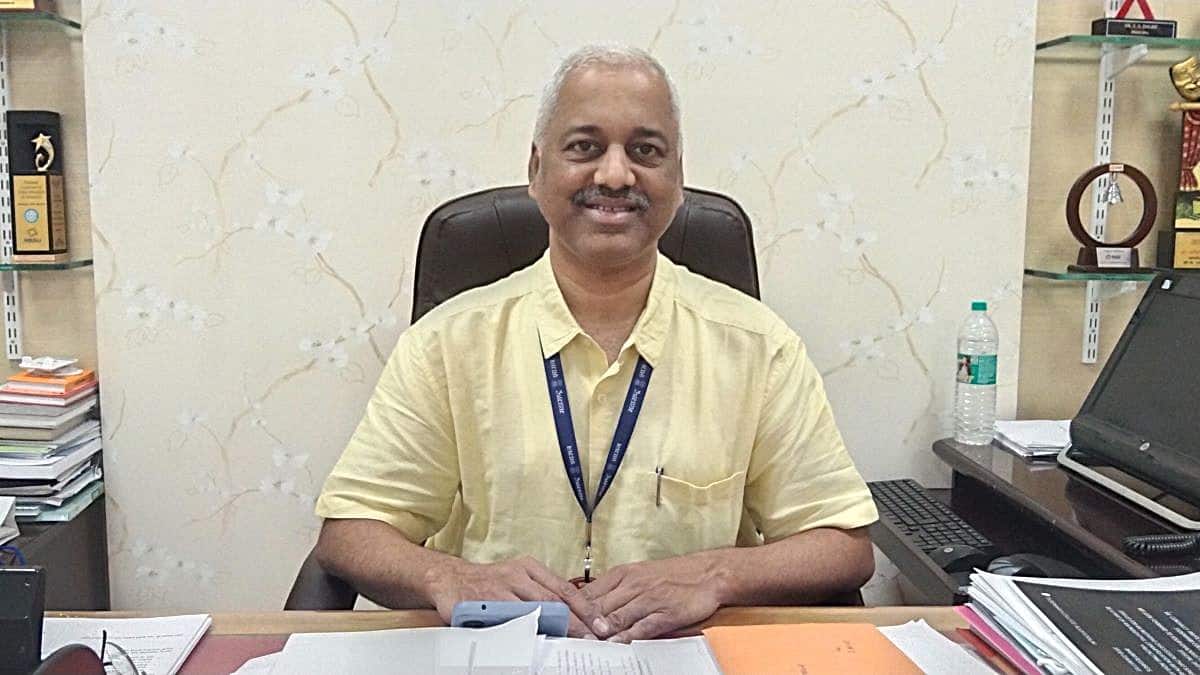
The Sydenham Institute of Management Studies Research and Entrepreneurship (SIMSREE) branched out of Mumbai’s Sydenham College of Commerce & Economics, the first modern commerce education institution in Asia in 1983. Since then, the government of Maharashtra-run institute has made a name for itself as one of the foremost centres of management education in the country. After decades of being affiliated to the University of Mumbai (MU), the B-school joined its parent institution to become one of the six constituent colleges of Dr Homi Bhabha State University (HBSU).
In this interaction with Careers360, SIMSREE director and mathematician Shriniwas Dhure speaks about changes in the institute’s curriculum, NIRF rankings and importance of mental health in management students. Edited excerpts:
What have been your priorities for the institute?
One of my first acts was getting 60 postgraduation diploma in management (PGDM) seats converted for Masters in Management Studies (MMS), ensuring that all our seats are fully recognised by the All India Council for Technical Education (AICTE). With this move, the graduates no longer need equivalence certificates.
We have also greatly enhanced the involvement of our alumni, which has helped in bringing internships and live projects to the students. We had a database of around 5,000 alumni. Reaching out to all of them was difficult but online communication becoming more prevalent during Covid-19 pandemic turned out to be a blessing. We are now able to interact with the alums settled abroad too.
What has changed since the institute moved from MU to HBSU?
Leaving the MU brand was a challenge but SIMSREE is a brand unto itself. Hence, there wasn’t any negative impact. We took it as an opportunity to develop our own curriculum.
We have since designed some new courses, such as MSc Finance, the inspiration for which came from the London School of Economics and Political Science (LSE). It’s geared more towards core finance as opposed to the management finance taught in the MMS programme. Students enrolled in the course will, among other things, learn about financial technology (FinTech).
While we wish to add more such self-financed programmes, we are handicapped by space constraints.
Also read FORE Delhi director: ‘Indian B-schools have become overtly placement-driven’
Are these self-financed programmes meant to buttress the institute’s revenue?
Yes, we need to adapt to the current trends in the education sector. We are engaging industry resource persons, who charge substantial compensation. At the same time, our annual fee continues to be only Rs 69,000, despite us bringing packages to the tune of Rs 25 lakh, making us the third-best institute across the country in terms of the return on investment (ROI). We don’t plan to hike the fees.
Is SIMSREE looking at other income streams, such as consultancy projects?
We don’t have any consultancy projects, though we should look into it as a revenue source. Some faculty members do get some research projects, but they only sustain the teachers. The institute doesn’t earn anything out of them.
The government, however, has been spending generously to improve our infrastructure, adding new facilities such as smart boards in classrooms.
Has the National Education Policy (NEP) brought any changes to the management curriculum?
With NEP’s emphasis on multidisciplinarity, more subjects from other specialisations have been added across management streams – finance, marketing and human resources (HR). There’s greater freedom to study courses outside the discipline but we are yet to add more programmes due to manpower constraints.
These reforms are in line with the changing face of the workplace, where the knowledge of only one specialisation is no longer enough. A finance person should also know about marketing and HR. At the same time, I believe that around 70% of the syllabus should still be related to the core subjects.
The activity-based learning proposed in the new policy has been a part of SIMSREE’s culture for a long time. Most of the decisions and activities at the institute are driven by the students, who run several committees and societies. We could see the benefits of this approach.
Also read 21 IIMs have less than 200 SC, ST, OBC teachers against 1,880 sanctioned posts despite quota law
How diverse is your student body? Are you taking any specific steps to make it more inclusive?
We give full consideration to diversity. Being located in a metropolitan area, gender diversity is not an issue. As the admission to the institute is through the state entrance test [MAH MBA/MMS CET], we get students from even mofussil areas. We ensure that learners from different backgrounds participate in student bodies and committees. This accommodation has been well enshrined in our ethos, with seniors passing on the baton to their juniors through mentorship and handholding.
SIMSREE has a ‘HappyNess Research Centre’. What’s its purpose?
The centre is the brainchild of Ashish Ambasta, a consultant who has studied the role of positive emotions and happiness in the Indian work environment as part of his doctorate. He measures happiness among students using a happiness index, evaluating which activities make them happy or sad.
We started this centre, as the students, who are going to become managers, should be mentally healthy. For this purpose, they are subjected to various exercises such as recognising goodness in others and shortfalls in one’s own selves.
Why hasn’t the institute figured in the National Institutional Ranking Framework (NIRF) lists?
Our main challenge is vacancies in regular teaching posts – only around five out of around 18 faculty positions are filled. While the shortfall has been a blessing in disguise, as we largely rely on 20-odd visiting faculty from industry. The ranking system should recognise and look upon positively at the industry expertise available at an institute.
How is the institute integrating artificial intelligence (AI) in the learning process?
We use some AI tools for data analysis and derivatives, but not beyond that. We do offer courses in [computer coding language] Python, [quality improvement tool] Six Sigma and harnessing data from LinkedIn, as these skills are sought by employers.
What are the placement trends at the institute?
Finance has traditionally been our strong suit and we continue to do well in it compared to other sectors. This will likely remain the picture for the next decade as the country’s economy is booming.
In marketing, there’s a heightened demand for specific roles such as digital marketing to cater to the influential culture and economy. While we have added digital marketing to the curriculum, the influencer economy needs to be incorporated too.
There appears a stagnancy in campus hirings across B-schools. What is the reason?
There’s still a gap between the industry’s requirements and MBA graduates. The employers need AI-ready employees. But as of now, graduates are not prepared for those roles. We are trying to give them the necessary training.
How do you plan to keep up with these changes?
We have to keep our syllabus dynamic. We can't have the pattern that we did 10 years ago. We may now need to change our syllabus every year, as the speed of change is very rapid. We have signed agreements with some firms, which keep providing us with inputs.
How should mathematics education evolve?
The teaching of mathematics should include aspects of logical reasoning and data analysis. We can’t have rigid maths anymore.
 Add as a preferred source on google
Follow us for the latest education news on colleges and universities, admission, courses, exams, research, education policies, study abroad and more..
To get in touch, write to us at news@careers360.com.
Next Story
]‘PUMBA Pune has added AI, big data to MBA courses; making curriculum trendy’: HOD
Department of Management Sciences at Savitribai Phule Pune University aims to modernise classrooms, revive MBA student cells, and integrate emerging technologies such as ai and cloud computing in flagship courses
Musab QaziLatest Education News
]Related News
]Jamia Millia Islamia students refuse to end protest; alumni extend support
JMI Protest: Congress extends support to protesters amid campus unrest
ESTIC 2026: PM Modi to inaugurate emerging science and technology conclave on October 27


