
CBSE cuts re-evaluation fee to Rs 100; defends OSM
Ruchika Kumari | May 17, 2026 | 01:33 PM IST | 3 mins read
CBSE clarifies OSM involves step-wise digital evaluation; announces a refund if marks change after re-evaluation.
50+ Entrance Exams after 12th
Download this ebook to explore 50+ entrance exams after Class 12 for admission into top undergraduate colleges across engineering, management, law & more.
Download Now
Amid growing concerns among students over On-Screen Marking (OSM) system, School Education Secretary Sanjay Kumar conducted a press conference today. He announced board's plan to return fee collected for revaluation if a student’s marks are increased post verification. Addressing concerns over the reduction in the board pass percentage, Kumar said that question papers differ every year, which could be one of the reasons for the variation in results. He added that out of a total of 98 lakh answer sheets, around 13,000 were evaluated manually, and the system is continuously under review.
IMP. Ques & PYQ's: Physics | Chemistry | Maths | Biology | English
Formula Sheet & PYQ's: Physics | Chemistry | Maths | PYQ's (All Subjects)
Also See: Foreign Universities in India | Liverpool | York | Bristol | Victoria
Free Study Material for Class 12th: Boards & JEE | Boards & NEET
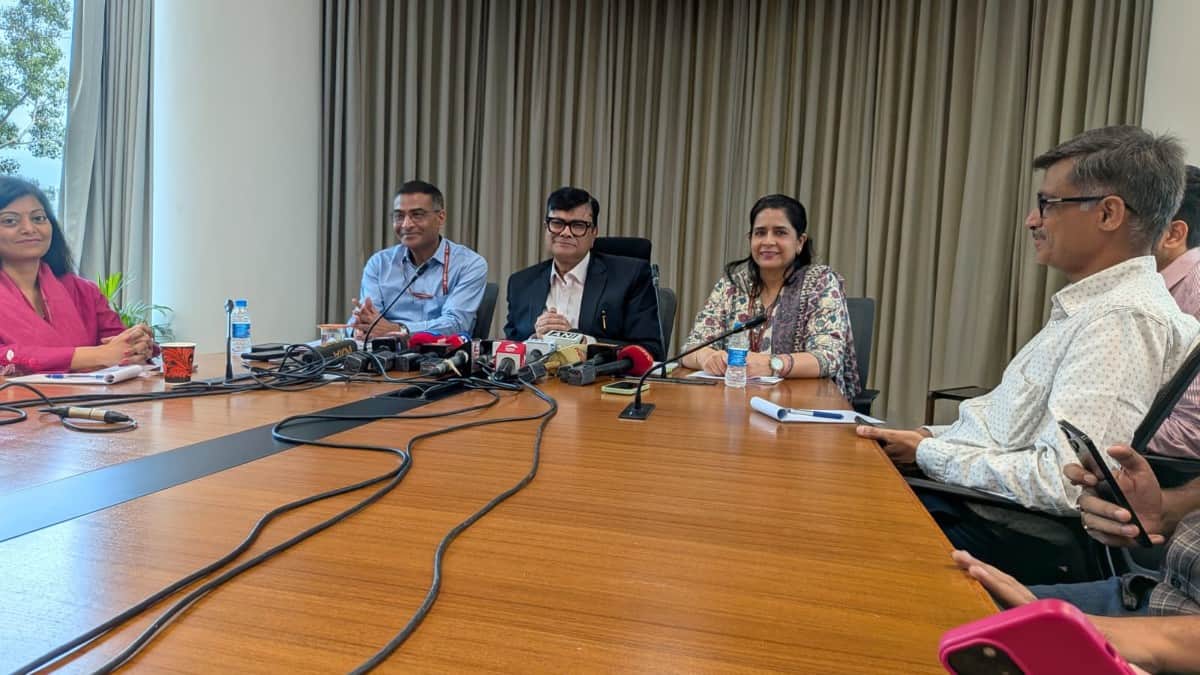 School Education Secretary Sanjay Kumar addressed concerns over OSM
Also read CBSE makes third language compulsory for Class 9 from July, with Class 6 books and shared teachers
OSM introduced in 2014
Establishing that OSM is not new, Kumar said CBSE had first introduced On-Screen Marking in 2014. However, at that time, the board felt that the system could not be continued on a larger scale due to technological and operational limitations. “In 2014, CBSE started OSM. During that time, CBSE felt they could not continue. But now we have started again,” he said.
The official added that many national and international institutions already use digital evaluation systems successfully. He said organizations such as Mumbai University and the Institute of Chartered Accountants of India (ICAI) have adopted similar methods for answer sheet evaluation. He also pointed out that international boards like Cambridge and International Baccalaureate (IB) schools use on-screen assessment systems globally.
According to Kumar, the reintroduction of OSM became possible because of advancements in technology and digital infrastructure. “This time answer sheets were scanned and converted into PDFs. Around 90 lakh answer sheets were scanned and there were three levels of security in the process,” he said.
Steps involved in OSM
- Answer books are received and anonymised to ensure secrecy.
- They are scanned using scanners by an agency.
- Scanned copies undergo a quality check; unclear ones are re-scanned.
- Answer books are securely distributed across regions to maintain confidentiality.
- Static IPs of evaluation centres are whitelisted for security.
- Answer sheets are set-wise arranged and allotted to evaluators.
- Evaluators check and may reject poor-quality scans for correction.
- Final evaluation is cross-checked by Assistant Head Examiners/Head Examiners.
Also read 'No separate prep for CBSE and JEE': Gurugram CBSE topper balances both with one routine, here's how
CBSE reduces re-evaluation fee
CBSE also announced major changes in the re-evaluation process following complaints from students regarding high fees. Kumar said students will now be charged only Rs 100 for obtaining answer copies and review-related processes, significantly lower than the earlier charges.
Previously, students had to pay Rs 700 to access scanned answer sheets, Rs 500 for review of issues and Rs 100 per question challenged.
Under the revised structure Rs 100 will be charged for answer copy access and review, Rs 25 will be charged per question challenged “If the marks change after re-evaluation, we will return the money,” Kumar said. Officials said this provision had existed till 2019 before being discontinued, and has now been brought back.
Keshav Agrawal, Educationist and career counsellor who filed an RTI found out that CBSE collected Rs 23 crore in 2024-25 from students seeking photocopies and revaluation of answer sheets. He believes that public outrage forced board to revise fee and calls it a big win for students.
Also read CBSE Class 12 improvement exam 2026 application form date, process and more
CBSE officials said the OSM system follows step-wise evaluation, where examiners are required to award marks for every step of an answer instead of only checking the final response. The re-evaluation process will begin on May 19.
Rahul Singh said CBSE conducted a dry run of OSM in five schools in January. Training and demonstrations for government and private school teachers were held on February 9, following which changes were made based on feedback. The evaluation portal was opened for teachers on February 15 for practice assessments. Singh admitted there were some initial glitches, but said the issues were resolved and the system functioned smoothly by March 18.
OSM requires software, scanning infrastructure and digital infrastructure. In 2014 the scanning infrastructure wasn't good, answer books were mixed and post processing faced issues.
CBSE has provided tele-counselling support for students, parents, and schools at 1800-11-8004 to address queries related to exams, results, and evaluation. Students can also email their concerns to resultcbse2026@cbseshiksha.in for assistance and guidance.
 Add as a preferred source on google
Follow us for the latest education news on colleges and universities, admission, courses, exams, research, education policies, study abroad and more..
To get in touch, write to us at news@careers360.com.
Next Story
]Latest Education News
]Related News
]CBSE Date Sheet 2027 LIVE: Class 10, 12 private exam form out; apply by October 23
CBSE Class 10, 12 private exams 2026-27 registration begins on cbse.gov.in, check eligibility and fees
CBSE Board Exams 2027 LIVE: Class 12, 10 time table soon at cbse.gov.in; passing marks, OSM marking


