
VIT Vellore professor lectures in 7 languages at once to help BTech students with complex topics; here’s how
Pritha Roy Choudhury | May 1, 2026 | 10:39 AM IST | 8 mins read
Vellore Institute of Technology professor uses Sarvam AI to translate BTech lessons into Hindi, Bengali, Tamil, and others; VIT looking to dub full-length lectures across 220 courses
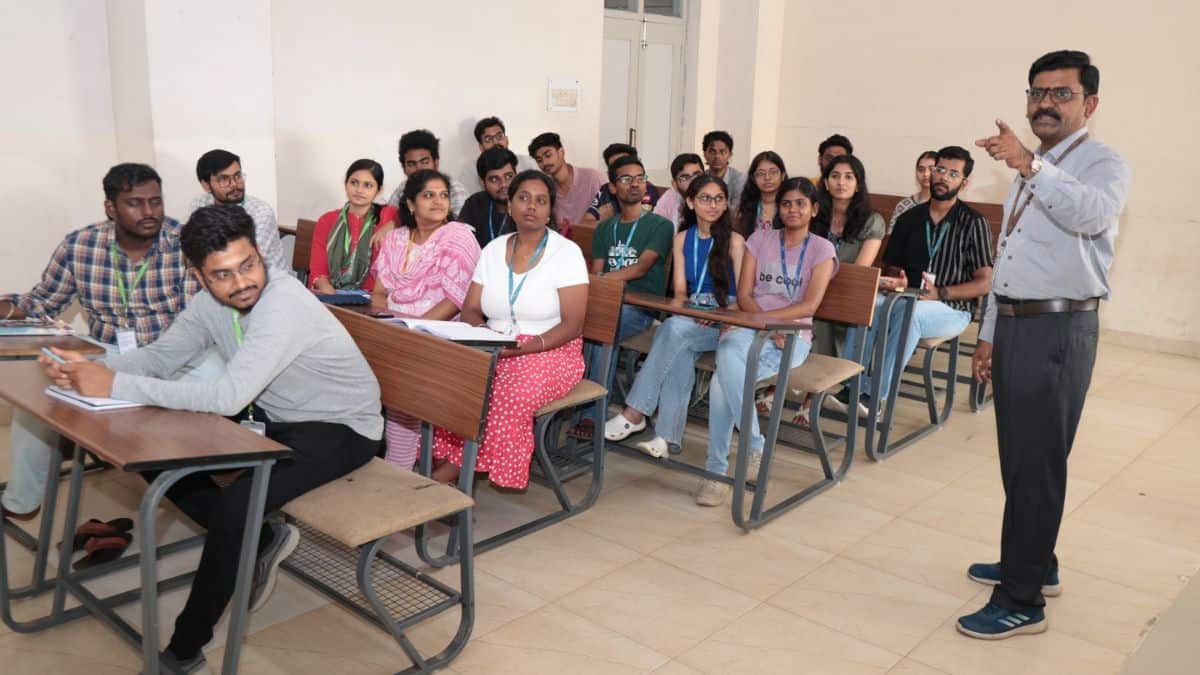
At VIT Vellore, Aswani Kumar Cherukuri, director of the Centre for Artificial Intelligence Research (C-FAIR), decided to test the idea of dubbing parts of his BTech lectures into several Indian languages using the platform, Sarvam AI. The small experiment aimed to see whether students relate better to complex topics when they hear explanations in their own language. Speaking to Careers360, he shares what worked, what surprised him, and where the experiment could lead next.
What made you experiment with dubbing your lecture into multiple Indian languages?
The main reason I ventured into this experiment was the diversity of students at Vellore Institute of Technology (VIT). On our campus, we have students from almost every state of India. Practically every major language spoken in the country is represented in our classrooms.This made me think about how students from different linguistic backgrounds experience classroom learning.
One of the thoughts that came to my mind was that if lecture content were available in students’ mother tongue, they might feel more comfortable and happier. Many students come from rural backgrounds. For them, understanding complex concepts in English sometimes takes more time. If they can listen to the same lecture in their own language later, it may help them understand the topic more deeply. They will still attend the lecture in English in the classroom.
We also considered how artificial intelligence could help us. Today, AI is progressing rapidly, and even the Government of India is encouraging the democratisation of AI, especially for educational purposes. In this context, we came across a platform called Sarvam AI which allows recorded lectures to be uploaded and automatically dubbed into multiple Indian languages.
At present, the platform supports around 10 or 11 Indian languages. To test how effective the system is, I decided to take one of my lectures, which was originally about 45 minutes long, and clip a three-minute portion of it as the platform currently allows free dubbing for a short duration. That three-minute segment was then dubbed into multiple Indian languages.
Also read IIT Bombay, Kanpur student journals tell you what the administration won't
When you say multiple languages, how many languages did you try?
For my experiment, I chose some of the major languages. I tried Hindi, Punjabi, Bengali, Tamil, Malayalam, Telugu, and Kannada. I wanted to see how well the platform would handle languages from both the northern and southern regions.
And how were the dubbed versions?
I found it quite interesting. I shared the dubbed clips with my students and asked them for feedback. The responses were impressive. One of the most fascinating aspects was that the platform managed to capture my tone almost exactly. It was not just a simple translation or mechanical voice. The system preserved the tone and rhythm of my speech. Even the way I pronounce certain words in English seemed to be reflected in the dubbed versions.
My speech identity, so to speak, was preserved. The pace at which I usually deliver my lecture and the duration of each sentence were also maintained. Students told me that it felt as if I was speaking in their mother tongue.
Is Sarvam AI free to use?
The platform has a combination of free and paid services. In many cases, users access the platform through Application Programming Interfaces (APIs). These APIs allow developers to integrate Sarvam AI’s capabilities into their own applications. For testing purposes, it allows users to dub a video of around two to three minutes free of cost. However, if someone wants to process longer videos or make repeated use of the service, there is a pricing model. The charges depend on factors such as the number of characters processed, the length of the audio or video, or the number of API calls made.
Also read With CSE surge, these specialised BTech courses are vanishing from engineering colleges
How much effort did you personally put into this experiment?
The first requirement is that the lecture must be available in digital form. In many classrooms, lectures are delivered live without recording infrastructure. In my case, I had previously recorded a full lecture of about 45 minutes on my system. From that lecture, I selected a three-minute segment and uploaded it to the Sarvam AI platform. Then I selected the languages in which I wanted dubbing.
The platform itself is quite user-friendly. Even someone without technical knowledge of AI can use it easily. The user needs to upload the input content and select the required options, and the platform processes everything automatically.
How did you introduce this idea to your students?
Since our classrooms consist of students from different linguistic backgrounds, they were quite excited. There is an emotional connection that students feel when they hear familiar language, especially when it comes from their teacher.
Another advantage is conceptual clarity. Some students genuinely find it easier to grasp technical ideas when they are explained in their native language. Our overall aim is to explore how AI can improve teaching and learning processes.This is just one of the several initiatives we are exploring to make classroom engagement more effective.
Also read Govt school to Glasgow: NIT Agartala civil engineer wins Marie Curie Postdoctoral Fellowship
If students understand concepts in their mother tongue, how will they write examinations, which are usually in English?
That is a valid question. The course itself continues to be taught in English, and examinations, also in English. The use of the mother tongue is primarily for reinforcing conceptual understanding. When students listen to explanations in their native language, they often grasp the underlying ideas more quickly and deeply. A complex topic that might take a long time to understand in English can sometimes become much clearer in the mother tongue.
However, this does not mean that students lack the ability to write in English. They are still able to express their answers in English during exams. The advantage of AI tools is that they allow a certain level of customisation in learning. Some students learn quickly, while others may need additional support. A single faculty member cannot explain the same concept in multiple languages during a classroom lecture, especially when there are 60 students from different backgrounds. But by providing recorded content in multiple languages, students can review the material at their own pace.
Are you using AI directly during classroom teaching?
We are exploring the use of AI both inside and outside the classroom. AI can help not only in delivering content but also in engaging with students and assessing their progress.
Our overall aim is to explore how AI can improve teaching and learning processes. At the moment, in VIT, we are making a pilot study on integrating AI into our classroom teaching, student engagement in the class and beyond. Overall, we want to harness the potential of AI in enhancing the learning experience of the students and assist the faculty in doing it.
Do you also play the translated lecture during class?
No, not at all. My classroom lecture is delivered in English, as usual. After the class, students receive the recorded lecture material. In this particular case, the three-minute dubbed version was shared with them as an experiment. Normally, I already provide recordings of my lectures through my YouTube channel. The difference this time was that a small portion of the lecture was available in their mother tongue.
Also read ‘Not just academic, but personal’: NSUT Delhi takes AI beyond BTech, across non-engineering courses
So students get only three minutes in their language and the rest in English?
Yes, at the moment that is the case because this was only an experimental trial. The purpose was to evaluate the quality of the dubbing and see how students responded to it. I wanted to know whether the platform was able to reproduce the lecture effectively and whether students found it useful.
Since students have already experienced the three-minute version, they might want the entire lecture in their language. Do you have a plan for that?
I had clearly informed the students that the current experiment was limited to three minutes and that it was only a test. They understood that it was not yet a full implementation. In future, depending on resources and collaboration with the platform, we may explore converting longer lectures as well. But at this stage, no specific timeline has been announced.
What are your plans regarding this experiment?
We are currently in discussions with Sarvam AI about how we can expand the use of this technology. One possibility is obtaining AI credits that would allow us to convert more lectures into multiple languages. While I cannot give an exact timeline at the moment, we are hoping to integrate more AI-based features into our teaching process from the next fall semester onwards.
At the moment, we are making a pilot study with 220 different courses on integrating AI into our classroom and beyond. We are ready to provide such quality content for all students if there is support from the platform in terms of making this available to us free for dubbing the lectures.This is the whole concept of democratisation of AI where the benefits serve all, particularly students.
Are the lectures on your YouTube channel open to everyone?
Yes, they are open to the public. This aligns with the idea of democratising knowledge and technology. Many universities and institutes around the world make their lecture content publicly available so that learners everywhere can benefit.
The advantage of digital platforms like YouTube is that students from any part of the country or even the world can learn from different teachers. Different professors explain topics in different ways, and students often benefit from listening to multiple perspectives on the same subject.
If, in future, there are initiatives that support large-scale translation of educational content into Indian languages, it could significantly expand the reach of such lectures.
 Add as a preferred source on google
Follow us for the latest education news on colleges and universities, admission, courses, exams, research, education policies, study abroad and more..
To get in touch, write to us at news@careers360.com.
Next Story
]Promised, but missing: Five years on, National Digital University reduced to a budget item, with no funds
Finance minister Nirmala Sitharaman earmarked Rs 100 crore in the union budget for the National Digital University that was to be headed by UGC ex-chairman M Jagadesh Kumar. 5 years on, there’s neither budget, nor university
Shradha Chettri


