
Jamia Millia Islamia student’s project can help Delhi’s unauthorised colonies ride out a heat wave
Azib Ahmed | May 22, 2026 | 04:07 PM IST | 4 mins read
JMI’s Yusra Gul explores low-cost ways for densely-packed unauthorised colonies – ‘heat traps’ whose residents suffer most in a Delhi heat wave
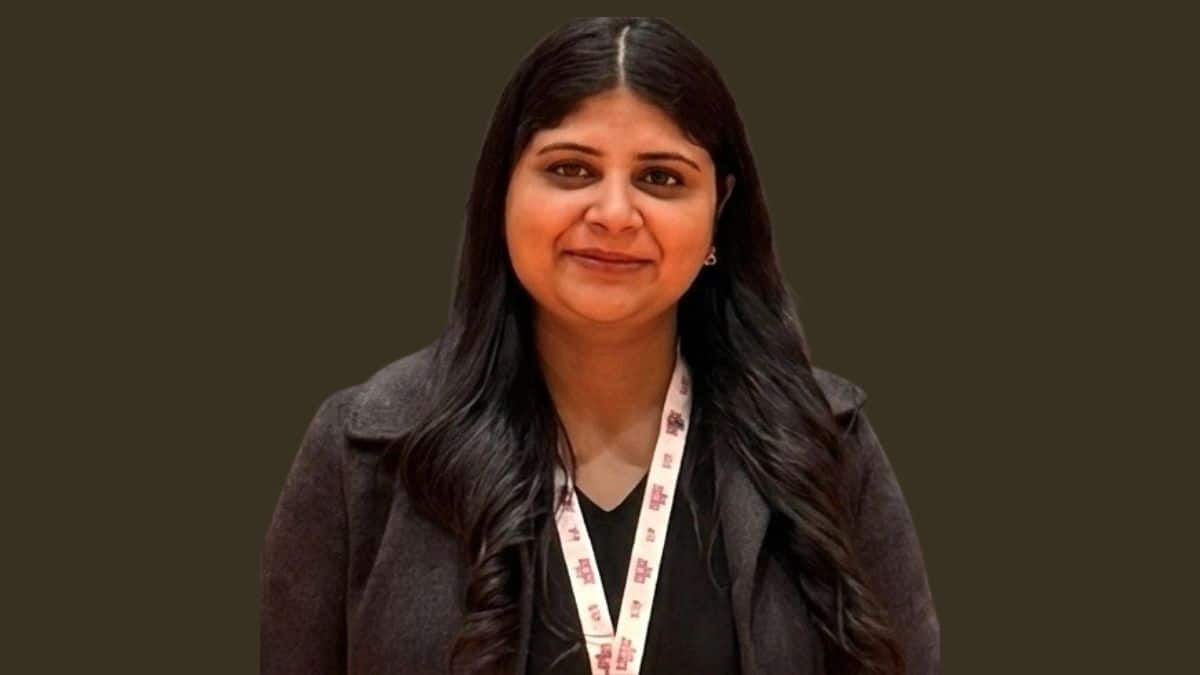
Living in Abul Fazal Enclave, a densely-packed neighbourhood in south-east Delhi, pushed architecture student and researcher, Yusra Gul, to think about heat resilience in informal, urban settlements. In the first year of PhD at Jamia Millia Islamia’s Faculty of Architecture and Ekistics, Gul has proposed ways to cool down “urban jungles” like Delhi’s unplanned residential settlements.
Before beginning her doctoral work, Gul attended seminars, conferences and a residential training programme organised by the Centre for Science and Environment (CSE) focused on climate change and urban heat. “That programme impacted me deeply,” she said. “After that, I decided I would pursue my PhD in this area.”
Three simple, cost-effective solutions she proposed as part of her project, ‘Borrowed Sky: Collective Roofscapes as Thermal Commons in Informal Settlements’, won second place in the “Rethinking Roofs – Global Competition” organised by Europe-based Informal Settlements to Build, in partnership with the Institute for Housing and Urban Development Studies.
Delhi heat wave in informal settlements
Gul’s PhD focuses on how heat affects informal settlements differently from planned colonies.
“There are a lot of publications and a lot of work is going on around heat mitigation,” she said. “But most of them do not directly address the issues of informal settlements because these areas are built very differently from planned colonies.”
Informal settlements are densely-populated unplanned neighbourhoods and unauthorised colonies that typically develop outside formal urban planning systems. They often lack adequate ventilation, open spaces, greenery and basic infrastructure.
According to Gul, narrow lanes, dense construction, lack of ventilation and limited greenery trap heat, especially during nighttime. “The people of informal settlements face more problems in the nighttime because the heat gets trapped due to narrow streets,” she said. “We are more concerned about nighttime temperatures.”
The groundwork for the project was carried out in Abul Fazal Enclave in Delhi, where Gul has lived and worked closely with residents for years. Her observations were conducted on five to six four-storey houses in the locality.
Jamia: Shading, paint, turbine
Gul proposes temporary shade structures installed above rooftops using bamboo supports and low-cost green fabric commonly used in agriculture.
“Roofs receive the maximum sunlight,” Gul explained. “In informal settlements, streets are narrow so there is already mutual shading. But roofs remain exposed.” Shading with green fabric is inexpensive and uses locally-available materials. It would cost around Rs 300 - 400 per household if implemented collectively at the community level.
“We studied what these nets or shades are doing in reducing roof temperatures and improving indoor thermal comfort,” she said. It made a difference of 2-3 degrees, they found.
Nisar Khan, professor and one of Gul’s two supervisors, said she had proposed three low-cost solutions specifically for unauthorised and densely packed colonies. “One solution was the canopy system using green textile fabric,” Khan said. “The second was painting roofs white, and the third was creating shaft ventilation using turbine chimneys.”
Coating rooftops with reflective white paint reduces solar heat gain. “When we tested it, one roof showed 48 degrees Celsius while the adjacent white-painted roof showed 38 degrees,” Khan said. “So, surface temperature can be reduced by 8 to 10 degrees.”
The third solution uses turbine chimneys installed above ventilation shafts in buildings. These devices work without electricity. “It works like an exhaust system,” Khan explained. “Hot air escapes through the shaft, which helps cool the building.”
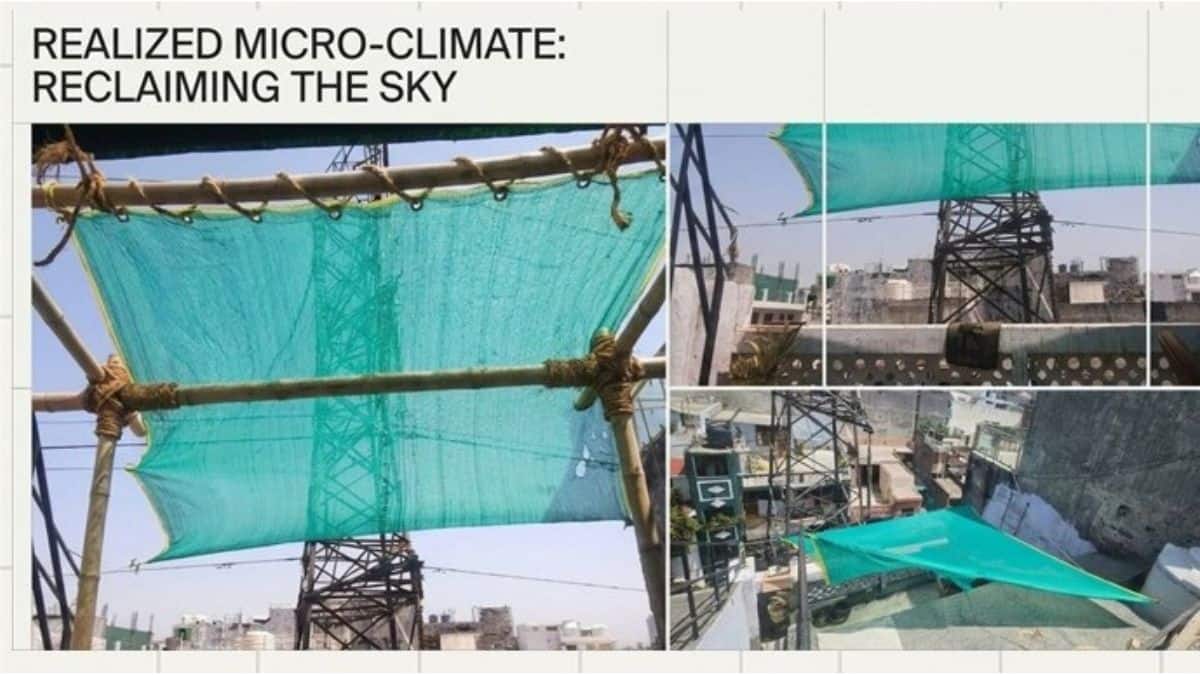 Low-cost rooftop shading prototype designed to reduce heat stress in Delhi’s informal settlements. (Image: By special arrangement)
Women, children, elderly affected: JMI scholar
Professor Hina Zia, Gul’s other supervisor, said informal settlements suffer from a “double whammy” during heat waves. “Everything is organic and unplanned,” she said. “Every inch of space is used. Streets are narrow, there is little greenery and limited cross ventilation.”
Zia noted that urban heat island effects caused by concrete surfaces, glass facades, paving materials and lack of vegetation worsen the impacts of already rising temperatures linked to climate change.
“At night, these buildings re-radiate stored heat,” she said. “People who work outside all day come back home and still cannot sleep properly because the heat remains trapped.”
She emphasised that women, children and elderly residents are often the worst affected because they spend longer hours indoors.
According to Delhi Development Authority (DDA) data, Delhi has more than 1,700 unauthorised colonies, including Sangam Vihar, Shiv Vihar, Zakir Nagar, Uttam Nagar and Chattarpur.
“About 40 to 45 percent of Delhi’s population lives in such colonies,” Khan said.
Gul plans to continue researching heat mitigation in informal settlements with a stronger focus on practical and affordable solutions. She said her future work will also explore cool roofs, building morphology and ways to reduce nighttime heat stress in dense urban neighbourhoods. She earned her bachelor of architecture (B.Arch) and M.Arch degrees in urban regeneration from Jamia Millia Islamia in 2015. before enrolling in a PhD programme in 2025.
 Add as a preferred source on google
Follow us for the latest education news on colleges and universities, admission, courses, exams, research, education policies, study abroad and more..
To get in touch, write to us at news@careers360.com.
Next Story
]CBSE makes third language compulsory for Class 9 from July, with Class 6 books and shared teachers
CBSE 9th Class syllabus will include compulsory third language from 2026; board asks school to use Class 6 textbooks, other subject teachers; Sanskrit may again be only R3 option for English-medium schools
Shradha ChettriLatest Education News
]Related News
]Delhi High Court dismisses pleas seeking SIT probe into 2020 northeast Delhi riots, Jamia violence
Jamia students protest eviction notices to 3 women hostellers; university calls it ‘misrepresentation'
JMI students protest over ‘arbitrary’ eviction notices to women hostellers; AISA, SFI, SIO join agitation


