
Assam Women’s University: From handful of students to robots in village schools, AWU is just getting started
Pritha Roy Choudhury | April 11, 2026 | 06:27 PM IST | 5 mins read
Assam Women’s University battles faculty shortage, infrastructure constraints while rolling out new courses – from Japanese, Spanish to petroleum science
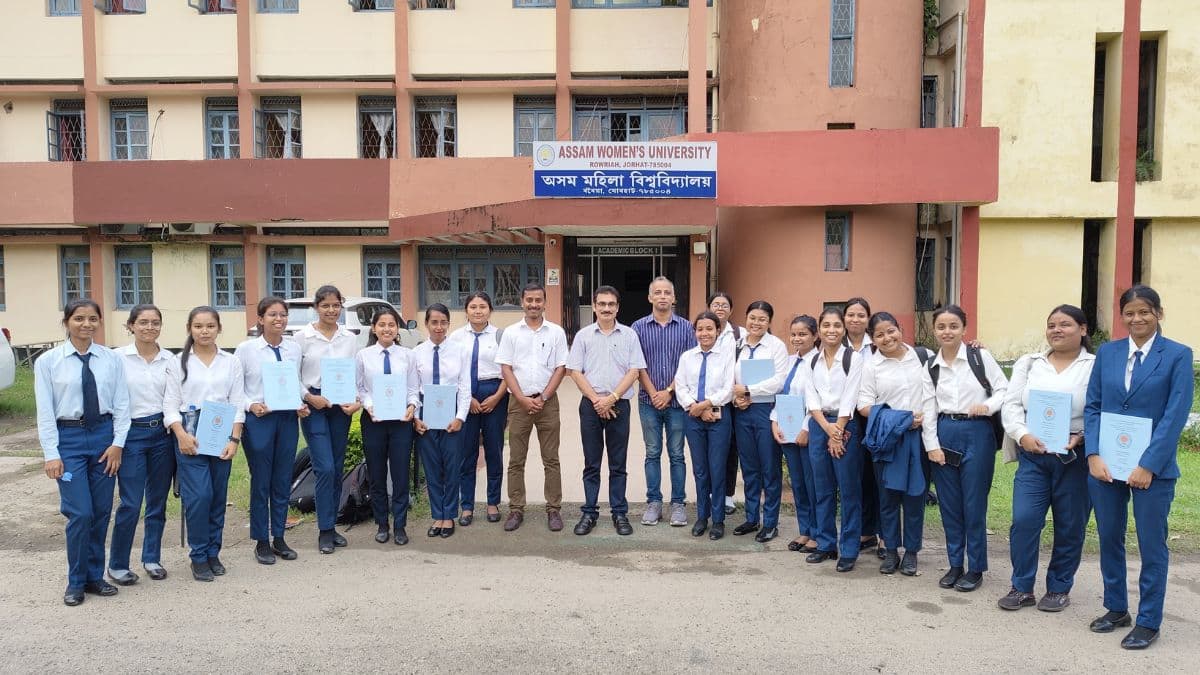
In a village school in Assam, children are learning from a robot – and they love it because unlike their teachers, it never scolds them when they get an answer wrong. The robot, named Maya, was built by students and faculty at Assam Women’s University (AWU), a decade-old institution that has grown from 400 students and a handful of classrooms into one of Northeast India’s most ambitious institutions in women’s education.
Its vice chancellor Ajanta Borgohain Rajkonwar puts it plainly: “Our goal is to ensure that when students leave this university, they do not just carry degrees. They carry the confidence to make decisions and shape their own future,” she concluded.
Established through an Act of the Assam Legislative Assembly in 2013, AWU began its journey in 2014 with very few departments. Over the years, it has steadily expanded into a multidisciplinary university with 17 departments across five academic schools and an enrollment of more than 1,200 students. New departments such as commerce and applied geology have recently been introduced.
As Biswajyoti Sarmah, head of the department, economics, said, “Our university was established with the vision to empower women, particularly those who want to pursue higher education. Our mission is to create women who will become decision-makers in their families, in society and in their professional lives.”
Assam Women’s University: Building an identity
Like many young universities in India, AWU had to build its academic and administrative ecosystem from scratch. The early years were focused on establishing departments, recruiting faculty, developing statutes and forming statutory bodies necessary for smooth functioning.
VC Rajkonwar spoke, while talking about the challenges while strengthening the institution’s framework, said: “When I joined, many statutory committees were yet to be fully functional. We had to constitute the Board of Studies, Academic Council, Executive Council and other bodies. It was a long administrative process, but it was necessary.”
While some programmes are still in the process of being operational due to faculty and infrastructure requirements, the university is expanding to ensure sustainability and quality.
Faculty shortages
Faculty recruitment remains a challenge. While most assistant and associate professor positions have been filled, several senior professor posts remain vacant. To ensure continuity in teaching, the university has adopted a flexible approach by engaging teaching associates, guest faculty and industry professionals.
“Yes, there is some shortage of faculty, especially because the National Education Policy (NEP) requires more multidisciplinary teaching and more electives. We are managing through teaching associates and guest faculty wherever necessary,” said Sarmah
The university has also appointed a professor of practice, teaching human resources from the corporate sector to provide students with industry exposure and career guidance. “Industry professionals help students understand what the job market expects from them. That exposure is very important.”
Assam Women’s University: Infrastructure challenges
Infrastructure constraints were among the biggest challenges during the university’s formative years, said Rajkonwar. Limited classroom space in the old campus forced the administration to restrict student intake despite high demand.
However, the recent shift to a new campus has improved the situation considerably, she said, adding that the new academic building has expanded classroom capacity and created better learning spaces, although administrative infrastructure is still being developed.
“Earlier we had limited classrooms. Now, after shifting to the new campus, most academic space issues have been resolved. Once the administrative block is completed, things will become more streamlined,” she said.
Further expansion is underway through external funding support, and new buildings are expected to strengthen the university’s infrastructure in the coming years.
Why a women’s university matters
Sarmah said many families still prefer women-only institutions due to safety concerns and social expectations. “Some students are allowed to pursue higher education only because such an institution exists.”
The university also believes that a women-only academic environment allows students to express themselves more freely and build confidence. “We try to create a space where students can express themselves without hesitation. Confidence building is a very important part of empowerment.”
One of the distinctive academic initiatives at AWU is the introduction of a compulsory gender sensitisation course across departments. The course aims to help students understand social dynamics, rights, and gender perspectives.
“Empowerment is not only about degrees. It is also about awareness, perspective and confidence. We are the only university in the Northeast where we, as per the guideline of UGC, provide a gender sensitisation course,” said Sarmah.
Programmes such as physiotherapy, education, economics and language studies regularly attract far more applicants than the university can accommodate.
“Physiotherapy, introduced when the university began academic operations in 2014, remains one of AWU’s key courses. There is a high demand and teachers are also very dedicated,” said Rajkonwar.
The university also introduced an executive MBA programme for working women professionals, particularly those at the middle-management level, who often do not have access to flexible management education opportunities. Unlike traditional executive MBA programmes that typically cater to senior executives, the university designed this course after conducting a needs assessment which showed that mid-career women professionals also require management qualifications for career progression.
Skill education
Alongside subjects such as English, sociology and economics, the university has introduced foreign languages, cultural studies and professional skills courses.
Foreign language programmes, including Japanese and Spanish, have been introduced.
“We will start more courses connected to regional cultural traditions like Bihu and from August we will introduce Bhawna (it is a play introduced by Srimanta Shankardev, a scholar of the 16th century. His work is known for inculcating moral responsibility among the people of Assam among the community. The plays are performed in naam ghar or places of worship),” said Rajkonwar.
The university will also offer a diploma programme in Petroleum Science and Technology also from August. The programme will be offered in hybrid mode.
Technology integration is another area where the university is trying to innovate despite resource constraints, said Rajkonwar. Initiatives include robotics demonstrations, virtual learning environments and exposure to emerging technologies.
Rajkonwar also said that much of the recent progress has been made possible due to support from the incumbent state government.
Assam Women’s University: Student enrollment
Student enrolment has grown steadily, increasing from just over 400 students in 2014 when the university had started to more than 1,200 today.
Rajkonwar also said that the hostel facilities, which were limited earlier, are gradually being expanded. New hostels are planned alongside existing accommodation. The university has completed NAAC accreditation and has applied for national ranking processes for the upcoming year.
Despite challenges typical of a young public university, the institution’s leadership remains optimistic about its future. “We are still growing. But we are building the foundation step by step. Our aim is not just to produce graduates but to create confident women who can lead and contribute to society,” said Rankonwar.
 Add as a preferred source on google
Follow us for the latest education news on colleges and universities, admission, courses, exams, research, education policies, study abroad and more..
To get in touch, write to us at news@careers360.com.
Next Story
]Latest Education News
]Related News
]Allahabad HC questions UP government over SC quota in four medical colleges
DU proposes new hostels, redevelopment projects to accommodate over 30,000 students
Delhi University EC to discuss Rs 8,000-crore hostel plan for over 30,000 students


