
With CSE surge, these specialised BTech courses are vanishing from engineering colleges
Musab Qazi | April 28, 2026 | 11:29 AM IST | 8 mins read
Core BTech courses are hobbled by dated curricula, declining interest as engineering colleges add more CS and AI branches; ITI technicians, diploma engineers struggle to fill gap
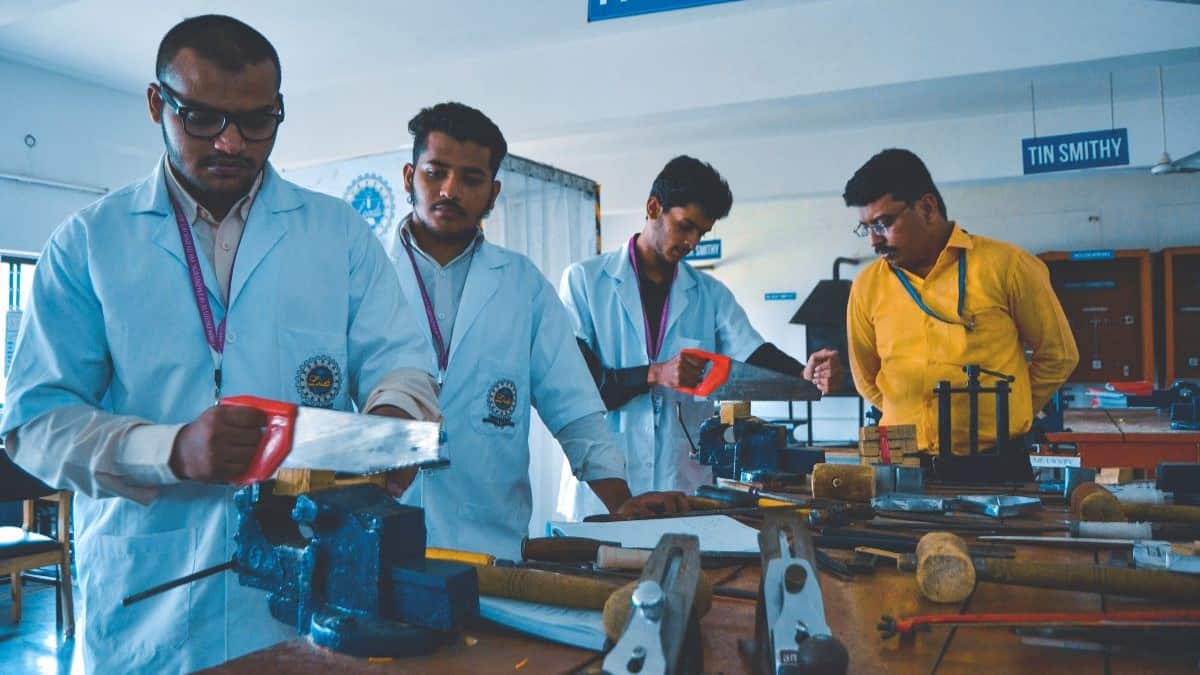
The PES College of Engineering, a government-aided tech education institute in Mandya city in southern Karnataka, was among the first in the state to establish an automobile engineering department in 1980 – around the time when the automotive sector in India began flourishing thanks to loosening of some regulations.
Today, the department is a ghost town. Most of the staff has retired and only a handful of students are left. The institute officially shut down its undergraduate (UG) programme in automobile engineering in 2024-25, with the final batch awaiting to graduate.
“The management decided to close it. We really wished to run it, but there were very few admissions – between nine and 12 in the last five years. Our department is well established, with Rs 6-7 crore worth of equipment. As of now, the final-year is in progress. I don't know what will happen after that,” said NL Murali Krishna, principal of the college.
PES College is among 14 engineering institutes in Karnataka, and 137 across the country, that had to close their automobile programmes, which had emerged as a specialised offering within the mechanical engineering discipline, in the last 13 years. These closures span both government-run and aided as well as self-financed institutes, with even established colleges feeling compelled to discontinue the programme. The course is now offered at only six institutes in the state.
IT Engineering Surge: AL, ML and data science
The closures are part of a decade-long trend of the legacy engineering disciplines, such as civil, mechanical, electrical, automobile, chemical, aeronautical and production – commonly referred to as ‘core’ branches – falling out of favour. As the colleges continue to add yet newer courses within the computer science (CS) umbrella – most of them structured around artificial intelligence (AI), machine learning and data science – some of the older, niche programmes like mining, textile and metallurgical and materials engineering are no longer available at the few places that had them.
Even the premier national tech schools, the Indian Institutes of Technology (IITs), aren’t immune from this trend. An earlier analysis by Careers360 showed that eight of the oldest IITs had reduced hundreds of seats and shut down some of the BTech programmes in core branches over the last decade. These closures corresponded to a significant increase in the intake for information technology (IT), CS and related specialisations.
The trend mirror the national macroeconomic direction, where the contribution of service sector, primarily driven by the IT and IT-enabled services (ITES) firms, to the total gross value added (GVA) in the economy has risen from 50.6% to 55.3% from the financial year 2014-15 to 2025-26. In this period, the manufacturing sector’s contribution to GVA has hovered between 16.9% and 18.5%, as per data shared with parliament. However, the general prestige associated with software engineering in comparison to core branches, coupled with the latter’s static curriculum has also contributed to their decline.
Also read Another IIT, 5 DU colleges to launch ITEP courses in 2026 even as seats go vacant in top institutes
Even as the closure of core engineering branches has shrunk the talent pipeline for the manufacturing and infrastructure sectors, it has yet to have any noticeable impact as they continue to rely more on the large pool of available diploma holders and the Industrial Training Institute (ITI) graduates than engineers. The experts, however, worry about the long-term impact on industrial growth and innovation due to a general decline in domain knowledge about the respective fields.
Mechanical and civil engineering courses
According to All India Council for Technical Education’s (AICTE) data, between 2012-13 and 2024-25, as many as 454 BE/BTech Mechanical Engineering and 409 BE/BTech Civil Engineering courses – two of the main core engineering branches – shut down. Over the same period, 357 and 322 diploma courses under these branches were also shut. These figures don’t include related courses with slightly different nomenclature or specialisations within these fields, such as civil engineering (environmental and pollution control) or mechanical engineering production.
The number of closures steadily rose since 2012-13, peaking in 2019-20 and 2020-21, when the engineering education bubble was bursting due to an oversupply of seats and colleges. The 2020-21 was also the year when educational institutes moved to online instructions under the Covid-19 induced lockdown. The pandemic also precipitated an unprecedented surge in IT hiring due to the global digital transformation, though it was quickly followed by large-scale layoffs. This was also the time when AICTE pushed for the adoption of “new age” programmes, namely those encompassing AI, ML and data science.
The changes firmly established a hierarchy within engineering branches. “In Andhra Pradesh and Telangana, and even outside, there's only demand for CS, and not for mechanical and civil engineering. If the students get higher rank [in entrance tests], they prefer the CS department. The parents won’t allow their children to take up anything else,” said Padmakar Maddala, associate dean (administration), at Dadi Institute of Engineering and Technology (DIET) in Anakapalle, Andhra Pradesh.
The institute had to close its diploma civil engineering course in 2022-23, after the enrollment dropped to single digits against 60 intake, though it has managed to continue the UG programme. The faculty for core courses are also facing the brunt of rapid shutdowns and are forced to learn and teach coding to save their jobs.
“Even the top engineering colleges have removed some of the sections belonging to core branches, while increasing seats for CS, as the students are ready to shell out higher fees for them. Even [though] the placements for CS are stagnant, there’s still demand. This is happening due to a lack of awareness,” Maddala added.
In Srikakulam, another Andhra Pradesh city, Aditya Institute of Technology and Management has stopped offering its postgraduate (PG) course in thermal engineering, a sub-discipline of mechanical engineering, barely six years after introducing the programme, replacing it with another, more contemporary, specialisation – computer-integrated manufacturing.
“Thermal engineering is one of the oldest branches, but the admissions dwindled as many colleges offer the course,” said Adari Satya Srinivasa, principal of the institute.
Srinivasa, too, blamed the “student mindset” of preferring white collar professions over the more rugged core branches, though he acknowledged that the entry-level salaries by software companies often outmatch those by manufacturing firms.
BTech Courses: Dated curriculum
The experts, however, believe that the academic institutes must also share the blame for being slow to upgrade their programmes and not offering sufficient hands-on training to engineering students.
“They have to keep up with technological advances. Topics such as drone surveys, 3D printing and AI need to be incorporated in the civil engineering curriculum. That's why students are not opting for it, said Rajendra Kalbavi Rao, President, Association of Consulting Civil Engineers (India).
Speaking on the condition of anonymity, a senior manager at a Chennai-based automotive firm added, “The industry is moving towards autonomous vehicles. The students need basic knowledge about it, besides AI/ML. We are missing practical aspects in education. The students should spend at least a year in a company where they see the physical vehicle.”
“The primary issue lies in the disconnect between curriculum delivery and industry requirements. Faculty exposure to evolving industry practices in core sectors remains limited, while industry expectations have changed significantly,’ said G Srinivasa Rao, principal of Shri Vishnu Engineering College for Women at Bhimavaram, Andhra Pradesh.
“Unlike the software industry, core industries cannot afford to hire and train fresh graduates extensively while keeping them on the bench. Therefore, it becomes essential for institutions to equip students with practical skills beyond regular academics, particularly through hands-on training,” he added
Rao said that despite being a women-only institute in a small town, they have not only retained their mechanical and civil programmes but have also steadily filled their seats and placed a sizeable chunk of their students. They achieved it through revitalising their core BTech programmes by setting up facilities such as vehicle design lab and concrete canoe labs, providing hands-on training in design and fabrication.
Also read Govt school to Glasgow: NIT Agartala civil engineer wins Marie Curie Postdoctoral Fellowship
ITI and polytechnics
The situation is yet to ring alarm bells in the industry, which continues to rely on ITI and polytechnic graduates. The growing automation and use of AI in manufacturing and construction projects has also brought down the manpower requirement to some extent.
“The manufacturing sector in India is in a poor shape, as most of the industries are micro, small and medium enterprises. They don’t need graduates as much as ITI certificate and diploma holders,” said Adari Satya Srinivasa.
While asserting that the decline of core branches is a national concern, Rajeev John, director general, Builders Association of India (BAI), said, “An acute shortage is not visible, as people are still coming out of colleges. There are also the existing professionals as well as the advanced technology. If any minor alterations in [civil engineering works] is needed, it’s immediately known to computers. The technology also monitors quality and material requirements while doing cost analysis. AI has taken a big role even in large constructions.”
Others, however, point out that this trend poses a long-term threat for manufacturing and infrastructure sectors, especially in emerging areas like semiconductor manufacturing. “Regardless of automation levels, skilled engineers are indispensable for designing, implementing, and maintaining these systems. A shortage of well-trained graduates will directly affect industrial growth and innovation,” said G Srinivasa Rao.
Having read the writing on the wall, the colleges are increasingly moving towards a multi-disciplinary approach – offering both CS and core engineering students courses outside their domains. “Core engineering disciplines are not obsolete -- they are evolving. With the right academic strategies, industry alignment, and experiential learning models, these branches can thrive and continue to play a vital role in national development,” said Rao.
 Add as a preferred source on google
Follow us for the latest education news on colleges and universities, admission, courses, exams, research, education policies, study abroad and more..
To get in touch, write to us at news@careers360.com.
Next Story
]UGC allows state colleges to seek deemed-university status, become off-campus centres of other institutions
University Grants Commission amendment mandates NAAC grades for status, adds section on philanthropic organisations. Government-aided deemed-universities need not renew MoA if they generate 50% of funds
Shradha ChettriLatest Education News
]Related News
]Students' stir politicised, external forces driving agenda: SRFTI vice chancellor
Delhi University welcomes Tamil Nadu students for 'Yuva Sangam' phase 7 initiative
Jamia teachers allege political interference in student union protest


