
JK Lakshmipat University VC on education in AI era: ‘Every course, every classroom must evolve’
Pritha Roy Choudhury | April 4, 2026 | 02:13 PM IST | 5 mins read
With exchange programmes at IITs and global universities, JKLU focuses on maths, physics, communication as the only reliable skills in an AI-disrupted future
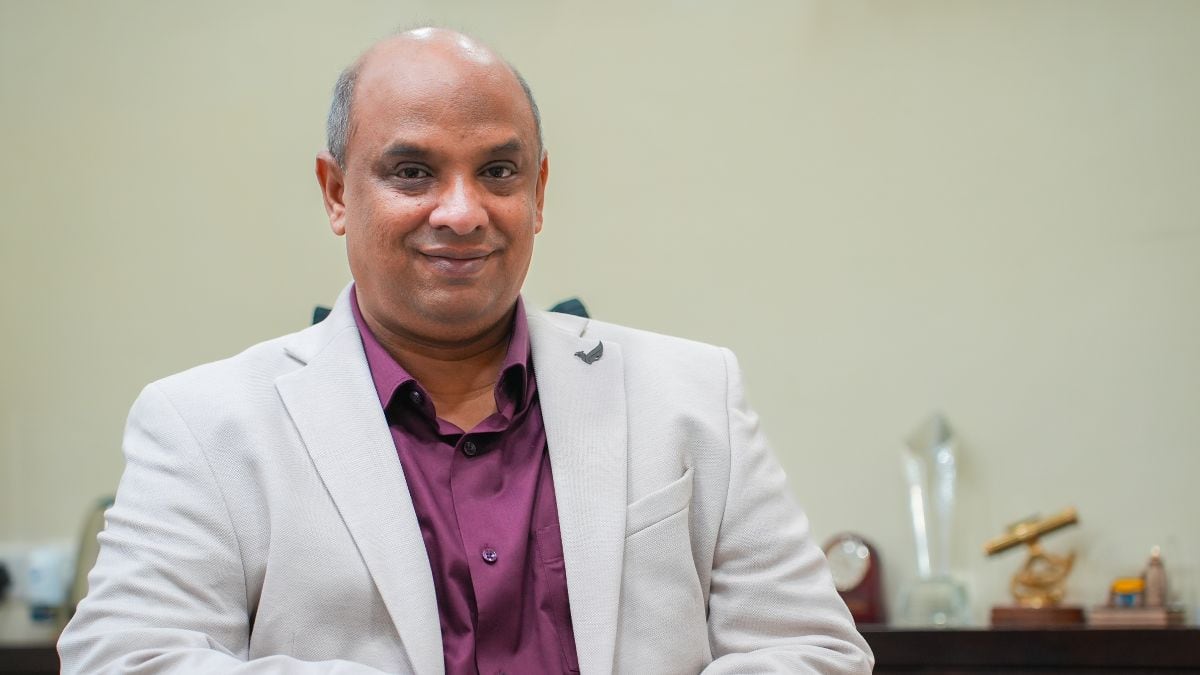
Vijaysekhar Chellaboina, vice chancellor of JK Lakshmipat University, believes that the future of higher education lies in adaptability, interdisciplinary learning, and moving beyond exam-centric evaluation. In a conversation with Careers360, Chellabonia said there should be a strong focus on integrating AI across engineering, management, and design. He discusses preparing students for emerging industries, strengthening global collaborations, and why communication and critical thinking will remain the most valuable skills in an unpredictable future. Edited excerpts:
What are your key plans and priorities for the university?
Currently, we have three institutes – engineering (primarily computer science and VLSI), design, and management. We offer bachelor’s, master’s, and PhD programmes across all three, with the largest enrolment at the undergraduate level.
One of my immediate priorities is to rethink how we teach in the era of artificial intelligence. With the rapid rise of AI, we cannot continue teaching in the same way we have for the last 50 or 100 years. Even though the industry itself is still trying to understand where AI will ultimately lead, we must begin adapting now.
One thing is very clear: every course and every classroom must evolve. My advice to faculty: do not remain static, experiment with new methods. This transformation will take a few years to stabilise, but we must begin now.
Among engineering, management, and design, where is AI integration easiest and where is it most challenging?
Engineering, particularly computer science, is the most straightforward area because many AI applications already exist there.
For example, in mathematics, we traditionally focus on solving problems manually. However, AI can now solve complex calculations. So instead of only teaching students how to solve problems, we must focus more on how to formulate problems. That is the real skill students need. This idea applies across disciplines.
In management, AI makes it possible to work with real datasets. For example, instead of just teaching GDP definitions, students can analyse real economic data, generate graphs, and interpret results using AI tools.
In design, AI can generate ideas and visual concepts, but it still struggles to fully understand nuanced instructions. It can provide multiple creative options, but human judgment remains essential. So AI should be seen as a support tool rather than a replacement.
How has the university performed in NIRF rankings?
We have intentionally remained a relatively small university focused on quality rather than scale. Because of this, our NIRF rankings are modest. We have been ranked around 82 in engineering and around 77 in BBA programmes. We have not yet entered the overall top 100, but our focus remains on quality education rather than just rankings.
How is interdisciplinary education reflected in pedagogy and assessment?
We strongly believe in project-based learning. A few years ago, we collaborated with Olin College of Engineering in Boston. While we cannot replicate their model, we have adapted elements of it.
In project-based learning, students solve real problems without worrying about disciplinary boundaries. A project might involve engineering, design, and management concepts simultaneously. This naturally introduces interdisciplinary learning.
This aspect comes primarily through projects rather than traditional lectures. We also encourage collaboration between institutes. Students from engineering, design, and management often work together on projects sourced from industry.
Any recent recognitions in design education?
Our design school recently received the Don Norman Design Award (DNDA) 2025 in the education category. We were the only Indian university to receive this recognition.
One of our strengths is systems design, where students look at entire ecosystems — such as villages or governance systems — rather than isolated design problems. By nature, this makes design education interdisciplinary.
Also read ChatGPT for education? IIT Madras director on how Bodhan AI will work and what it can do
How do you prepare students for future industries?
Honestly, nobody can clearly predict how industries will look like five years from now, especially with AI, quantum computing, and semiconductor advances changing the landscape. So instead of focusing on specific industries, we focus on three core areas:
- Communication skills
- Problem-solving ability
- Strong fundamentals (mathematics, physics, and domain basics)
These fundamentals have remained relevant for centuries and will continue to matter.
Could you elaborate on your collaborations with IITs and international universities?
We have long-standing exchange programmes with IITs, IIITs, and some international universities. Students typically go for a semester, take courses or do research projects, and the credits are transferred toward their degree. Students usually participate from the fifth semester onwards. Some may even go earlier.
These experiences are transformative. Students are exposed to different academic cultures and work ethics and often return with a broader perspective.
Do you think Indian universities need policy reforms to enable such collaborations?
Yes and no. Policies such as the National Education Policy (NEP) already provide flexibility through mechanisms like the Academic Bank of Credits. Regulations allow up to 50% of credits to be earned from other institutions, provided the home university awards the degree. So the policy framework exists. The key is effective implementation at the institutional level.
India has traditionally been exam-centric. How should students navigate assessments in an AI-driven world?
I have personally never been a strong supporter of exam-centric education. Fortunately, JKLU already had leadership that believed in reducing exam dependence. We emphasise project-based learning and case-study methods.
Our end-of-semester exams typically account for no more than 30% of the evaluation. The remaining 70% comes from continuous assessment methods.
We also design questions that test higher-order thinking based on Bloom’s taxonomy rather than simple descriptive answers. In some cases, students are even encouraged to use AI tools, but they must explain their process.
What is the placement scenario at the university?
We have a strong and improving placement programme. The median and average salary for engineering graduates is around Rs 5.7-Rs 6 lakh per annum.
Many design students pursue entrepreneurship. Similarly, many management students come from business families and focus on strengthening their entrepreneurial skills.
Any final thoughts on future-ready education?
We emphasise critical thinking, communication, adaptability, and hands-on learning. Learning is not just about passing exams but about being ready for situations we have never encountered before.
We are entering a period where education may look very different in five years. I cannot predict it, but I am excited to be part of this transformation. Our goal is to ensure our students are ready. Adaptability and strong fundamentals will always help students succeed.
 Add as a preferred source on google
Follow us for the latest education news on colleges and universities, admission, courses, exams, research, education policies, study abroad and more..
To get in touch, write to us at news@careers360.com.
Next Story
]Latest Education News
]Related News
]ESTIC 2026: PM Modi to inaugurate emerging science and technology conclave on October 27
SFI calls for campus protests against 'efforts' to suppress students' democratic rights


